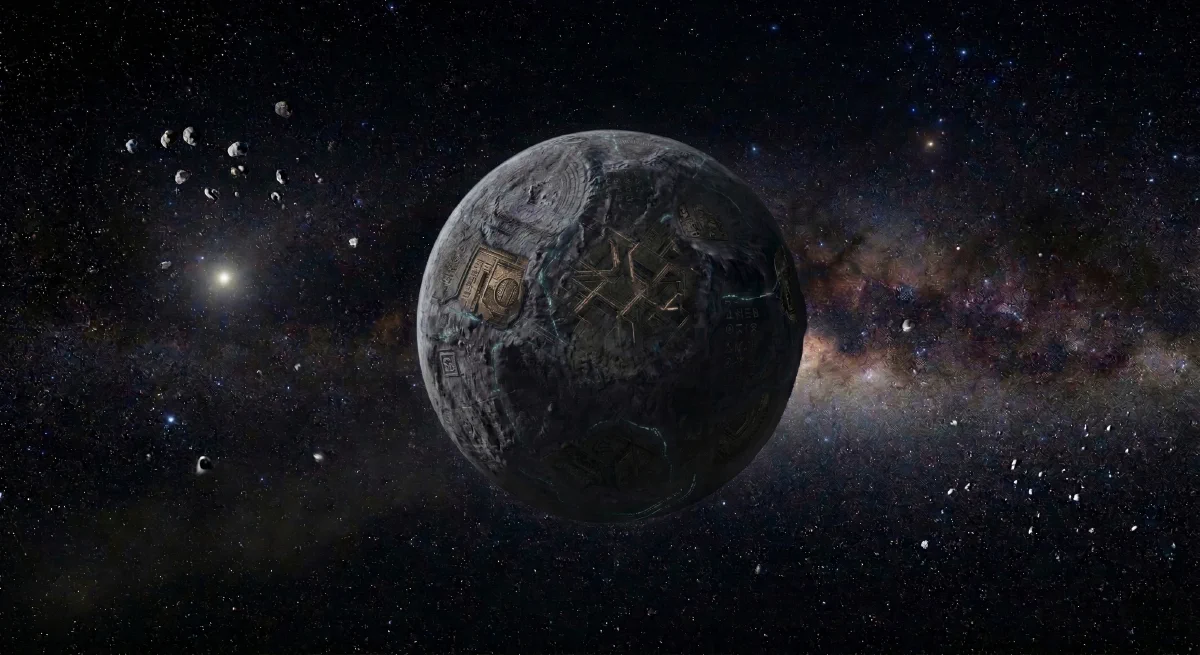
The Correction
The residuals were wrong again.
Maren sat with her chin in her hand, scrolling through the latest batch of astrometric observations, and the numbers didn’t match her model. This was not, in itself, unusual. Residuals (the gap between where a model predicts an object will be and where it actually is) are the background noise of orbital mechanics. Everything has residuals. The Moon has residuals. Jupiter’s moons have residuals that took centuries to untangle, and the untangling produced some of the most elegant mathematics in the history of the discipline. Residuals are the sound of reality being slightly more complicated than your equations, and Maren had spent the better part of fifteen years learning to hear them.
These were different.
She was working with the Rubin catalog, the continuously updated survey that the Vera C. Rubin Observatory had been building for over a decade. Forty-three thousand Kuiper Belt objects and counting, their positions measured every few nights as the telescope swept the sky. Each observation was a single data point: a smudge of reflected sunlight on a detector, faint enough to be invisible to any instrument built before the last decade, from which the software extracted a precise position, a precise time, and a precise uncertainty. Stack enough of these measurements and you can calculate an orbit. Stack enough orbits and you can model the gravitational dynamics of the entire Belt, every object pulling on every other object in a slow, continuous negotiation that has been going on for four and a half billion years.
Maren’s particular interest was a cluster of cold classical objects between 41 and 43 AU. Thirty-seven bodies, none larger than two hundred kilometres across, all moving in nearly circular orbits with low inclinations. Cold classicals are the Belt’s original inhabitants, the objects that formed in place and were never significantly disturbed by Neptune’s outward migration. They are, in a sense, fossils. The most pristine remnants of the solar system’s formation, sitting where they’ve sat since before there was an Earth.
They were also, according to her models, too uniform.
She had noticed it eight months ago. The orbital elements of the thirty-seven objects (their eccentricities, inclinations, the orientations of their orbital planes) matched each other to more decimal places than her N-body models could produce. Run the gravitational dynamics forward and backward, account for every known perturbation source, and the natural scatter should be larger than what she observed. The objects were too precisely aligned. Not dramatically, not by the kind of margin that leapt off the screen. By the kind of margin that sat at the fourth decimal place and refused to go away.
She had brought it to the department. Specifically, she brought it to a Tuesday seminar where she stood in front of twelve colleagues and two dozen students and presented a statistical analysis titled “Anomalous Orbital Coherence in a Cold Classical KBO Cluster.” The response was collegial and dismissive. Measurement artifacts, someone suggested. Systematic bias in the Rubin pipeline. Unmodeled perturbation from a yet-undiscovered large body. The usual suspects. Maren had already tested for all of them. She said so. The conversation moved on.
That had been four months ago. She had been working on it alone since then, not because anyone had told her to stop but because no one had offered to help. The Kuiper Belt was not glamorous science. It was cold, dark, distant, and slow. The objects she studied took hundreds of years to complete a single orbit. Changes happened on time scales that made geology look hasty. There was no urgency to any of it, which meant there was no funding, which meant there was no attention, which meant Maren Voss sat in a shared office at nine-thirty on a Thursday evening, the building quiet around her, running perturbation models that no one had asked for.
The shared office was on the third floor of the Planetary Sciences building, a concrete structure from the 1970s that the university had been threatening to renovate for as long as Maren had worked there. The overhead lights were fluorescent. The carpet was the colour of compromise. Her desk faced a window that, during the day, looked out on a parking lot and a row of eucalyptus trees and, beyond them, the mathematics building. At night, the window was a mirror, and she could see herself reflected in it: a woman at a desk, lit by the glow of two monitors, surrounded by the detritus of academic life (papers, coffee mug, a succulent that was alive through no effort of her own).
The residuals she was reviewing tonight were from the latest Rubin data release, observations taken over the past two weeks. She had a routine: every time new positions came in, she updated her model, recalculated the predicted orbits, and compared them to the observations. The residuals should be small and randomly distributed, scattered evenly around zero. If her model was good, the errors should look like noise.
What she saw instead was a pattern. Or rather, the absence of one. For thirty-six of the thirty-seven objects, the residuals were exactly what she expected: small, random, consistent with the observational uncertainty. Normal. But for the thirty-seventh, designation 2037 QR₁₁₃, the residuals told a story.
She pulled up the object’s tracking history. Plotted it.
The data went back eighteen months. For the first twelve months, 2037 QR₁₁₃ had followed its predicted orbit with the same unsettling precision as the rest of the cluster. Then, three months ago, it had begun to drift. A slight deviation, barely detectable, less than an arcsecond from the predicted position. But the direction of the drift was distinctive: it was moving perpendicular to its orbital plane. Not faster or slower along its orbit (which would suggest a gravitational perturbation from something in the plane). Up, in the crude shorthand of orbital mechanics. Out of alignment.
Maren had noted this in her log at the time. Flagged it for follow-up. A KBO deviating perpendicular to its orbital plane was unusual but not inexplicable. A close encounter with a smaller, undetected object could do it. An outgassing event, if the object had volatile ices near the surface (unlikely for a cold classical, but not impossible). She’d set a reminder to check the next observations.
The next observations, two weeks ago, had shown the drift continuing. The object was 0.3 arcseconds from its predicted position, still perpendicular, still climbing away from the cluster’s mean orbital plane. She’d updated her model to account for a possible perturbation and flagged it again.
Tonight’s data was different.
She stared at the screen. The new observation, taken four nights ago, showed 2037 QR₁₁₃ back on its original orbit. Not close to it. On it. The residual was less than fifteen milliarcseconds, within the astrometric uncertainty of the stacked observations. The object was exactly where her original model had predicted it would be, as if the three-month drift had never happened.
She re-checked the observation. Pulled the raw imaging data, the calibration frames, the pipeline reduction. Everything was clean. The observation was solid. She checked the previous two observations (the ones showing the drift) and they were solid too. There was no pipeline error, no misidentification, no cosmic ray artifact masquerading as a KBO. The data was the data.
Three months ago, 2037 QR₁₁₃ had begun drifting out of alignment with the cluster. It had drifted for three months, reaching a deviation of 0.3 arcseconds. Then, at some point in the last two weeks, it had moved back.
Maren calculated the delta-v required to produce this correction. The number was small. Fractions of a metre per second. A nudge. But a nudge required energy. A nudge perpendicular to the orbital plane, precisely cancelling the accumulated drift, returning the object to its exact predicted position… that required not just energy but aim. Direction. Intent was not a word she used in her professional vocabulary, but it was the word that formed, unbidden, and sat in the back of her mind like a stone.
She ran the perturbation check. Systematically, the way she had been trained. Was there a known body whose gravitational influence could produce this specific correction? She queried every object in the JPL Small-Body Database within five AU. Calculated the tidal influence of Neptune, which was the dominant perturber at these distances. Checked for recently catalogued objects that might have passed close enough to alter the orbit.
Nothing. Every check returned null. There was no modeled body, no known force, no physical mechanism in her toolkit that explained a KBO drifting off its orbit and then drifting back.
She sat with this.
The building was quiet. Down the hall, a graduate student’s office light was visible under the door (they were always there, the graduate students, at all hours, fuelled by determination and poor judgement). The air conditioning clicked on, ran for forty seconds, clicked off. Somewhere far away, a door closed.
She could email someone. She could call. But the weight of the last four months, of presenting data to a room that had nodded politely and moved on, was specific and familiar. She knew what would happen if she sent an email tonight saying she’d observed an anomalous orbital correction in a Kuiper Belt object. Someone would reply tomorrow suggesting an outgassing event. Someone else would suggest a data processing error. A third person would say something about Occam’s razor. They wouldn’t be wrong to be skeptical. Skepticism is how science works. But they would be skeptical in the way that people are skeptical of things that don’t fit into the space they’ve allocated for reality, which is a different thing from scientific rigor, and Maren had learned, slowly and at some personal cost, to tell the difference.
She didn’t call anyone.
Instead, she opened a new document. Began writing. Date, time, observation ID. The tracking history of 2037 QR₁₁₃ over eighteen months, plotted and annotated. The three-month drift, quantified. The correction, quantified. The delta-v calculation. The perturbation analysis, every check and its null result. She wrote it the way you write something you know will be questioned: precisely, thoroughly, with every assumption stated and every alternative considered. Not a paper. Not yet. A record. Evidence.
She worked for an hour. The coffee mug sat empty beside her. The window reflected the room back at her, the woman at the desk, the blue glow of the screens. Outside, the eucalyptus trees were still. There was no wind.
When she finished, she saved the document. Backed it up to two separate drives. Timestamped it. Then she sat back and looked at the plots on her screen: the smooth arc of 2037 QR₁₁₃’s predicted orbit, the slight deviation over three months, and the clean return to alignment.
An object made of ice and rock, four and a half billion years old, sitting in the coldest, emptiest part of the solar system, had just corrected its own trajectory.
She had no theory for this. She had no hypothesis. She had thirty-seven objects whose orbits were too precise and one of them that had just demonstrated, in the tracking data, why they were precise. They were maintained. Something was keeping them in alignment. Something had been keeping them in alignment for a very long time.
She did not think the word machine. Not yet. That would come later, after more data, after more nights like this one. For now she sat in the quiet of the empty building with the fluorescent lights humming above her and the window showing her own reflection and the feeling, familiar from a lifetime of working with systems that are more complicated than they first appear, that she had just seen the edge of something very large.
She shut down the secondary monitor but left the primary running, the plots still displayed. She picked up her mug, her jacket, her keys, and turned off the desk lamp but not the overhead light (a habit, so the custodial staff knew someone had been working late and the office was unoccupied). Walked down the hall, past the graduate student’s closed door, down the stairwell, out through the lobby where the security guard nodded at her without looking up from his phone.
The parking lot was mostly empty. Her car was one of four. The air outside was cool and dry, the sky clear, and she looked up automatically, the way anyone in her field does when they step outside at night. The stars were there, the familiar ones, Orion high in the south, Sirius burning white and low. And beyond them, invisible, beyond the reach of any eye, the Kuiper Belt. Thirty to fifty AU out, dark, cold, a scattered field of ancient ice and rock.
One of those objects, tonight, had done something it should not be able to do.
Maren got in her car and drove home through the empty campus streets, past the darkened buildings and the lit walkways and the occasional student walking alone in the artificial light. She didn’t turn on the radio, didn’t call anyone. The car was quiet, and the night was quiet, and the thing she had seen sat in her mind the way all her best work had ever begun: not as an answer, but as a question that had changed shape. She knew something now that she hadn’t known that morning. She didn’t yet know what it meant, only that it was real, and that the world in which it was real was different from the one she had woken up in.
She parked and walked up to her apartment, locked the door behind her, put the mug in the sink. She stood at the kitchen window for a long time, looking at nothing, thinking about a piece of ice and rock four billion miles away, and the small, precise movement it had made while no one was watching.