The Case
She didn’t tell anyone for eleven days.
This was not secrecy. It was discipline. The data was extraordinary, and extraordinary data demanded ordinary rigor before it demanded anything else. She spent the eleven days re-running every analysis, testing every assumption, looking for the error that would make the correction event explicable. She checked the Rubin pipeline for systematic biases that could mimic a positional shift. She modeled hypothetical perturbers (dark objects, undetected at Rubin’s magnitude limit, passing close enough to nudge 2037 QR₁₁₃ back into alignment) and found that the required mass and trajectory were implausible, the kind of solution that technically satisfied the equations while violating everything else. She checked her own code, line by line. She found a rounding error in one of her scripts that had been there for two years and had never mattered, and she fixed it, and the results didn’t change.
On the twelfth day, while reviewing the latest Rubin data release at her desk, she found a second correction.
The object was 2038 TL₇, on the far side of the cluster from QR₁₁₃. It had been drifting for six weeks (she could see it now in the data she hadn’t thought to check, a slow deviation from the cluster’s mean orbital plane that had begun while she was focused on QR₁₁₃). The latest observation showed it back on its predicted orbit. Same signature: perpendicular drift, clean return, delta-v with no modeled source. The correction had happened between the last two observation epochs, sometime in the past four days.
Two objects. Two independent corrections. The same impossible behaviour.
She sat in her office chair and looked at the plots side by side on her monitors, and for the first time since she had begun this work eight months ago, she felt something that was not curiosity. It was closer to vertigo. Not because the data was strange (she had been living with strange data for months) but because the data was consistent. One anomalous correction could be an error she hadn’t found yet. Two, with the same signature, in different objects, weeks apart… that was not an error. That was a pattern. And patterns, in her experience, didn’t emerge from noise. They emerged from systems.
Then she opened her document from eleven days ago, added the new data, and began writing the paper.
The paper took three weeks. She titled it “Evidence for Active Orbital Maintenance in a Cold Classical Kuiper Belt Object Cluster” and submitted it to The Astronomical Journal on a Tuesday morning, which she noted with a private, humourless satisfaction. The last time she had presented this work on a Tuesday, twelve colleagues had nodded politely and moved on.
The review process was fast. Anomalously fast, by the standards of academic publishing. The first referee report came back in nine days (it usually took months). The referee’s comments were technical, thorough, and ended with a sentence that Maren read three times: If the reported observations are confirmed by independent analysis, the implications for our understanding of Kuiper Belt dynamics are difficult to overstate.
The paper was published six weeks after submission. For three days, nothing happened.
On the fourth day, her inbox began to fill.
The messages came from planetary scientists, astrodynamicists, celestial mechanics groups at institutions she recognized and some she didn’t. They were not fan mail. They were data. Researchers who had read her paper and gone back to their own tracking datasets, looking for the same signature, were finding it. Not in her cluster. In other populations. A group at the Minor Planet Center identified four probable correction events in plutinos (objects locked in Neptune’s 3:2 orbital resonance, at 39.4 AU). A team in Tokyo found two in the scattered disk. A graduate student at Leiden, working on a thesis that nobody had been paying attention to, emailed Maren directly with a dataset showing anomalous orbital coherence in twotinos (objects in Neptune’s 2:1 resonance) that matched her cluster’s signature to three decimal places.
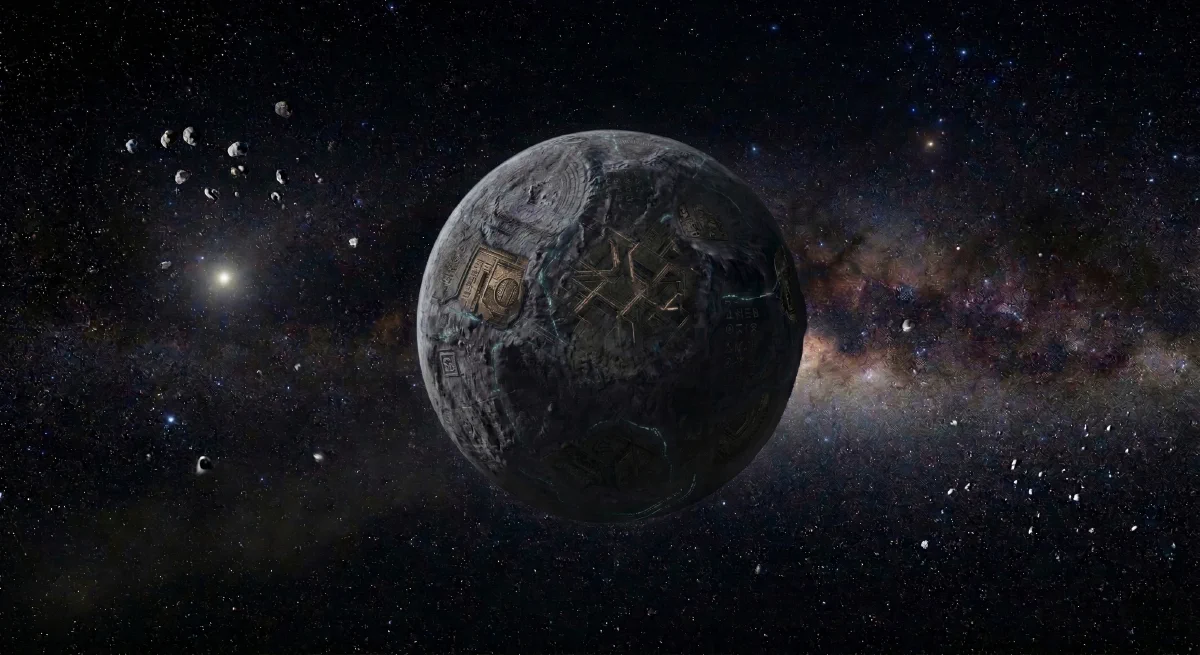
The anomaly was not local. It was not confined to thirty-seven objects between 41 and 43 AU. It was everywhere in the Belt that anyone had looked carefully enough to see.
Maren read every email. Replied to every one. She didn’t sleep much. She wasn’t excited, exactly. The feeling was more specific than that. It was the feeling of a pattern resolving, the way a shape emerges from noise when you’ve been staring at the data long enough. She had been staring for eight months. The shape was larger than she had thought.
Seven months after publication, she was in a conference room in Geneva that was nothing like the seminar room where her colleagues had nodded politely and moved on.
The room was on the fourth floor of the Palais des Nations, in a wing that was not open to the public. The table was long, the chairs were comfortable, and the people in them represented space agencies, defence ministries, and scientific advisory committees from nine countries. There were no projector screens. The briefing documents had been distributed in advance, printed on paper that would be collected at the end of the meeting. Maren knew what this meant. She had never been in a room like this before, but she understood the grammar of institutional seriousness: when they stopped putting things on screens, they’d started taking it seriously.
She wasn’t the only scientist at the table. There were four others, representing the research groups whose independent confirmations had made her paper undeniable. But she was the one they kept looking at, because she was the one who had seen it first, and because her analysis of the correction events remained the most complete.
“Dr. Voss.” The committee chair was a Belgian diplomat whose name she had already forgotten, a man with the practiced calm of someone accustomed to discussing things that were not yet public. “Your paper describes what you call ‘active orbital maintenance.’ I’d like you to clarify what you mean by ‘active.’”
“I mean that the orbital parameters of these objects are being corrected in real time,” Maren said. “Not over geological time scales. Over weeks and months. Objects drift out of alignment, and something puts them back.”
“Something.”
“A force or mechanism that we cannot identify and that is not consistent with any known gravitational, thermal, or electromagnetic process.”
The room was quiet in the particular way that rooms are quiet when everyone present is thinking the same thing and no one wants to say it first. Maren waited. She had learned, over the past seven months, that the most useful thing she could do in rooms like this was state the data and then stop talking.
A woman across the table (Indian Space Research Organisation, Maren thought, though the nameplates were small and far away) leaned forward. “Dr. Voss, is there a natural explanation you haven’t yet ruled out?”
“There are always explanations I haven’t yet ruled out. But the ones that remain are increasingly contrived. The correction events require energy input with no identified source. They require precision targeting. And they are occurring across multiple dynamically distinct populations throughout the Belt.” She paused. “The simplest explanation consistent with the data is that these objects are components of an engineered system that is actively maintaining itself.”
She said it plainly, without emphasis, the way she would state any conclusion supported by evidence. The word engineered landed in the room and sat there. She watched it arrive on each face around the table, the small recalibrations, the suppressed reactions. The diplomat who was chairing the meeting wrote something on his notepad without looking up.
“An engineered system,” he said. “Four and a half billion years old.”
“The objects themselves date to the formation of the solar system. Whether the engineering is coeval, or was imposed later, is something we can’t determine from Earth-based observation alone.”
This was the sentence she had been building toward for seven months. She didn’t rush it. She let the implication settle: from Earth-based observation alone meant there was something that could only be determined from closer. And closer, in this case, meant the Kuiper Belt.
“You’re proposing a mission,” the chair said.
“I’m stating that the next useful data requires proximity. How you get that proximity is a policy question, not a scientific one.”
She was aware that this was not entirely true. She was aware that the distinction between proposing a mission and stating that a mission was the only path forward was rhetorical, not real. But she had spent seven months learning the language of rooms like this one, and one of the things she had learned was that scientists who proposed missions got thanked for their input. Scientists who presented data that made missions inevitable got invited back.
The mission took two years to approve, eighteen months to build, and the entire time Maren was certain it would be cancelled.
She was wrong, but the certainty was useful. It kept her working. It kept her building the case, refining the models, publishing follow-up analyses that closed off alternative explanations one by one. Each paper was a brick in a wall, and the wall was the argument that something in the Kuiper Belt was not what it appeared to be, and that leaving it unexamined was a decision with consequences that no committee wanted to be responsible for.
The mission was designated UNSV Lachesis. United Nations Space Vessel. The name was chosen by a subcommittee Maren was not part of. When she looked it up (Lachesis, the Greek Fate who measures the thread of life, who determines how long), she wondered whether someone on the subcommittee had intended the resonance or whether it had been an accident. She suspected it was intentional. People who named ships knew what they were doing.
The crew was assembled over six months. Five people, selected from a pool of several hundred. Maren was not automatically included. She was a civilian academic, not an astronaut, not military, not trained for long-duration spaceflight. She applied through the formal process, the same as everyone else. She wrote the application in her office on a Tuesday evening, in the same chair where she had first seen the residuals that started everything, and she didn’t allow herself to think about the odds.
The interview panel asked her why she wanted to go. She had prepared an answer about scientific continuity, about the value of having the original analyst present for in-situ observation, about her unique familiarity with the dataset. All of it was true. None of it was the reason.
The reason was that she had seen a piece of ice and rock correct its own orbit, and she needed to understand why. Not from a distance. Not through data relayed across five hours of light-lag. She needed to be there, close enough to measure it directly, close enough to see whatever it was that she had been modelling from forty AU away. The need was not rational in the way that her work was rational. It was older than that. It was the thing that had made her a scientist in the first place, before the training and the methodology and the institutional caution: the need to see for herself.
She said the prepared answer. The panel nodded.
Three weeks later, she was told she had been selected.
The crew met for the first time at the mission briefing facility in Kourou, French Guiana, where the Lachesis was being assembled in orbit above. Five people in a room: Maren, and four others who would share a space smaller than most apartments for the next five years of their lives.
Commander Daiyu Chen was the first to shake her hand. Former taikonaut, cross-trained with ESA, a woman in her late forties with close-cropped grey hair and the specific economy of movement that came from years of operating in confined spaces. She had a handshake that was firm without being performative and a gaze that was direct without being aggressive. Maren liked her immediately, in the cautious way she liked most people: as a data point that had so far been consistent with competence and good faith.
“Dr. Voss,” Chen said. “I’ve read your papers. All of them.”
“And?”
“And I think you’re either right or spectacularly wrong, and either way it’s worth the trip.”
Maren almost smiled.
The others introduced themselves. Dr. Rami Halabi, planetary geologist, whose handshake was warm and whose voice carried the particular gentleness of someone who had learned to be careful with other people’s certainties. Ines Lindqvist, systems engineer, who looked at Maren with the frank appraisal of someone who was already calculating how much oxygen she would consume over five years. Dr. Kofi Asante, communications and data systems, who said very little and listened to everything.
Five people. One ship. Five years out, eighteen months on station, five years back. Eleven years, if everything went perfectly. Longer, if it didn’t.
Maren stood at the window of the briefing room after the others had left, looking out at the equatorial sky. It was late afternoon, and the light was golden, and the jungle canopy stretched to the horizon, and somewhere above her, invisible in the daylight, the Lachesis was taking shape in orbit. A ship built to carry five people to the edge of the solar system because a woman in a shared office had noticed that the numbers were too clean.
She thought about her apartment, which she would leave. About her office, which someone else would use. About the eucalyptus trees outside the window, which she would not see for more than a decade. About the sky, which she had been looking at her whole professional life, and which she was about to enter.
She did not think about coming back. Not because she doubted the mission. Because the question of return belonged to a version of her life that hadn’t happened yet, and she had always been better at the data in front of her than the data she had to imagine.
The sun touched the treeline. The sky began to change colour. Maren watched it, this particular sunset, from this particular latitude, on this particular evening of her life.
Then she turned from the window and went to pack.