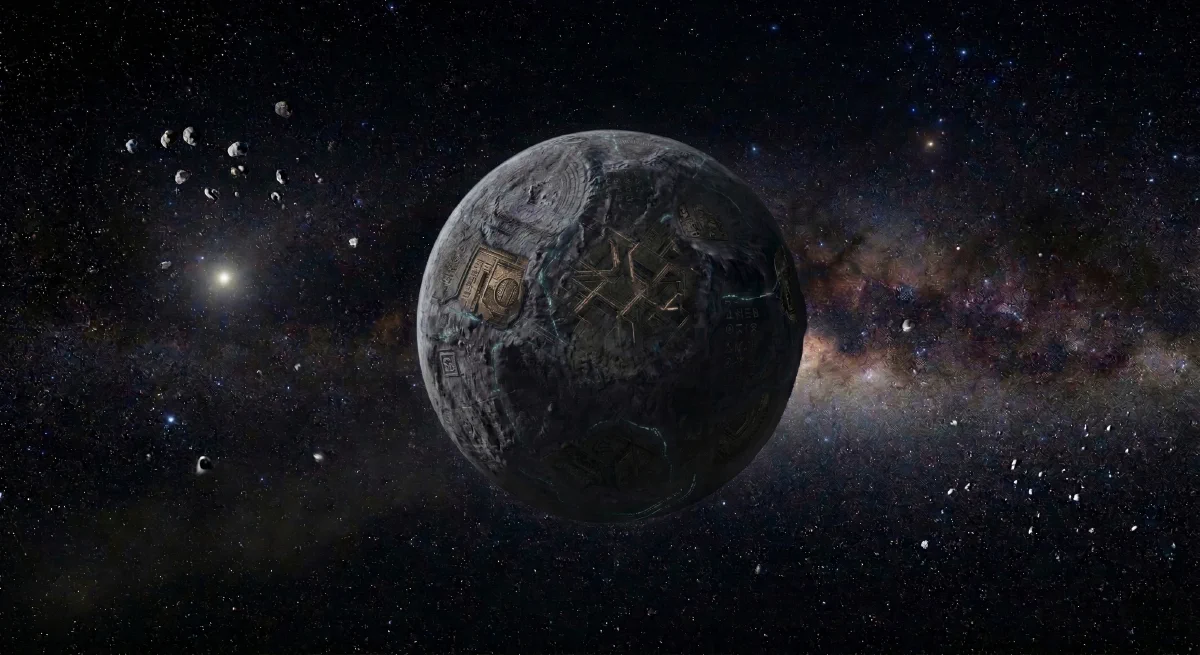
Transit
The launch was quiet.
Not silent. The NTP drive produced a low, continuous vibration that Maren felt in her teeth for the first three days before she stopped noticing it, the way you stop noticing the sound of your own breathing. But quiet in the human sense. No cheering crowds, no countdown drama. The Lachesis separated from the orbital assembly platform at 14:07 UTC on a Thursday, and Maren watched Earth shrink in the observation bay window with the precise attention she would give a data point: noting the rate, the geometry, the thin blue arc of atmosphere that got thinner as the distance grew.
Five people. Five years. The math was simpler than the reality.
The ship was smaller than she had expected. She had known the dimensions from the technical documents, studied them during training, memorized the layout, walked the mockup in Kourou until she could navigate it with her eyes closed. But knowing a space and living in it were different operations. Her berth was narrow enough that she could touch both walls with her elbows bent. The galley seated five if nobody pushed their chair back. The observation bay, the most generous space on the ship, was roughly the size of the shared office she had left behind on Earth, and it served as common room, meeting space, and (as Ines observed in the second week) the only place where you could have a private thought if everyone else happened to be somewhere else, which was rare.
The lab module was better. Purpose-built, instrument-dense, with two workstations and enough processing power to run orbital models that would have taxed her university’s computing cluster. Maren claimed the forward station on the first day, arranged her workspace with the same methodical care she had applied to her desk in Planetary Sciences, and began the work she had come to do.
Chen ran the ship the way she ran everything: with a quiet authority that made compliance feel like consensus. Morning briefings at 07:30, fifteen minutes, standing (there was no room for a conference table, and they wouldn’t have used it if there had been). Each crew member reported: systems, science, communications, health. Chen listened, nodded, asked one or two questions that were always more precise than they sounded, and dismissed them. The briefings rarely ran long. There was not much to report. The ship worked. The instruments worked. The people worked, within the limits of five human beings locked in a metal cylinder falling outward through the solar system.
Maren appreciated the discipline because it created structure, and structure was how you survived duration. She had read the literature on long-confinement psychology (the submarine studies, the Antarctic station reports, the Mars analog habitats where volunteers had spent eighteen months in sealed domes and emerged with data on what happens to human relationships when you can’t leave). The literature was unanimous: routine saved you. Not excitement, not novelty. Routine. The same coffee at the same time, the same exercise rotation, the same evening meal prepared by whoever drew the galley rota. The ship’s day was partitioned into blocks, and Maren followed them, and didn’t resent them, because the alternative was formlessness, and formlessness in a space this small would be unbearable.
At night, the ship sounded different. The drive hum dropped in register (or seemed to; Ines assured her the frequency was constant). The air recyclers cycled in a rhythm she learned to predict: forty seconds on, silence, forty seconds on. Water moved through pipes in the bulkhead behind her head. She lay in her berth and listened to the ship breathe around her, and it was not comforting exactly, but it was constant, which in a space this far from everything else was nearly the same thing.
The tracking data from Earth continued to arrive, relayed through Kofi’s communication link with decreasing urgency and increasing delay. Correction events were still being reported: six more in the first three months, scattered across the Belt’s resonant populations. Each one matched the signature she had identified two years ago. Perpendicular drift, clean return, delta-v with no source. She added each one to her database, updated her models, and watched the pattern grow.
Jupiter.
Thirteen months out, the Lachesis fell through the Jovian system on a gravity assist trajectory that would curve their path toward the outer solar system and shave two years off the transit. They weren’t stopping. The flyby was a slingshot, calculated to the metre, and their closest approach (1.2 million kilometres, well outside the radiation belts) lasted less than six hours.
But the view lasted longer.
Jupiter filled the observation bay for three days. Not in the way planets fill telescope eyepieces, small and jewel-like and abstract. It filled the window the way a landscape fills a car windshield, enormous and immediate and real. The cloud bands were visible to the naked eye, swirls of ammonia and hydrogen in rust and cream and pale yellow, storms larger than Earth spinning in silence. The Great Red Spot passed beneath them on the second day, and Maren stood at the window with Halabi and watched it roll past, a hurricane that had been raging since before there were telescopes to see it, and neither of them said anything for a long time.
“My wife asked me to take a photograph,” Halabi said eventually, without looking away from the window. “I told her the cameras are better than anything I could take. She said she wanted one I chose.”
He took the photograph. A careful composition: Jupiter’s south polar region, the cloud bands curving away, a single moon (Io, Maren thought, though she didn’t check) visible as a bright point against the dark. He sent it with the evening’s message packet. At Jupiter’s distance, the response took about forty minutes each way. He got a reply before he went to sleep: a single line, which he read and didn’t share.
The next morning, Jupiter was smaller. By the following week, it was a bright point again. The ship curved outward, and the Sun behind them was noticeably dimmer than it had been at Earth. Not alarmingly. Just… less. As if someone had turned down the brightness by a fraction, and the fraction was growing.
After Jupiter, the long middle began.
The crew’s habits, which had emerged in the first year, solidified into something more permanent. Ines conducted a systems audit every seventy-two hours, walking the ship with a tablet, checking readings she could check from any console. (“Because instruments lie,” she had told Maren once. “Not often. But they lie.”) In month nineteen, she caught a valve degradation in the water recycling loop by the sound of a pump working slightly harder than it should. The repair took forty minutes. Without it, the degradation would have reached critical in six weeks. This was how Ines operated: she watched the margins so carefully that the margins never closed.
Kofi maintained the Earth link, structuring the transmissions like correspondence: daily packets, time-stamped, organized by priority. Science data in one block, engineering telemetry in another, personal messages in a third. At Saturn’s orbit (month twenty-eight, 10 AU), the one-way delay reached eighty-three minutes. A question asked in the morning might be answered by lunch. By 15 AU, it was two hours each way. The conversations with Earth were no longer conversations. They were exchanges, each one a small act of faith that the signal would find someone on the other end who still cared about the answer.
Halabi wrote to his spouse every day. In the first year, the messages were long. Maren saw him in the communications alcove in the evenings (it was not private, nothing on the ship was private, but they had all learned not to look directly at certain things), composing on his tablet with the careful attention of someone writing letters, not emails. His spouse wrote back, the responses warm and detailed and full of the ordinary texture of a life continuing on Earth. Maren didn’t read them, but she saw Halabi’s face after he did, and for the first year the face was the face of a man who was far from home and holding on.
In the second year, the messages got shorter. Both directions. Not because the feeling had diminished (Maren inferred this from the consistency, from the fact that he still wrote every single day) but because distance exerted a pressure on language that had nothing to do with bandwidth. What do you say to someone you love when the delay between question and answer is two hours? Three? You cannot say “how was your day?” and expect the answer to arrive while it still matters. You cannot share a joke; the timing is destroyed by physics. What remained was something Maren had no word for. Not letters, exactly. Dispatches from parallel lives that were diverging slowly, like two objects in slightly different orbits whose separation grows with each revolution.
She didn’t ask Halabi about it. No one did.
Year three. The Sun was smaller than Maren’s thumbnail at arm’s length.
She checked this periodically, a habit she had developed without deciding to, standing at the observation bay window with her hand raised. It was a crude measurement and she knew it and she did it anyway, because the instruments told her the Sun’s apparent diameter in arcminutes and her hand told her something the instruments didn’t: what it felt like to watch your star shrink.
The ship was cold. Not inside (the thermal management system maintained a steady 21 degrees, Ines’s careful calibration) but in the way that knowing the exterior hull temperature was four Kelvin made the interior warmth feel provisional. The dark outside the observation bay was dense with stars, more stars than Maren had ever seen, the Milky Way a structural feature of the sky rather than a faint smear. There was no light pollution. There was no atmosphere. There was only the ship, a warm point in an ocean of cold, falling outward.
Kofi raised the question one evening over dinner.
They were in the galley, the five of them, which was the only time they were reliably all in the same room. Ines had made something with the hydroponic greens that was technically a salad and functionally an act of defiance against the monotony of stored rations. Halabi was eating slowly. Chen was reviewing a systems report on her tablet, which she did during meals despite having implemented a rule against it (the crew had noticed the hypocrisy in month four and agreed, silently, to let it go). Maren was thinking about correction intervals.
“I’ve been reading the crew psychology protocols,” Kofi said, in the unhurried way he said most things. “The section on cognitive integrity monitoring.”
“Riveting,” Ines said.
“The protocols assume that any cognitive influence on the crew would come from isolation, confinement, or interpersonal stress. Standard deep-space factors.” He paused. “They don’t account for the possibility that the environment itself might be a variable.”
The galley was quiet.
“Meaning,” Chen said.
“Meaning that if Dr. Voss is right, and we are travelling through an active, coordinated system that has been operating for four and a half billion years, then we are inside it. We have been inside it since we launched. Since before we launched. Since we were born.” He looked at Maren. “Is there a mechanism by which a system operating on gravitational time scales could influence human cognition?”
“No known mechanism,” Maren said. “Gravitational effects at these scales are measurable only with extremely sensitive instruments. The tidal forces from KBO interactions are orders of magnitude below any biological threshold.”
“That’s the physics,” Kofi said. “I’m asking about the epistemology. If the system is doing something we don’t understand, how would we know whether it’s affecting our ability to understand it?”
Nobody answered immediately. The question wasn’t paranoid. It was, Maren recognized, the question that any rigorous thinker would eventually ask, and the fact that it had taken Kofi three years to voice it openly said more about his discipline than about the question itself.
“We wouldn’t,” she said. “Not with certainty. We can monitor for anomalous patterns in our decision-making, our analysis, our psychological profiles. But if the influence were subtle enough…”
“There’s no control group,” Kofi said. “There’s no human who has ever existed outside this system.”
“If it exists,” Chen said.
“If it exists,” Kofi agreed.
He went back to eating. The conversation didn’t continue. The question remained.
That night, Maren didn’t sleep. She lay in her berth in the dark, the ship humming around her, the air recyclers cycling in their steady rhythm, and she thought about control groups. After an hour she gave up, pulled on her shoes, stopped at the galley for coffee, and went to the lab.
She worked. Not on the question Kofi had raised (there was no experiment for that, no dataset, no analysis that would resolve it) but on the correction data, because the correction data was what she had. She was reviewing the temporal distribution of the fifty-three confirmed events across six dynamically distinct populations when she noticed something she had not seen before.
The correction events, now numbering fifty-three confirmed instances across six dynamically distinct populations, were not distributed randomly in time. They clustered. A correction in one population was followed, within a predictable interval, by corrections in adjacent resonant populations. The intervals corresponded to the ratio of the populations’ mean motions, the rate at which they orbited the Sun. The corrections swept through the Belt’s orbital architecture like a wave, each population adjusting in turn, each adjustment timed to the dynamical relationship between that population and its neighbours.
The system was not correcting individual objects. It was tuning the Belt.
She ran the statistics. Monte Carlo simulations to test whether the clustering could arise by chance. The probability was vanishingly small. She checked her methodology, checked her code, the way she always did, the way she had done in her shared office on Earth when the numbers had first refused to make sense. She found no errors.
She sat at her workstation in the quiet lab, the results on her screen. She should tell the crew. She should present this at tomorrow’s briefing, the way she would have done six hours ago, before Kofi had asked his question.
But Kofi had asked his question. And now Maren was sitting in a lab inside a system that might or might not be influencing her ability to evaluate what she saw, looking at a pattern that her pattern-seeking mind had found in data about that same system, and she was not certain. Not of the statistics (the statistics were clean). Of herself. Of whether the part of her that saw the sweep and wanted to call it real was the part that had always made her a scientist, or something else.
She saved the analysis. She didn’t present it at the morning briefing, or the next day, or the day after that. She told herself she was waiting for more data, for independent confirmation, for the kind of certainty that would survive the question Kofi had planted in all of their minds. This was partly true. The rest was something she didn’t examine too closely.
Year four. The Sun was a star.
Not metaphorically. Literally. At 30 AU, it was the brightest object in the sky by a significant margin, bright enough to cast faint shadows inside the observation bay if you turned off the interior lights (Maren had done this, alone, at 02:00 ship time, standing in the pale light of a star that was also her sun). But it was no longer a disk. It was a point. A very bright point, but a point. The warmth was gone. The sense of orientation it had provided (the Sun was there, therefore I was here) had shifted into something more abstract. The Sun was there, yes. But there was very far away.
They had been together for four years. Not friends, exactly (friendship implied a choice, and they had chosen the mission, not each other). Something else. A unit. Five people who had learned each other’s rhythms the way Maren had learned the ship’s: involuntarily, by proximity, until the knowledge had become structural. She knew that Chen cleared her throat before saying something she considered important. That Ines hummed tunelessly while calibrating instruments. That Kofi slept with his door open and Halabi slept with his closed. These were not intimate details. They were the residue of four years in a space where privacy was architectural fiction.
Halabi had stopped sharing his spouse’s messages. Not stopped reading them (Maren still saw him in the communications alcove, every evening, his face lit by the tablet). But the face had changed. In the first year, reading the messages had been a bridge. Now it was something else. A ritual, maybe. Or an ache maintained by repetition.
She found him in the observation bay one evening, sitting in the dark, looking at nothing.
“Four and a half hours,” he said, when she sat down beside him. He didn’t need to explain. At their current distance, his evening message would arrive on Earth close to midnight. If his spouse read it in the morning and replied immediately, the reply would reach him the following afternoon. A single exchange took a full day. The grammar of the relationship had been rewritten by the speed of light.
“She’s patient,” Maren said, because it was the only true thing she could think of.
“She’s extraordinary,” Halabi said. Then, quietly: “I’m not sure patience is what this requires.”
They sat in the dark together for a while, not speaking, the stars steady and indifferent outside the window. Maren thought about her own apartment on Earth, which someone else was living in by then. Her office, which someone else was using. The eucalyptus trees outside the window. She had left all of it without looking back, and she hadn’t regretted it, and the fact that she hadn’t regretted it was, she suspected, a piece of data about herself that Halabi would find difficult to understand.
In the fifth year, the instruments began to see the Belt. Not the objects themselves (still too distant, too dark, too small) but the statistical signature of their presence: faint perturbations in the trajectories of known objects, gravitational whispers from the cold classical population that Maren had been studying from forty AU away and was now approaching.
Chen called a full mission briefing, the first in months. They gathered in the observation bay, the five of them, and for the first time since Jupiter the agenda was not routine.
“Instrument calibration sequence begins tomorrow,” Chen said. “Preliminary surveys start at 42 AU. Dr. Voss, what are we looking for?”
Maren had thought about this question for five years. Longer, if she counted the nights in her shared office, the parking lot, the sky.
“The corrections tell us the system is active,” she said. “What we don’t know is the mechanism. How does a piece of ice and rock correct its own orbit? The answer is in the objects themselves. Their composition, their internal structure, their physical properties. If the maintenance is engineered, the engineering has to be somewhere.”
She did not mention the sweeps. The temporal clustering, the wave of corrections she had found propagating through the Belt’s resonant architecture. She had been sitting on that analysis for nearly two years, and it sat in her like a stone, and she wasn’t sure whether her silence was caution or something less rational. But the data would be there when she was ready. If she was ever ready. If readiness was something she could trust.
“And if we don’t find it?” Ines asked. Not challenging. Genuinely asking.
“Then I’m spectacularly wrong,” Maren said, and glanced at Chen, who almost smiled.
The briefing ended. The crew dispersed to their stations. Maren stayed in the observation bay, looking out at the dark.
Five years before, she had stood at a window in Kourou and watched the sun set over the jungle and turned and gone to pack. Now she stood at a different window and there was no sunset, only the permanent dark of the outer solar system, and somewhere ahead of them, invisible, the objects she had been modelling for seven years. Ice and rock. The most ancient, most pristine, most unremarkable objects in the solar system, according to everything anyone had known before she noticed the residuals.
The observation bay window was cold to the touch. She didn’t touch it. She stood with her hands at her sides, looking out at the dark, feeling the ship hum around her, the steady vibration of the drive that had been pushing them outward for five years. Behind her, the Sun was a bright star. Ahead, nothing visible. Yet.