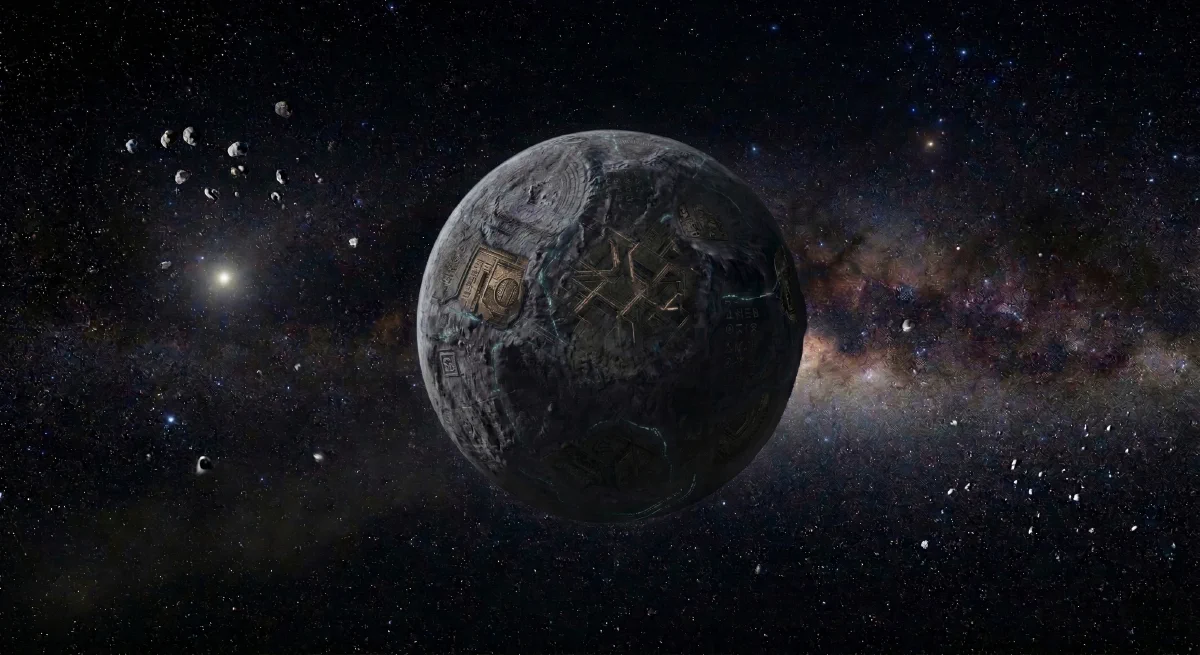
Arrival
The first thing she noticed was the silence.
Not true silence. The ship still hummed, the recyclers still cycled, the water still moved through pipes in the bulkhead. But the drive was off. For five years the NTP engine had pushed them outward, its vibration so constant that it had become a kind of gravity, a low-frequency presence she had stopped noticing the way you stop noticing the rotation of the Earth. Now it was gone, and the absence was physical, a subtraction she felt in her spine, in her teeth, in the suddenly unfamiliar stillness of the air.
They were on station. 42 AU. The deceleration burn had ended at 03:14 ship time, and Maren had lain awake in her berth listening to the ship settle into its new quiet, the small mechanical adjustments as systems that had been running against thrust recalibrated for drift. By 06:00 she was in the lab, at her workstation, pulling up the survey catalog.
The observation bay, when she passed through it, showed nothing.
This was accurate. At 42 AU, the Sun was a bright star roughly three degrees above the plane of the ecliptic (she had checked, out of a habit that had outlived its usefulness, because there was nothing to learn from the Sun’s position that the instruments didn’t already know). The rest was dark. Not the dark of a clear night on Earth, which was always qualified by atmosphere, by scattered light, by the faint glow of the horizon. This was unmediated. The stars were sharp and steady and numerous and utterly still, and between them there was nothing. No KBOs visible. No belt. The objects she had spent seven years studying were out there, thousands of them within the ship’s detection range, but they were dark (albedo 0.05 to 0.15, surfaces coated in tholins, the reddish-brown organic residue of four and a half billion years of radiation processing) and small (most under a hundred kilometres) and cold (40 Kelvin, minus 233 Celsius, cold enough that the difference between ice and rock was largely academic). You didn’t see them. You found them.
Chen called the briefing at 07:30, same as always. The rhythm hadn’t changed, but the content had. Systems report: Ines, brisk and thorough, noting that the deceleration sequence had performed within two percent of projected fuel expenditure. Communications: Kofi, confirming the latest Earth packet had been received, one-way delay now five hours and thirty-one minutes. Health: everyone fine, or fine enough, which after five years was the same thing.
“Science,” Chen said, and looked at Maren.
“Target selection is ready,” Maren said. “I’ve identified fourteen cold classical objects within our operational range based on the Rubin catalog positions, updated for the latest ephemeris corrections. I’m recommending we start with the closest, designation 2039 FH₄₀₈. It’s a forty-seven-kilometre body at a current range of approximately 1.2 million kilometres. Spectral class consistent with the anomalous cluster. It should be within radar range by tomorrow if we reposition the array.”
“Repositioning the array takes six hours,” Ines said.
“Then we should start now.”
Chen nodded. “Do it.”
The briefing ended. The crew dispersed to their stations, and for the first time in five years, they were not maintaining a transit. They were working. The distinction was subtle from the outside (five people in a small ship, moving between consoles and instruments and the galley) but Maren felt it. The rhythm was different. During transit, the work had been custodial: maintaining systems, processing data from Earth, waiting. Now there was something to point the instruments at. Something to measure. The waiting was over, and what replaced it was not excitement but focus, a narrowing of attention that Maren recognized from every late night in her office on Earth, every hour spent hunched over residuals that refused to resolve.
She spent the morning configuring the targeting models. The survey catalog gave her positions, but positions at these distances were approximations, updated periodically from Earth-based observations with uncertainties measured in arcseconds. Translating those into instrument pointings for a ship that was actually here, in the Belt, required a cascade of corrections: parallax, light-time delay, the ship’s own velocity relative to the target. She worked through them methodically, cross-referencing with the onboard navigation solution, and by midday the radar array was slewing toward 2039 FH₄₀₈.
Outside the ship, the Belt waited. Dark, cold, and patient in the way that only very old things can be patient.
First light came at 14:22 ship time the following day.
The radar return was unremarkable. A blip on the ranging display, distance 1.14 million kilometres, signal consistent with a body of approximately the expected size. Maren watched it resolve on her screen and felt nothing dramatic, which was itself notable. She had spent five years falling toward this moment, and the moment, when it arrived, was a data point. A number on a screen. The object was there, exactly where the ephemeris said it would be, and its existence was confirmed not by vision but by the travel time of a radio pulse.
The optical telescope found it twenty minutes later, after Maren refined the pointing. On the display it was a smudge. Not even a disk, at this range. A cluster of pixels barely distinguishable from the noise floor, reddish-brown in the processed colour data, which meant tholins, which meant a surface that had been marinating in solar wind and cosmic radiation since before there was life on Earth.
“There it is,” Halabi said, standing behind her. He had come into the lab without her noticing, drawn by the same gravity that drew all of them toward the instruments now that there was something to see.
“There it is,” Maren agreed.
They looked at it together. A piece of ice and rock, forty-seven kilometres across, sitting in the dark at 42 AU. It was, by any objective measure, one of the least visually interesting objects in the solar system. A smudge. A pixel. And yet Maren felt the weight of it in a way she hadn’t anticipated, a recognition that went beyond the data. She had modelled these objects for seven years. She had watched one correct its own orbit from a desk on Earth. She had spent five years falling outward to be close enough to touch them with instruments, and now here was the first one, small and dark and ancient and doing nothing, so far as she could see, except existing.
The instruments saw more.
Over the next twelve hours, the data accumulated. Spectroscopy first: the near-infrared spectrograph broke the reflected sunlight (what little there was of it, a faint gleam from a star-sized Sun) into its component wavelengths, and the absorption bands told the story of the surface. Water ice, as expected. Crystalline, not amorphous, which was mildly interesting (crystalline ice at these temperatures implied some thermal processing in the distant past, or a formation environment different from what the models predicted). Methanol. Ammonia hydrate. And tholins, lots of tholins, the complex organic polymers that gave the object its colour and that nobody fully understood because nobody had ever been close enough to study them in situ.
“Surface composition is textbook,” Halabi said, reviewing the spectra at the adjacent workstation. “This is exactly what a cold classical should look like.”
“Good,” Maren said, though she wasn’t sure whether she meant it. Part of her had been hoping for something anomalous on the surface, something visible, something that would make the next step obvious. But the Belt was not going to make this easy. The Belt, she was beginning to understand, did not advertise.
The radar data was more revealing. As the array continued to ping the object over successive hours, the returns built a picture of 2039 FH₄₀₈’s shape: bilobate, two roughly spherical lobes joined at a narrow neck. Contact binary. The shape was familiar. Arrokoth, the cold classical KBO that New Horizons had visited decades ago, had the same basic morphology. Two objects that had drifted together at walking speed and stuck, billions of years ago, and had been orbiting the Sun as a single body ever since.
The gravitational measurements came last, because they required the most time. By tracking the ship’s position relative to the object over several hours (using the radar range and the onboard accelerometers), Maren could extract the object’s gravitational influence on the Lachesis. The effect was tiny, barely above the instrument noise, but it was there, and from it she could calculate a mass. Combined with the radar-derived volume, that gave her a density.
She ran the calculation. Ran it again. Checked the inputs.
“Rami,” she said. “Look at this.”
Halabi rolled his chair over. She showed him the number on her screen.
The bulk density of 2039 FH₄₀₈ was 410 kilograms per cubic metre.
Halabi was quiet for a moment. “That’s high,” he said.
“It’s high.”
A cold classical KBO should be a rubble pile. Loosely bound aggregate of ice and rock, held together by weak self-gravity and surface forces. Arrokoth’s density had been measured at 235 kilograms per cubic metre, less dense than water, less dense than wood, the kind of number that made intuitive sense for an object that was essentially a snowball the size of a city. The cold classicals were supposed to be the most primitive objects in the solar system, unchanged since formation, and their densities reflected that: low, porous, loosely packed.
410 was not 235.
“Could be compositional,” Halabi said, the way he said most things, with a caution that was not doubt but rigour. “Higher silicate fraction. Less porosity. It’s within the range of plausible variation.”
“It is,” Maren said. “Barely.”
“Barely is still within.”
She didn’t argue. He was right. One measurement, one object. The error bars were not small. She could construct a perfectly reasonable explanation for a density of 410 that involved nothing more exotic than a slightly different mix of rock and ice, a slightly more compact internal structure, a formation history that happened to produce less porosity. The number was unusual, not impossible.
But it sat in her the way the first correction event had sat in her, years ago. Not as a conclusion. As a question that had changed shape.
Halabi presented the density data at the following morning’s briefing.
He had spent the night running his own analysis, and Maren could see it in his face: the careful fatigue of someone who had checked his work twice and found no errors. He put the number on the shared display (the observation bay’s primary screen, which served as their briefing room’s only visual aid) and walked the crew through the methodology: radar ranging, gravitational perturbation measurement, volume estimate, mass derivation, density calculation.
“Four hundred and ten kilograms per cubic metre,” he said. “Plus or minus roughly sixty.”
“For reference,” Maren added, “Arrokoth was measured at two hundred and thirty-five. The expected range for cold classical rubble piles is roughly two hundred to five hundred, with most clustering around two hundred to three hundred.”
“So it’s on the high end,” Chen said. “But within range.”
“The bulk density alone, yes,” Halabi said. He touched the display, bringing up a second plot. “The problem is the density profile.”
The radar returns, collected over enough hours and from enough angles as the ship’s relative position shifted, could be processed to yield not just the object’s overall shape but a rough model of its internal density distribution. The technique was imprecise at this range (they would need to be much closer for detailed tomography) but it could distinguish between a uniform interior and one with significant structure.
2039 FH₄₀₈’s interior was not uniform.
“What I’d expect from a rubble pile is essentially random,” Halabi said. “Loosely packed aggregate, voids distributed throughout, maybe some size-sorted layering from microimpacts over geological time. What I’m seeing instead is a density gradient. Higher density toward the core of each lobe, dropping off toward the surface, with a transition that’s…” He paused, choosing the word. “Organized.”
“Define organized,” Chen said.
“The gradient isn’t smooth. It steps. There are discrete density boundaries at specific depths, as if the material is arranged in shells. Or layers.” He looked at Maren. “The layering structure doesn’t match any formation model I know of for cold classical objects. These aren’t differentiated bodies. They never had enough mass or internal heat for gravitational differentiation. A rubble pile shouldn’t have concentric density structure.”
The observation bay was quiet. Ines leaned against the bulkhead with her arms crossed, watching the display. Kofi sat in his usual position, slightly apart, listening.
“What would produce that structure?” Chen asked.
“In a body this size? At these temperatures? With no internal heat source?” Halabi shook his head. “I don’t have a good answer. Crystalline organization at these scales doesn’t happen spontaneously in rubble piles. It requires… direction. Some process that sorts material by density and arranges it concentrically.”
“How confident are you in the radar tomography at this range?” Kofi asked. It was the first question he had asked at a science briefing in months, and Maren noted it the way she noted everything about Kofi: carefully, because the things he chose to say were always deliberate.
“Moderately,” Halabi said. “The resolution is low. But the shell boundaries are well above the noise floor. I wouldn’t publish this. But I wouldn’t ignore it.”
He didn’t say the word engineered. He didn’t need to. It was in the room already, left over from a meeting in Geneva years ago, from Maren’s paper, from the mission brief they had all read and that had brought them here.
“One object,” Chen said. “One measurement.”
“One object,” Halabi agreed. “One measurement. I’d want to see this in at least three more targets before drawing any conclusions.”
“Then we survey three more targets,” Chen said, and the briefing ended.
But Maren saw it in all of them as they left. The recalibration. The slight shift in posture, in attention, that came from hearing data that moved the ground under your feet by a fraction of a degree. Not a revelation. Not yet. A question. The same question, refined: if the objects were maintaining their own orbits, how were they doing it? And now, for the first time, a hint. Not on the surface, where the tholins and ice and ancient radiation chemistry looked exactly like what they should look like. Below the surface. Inside. Where a rubble pile should have been random and was, instead, structured.
Ines caught Maren’s eye as she left the observation bay. “How worried should I be?” she asked, with the dry directness that had made her, over five years, the person Maren trusted most to ask the question no one else would.
“About the density?”
“About what the density means.”
“I don’t know what it means yet,” Maren said. “That’s the honest answer.”
“I know,” Ines said. “That’s why I asked you and not Halabi. He’d have given me the diplomatic answer.”
She left. Maren watched her go, the engineer’s steady gait, the tablet already in her hand, already checking something, because Ines was always checking something. It was, Maren thought, a form of faith. Not in the ship, or the mission, or the outcome. Faith that the margins could be watched, and that watching them mattered.
She worked late.
The lab was quiet, the ship quiet, the stillness of a vessel at rest after years of motion. Kofi had gone to his berth. Halabi was in the communications alcove, reading whatever his spouse had sent in the latest packet. Ines was somewhere in the aft section, running a post-deceleration diagnostic on the propulsion system. Chen’s berth light was off. Maren was alone with the data.
She had the density profile on one screen and her correction event models on the other. Side by side, two datasets that had lived in separate parts of her analysis for years. The correction events told her what the system did: maintained orbits, adjusted trajectories, with a precision that no natural process could account for. The density profile, if Halabi’s reading was right, told her where the mechanism might live.
She pulled up the spectral data again. Crystalline water ice. The crystallinity had seemed like a minor anomaly when Halabi had first noted it, a footnote in the surface composition analysis. But crystalline ice at 40 Kelvin was unusual. At these temperatures, ice should be amorphous, the molecules frozen in place before they could settle into an ordered lattice. Crystalline ice meant heat, at some point, enough to allow the molecules to organize. Or it meant something else had organized them.
She was careful. She could feel herself wanting to connect the dots, the familiar pull of a pattern resolving, and she knew (Kofi’s question, two years old now and still lodged in her mind like a splinter) that the pull itself was suspect. A pattern-seeking mind will always find patterns. The question was whether the pattern was in the data or in her.
The statistics didn’t care about her doubt. She ran the numbers on the density profile, comparing the observed layering structure against models of natural rubble-pile formation, accretion, and compaction. The natural models couldn’t produce concentric shells in a body this small, at these temperatures, with no internal heat source. She ran them again with more generous assumptions, allowing for formation scenarios that were improbable but not impossible. The fit improved, but it didn’t match. The shells were too regular. The transitions too sharp.
One object. One measurement. Halabi was right to be cautious. Chen was right to want more data.
But Maren had been watching these objects for seven years, and she had learned to recognize the shape of a discovery before she could prove it. It was the same feeling she’d had in her office on Earth, watching 2037 QR₁₁₃ return to its predicted orbit, the correction clean and precise and impossible. The data was incomplete. The conclusion was premature. And the shape of the thing was becoming visible, the way a structure becomes visible in fog, not all at once but in fragments, an edge here, a line there, enough to know that something is there even if you can’t yet say what it is.
She saved her work. Closed the modeling environment. The correction event data stayed on the secondary screen, the sweep analysis she had never presented, the temporal clustering that showed the Belt being tuned like an instrument. She looked at it, as she did most nights, the way Halabi read his spouse’s messages: not because it would tell her anything new, but because looking was how she maintained her relationship with the question.
She didn’t have proof. She had one anomalous density reading, a set of correction events she couldn’t explain, and a sweep analysis she didn’t trust herself to present. She had seven years of data and five years of transit and the permanent, irreducible doubt that Kofi had given her over dinner in year three.
She also had thirteen more targets in the survey queue, and tomorrow the instruments would be pointed at the next one.
Maren shut down the secondary screen, then the primary. The lab went dim, lit only by the standby indicators on the instrument racks and the faint glow of the primary display’s power light. She sat for a moment in the near-dark, listening to the ship. The recyclers cycled. The pipes ticked softly in the walls. No drive hum. The silence where it had been was still strange, a gap in the world’s texture that her body hadn’t yet learned to fill.
She stood, stretched, and walked through the lab toward the corridor. As she passed the observation bay, she paused. The window was dark, as it always was now, the stars steady and indifferent beyond the glass. Somewhere out there, 1.14 million kilometres away, a piece of ice and rock that should have been a rubble pile was something else instead. And beyond it, thousands more, all dark, all ancient, all quietly doing whatever they had been doing since before there were eyes to see them.
She kept walking. The corridor was dim, the ship asleep, the Belt outside. She had work to do in the morning.