Chapter 1: Planetfall
The ramp lowered and the light was wrong.
It wasn’t just the color that was wrong, or the brightness even. It was wrong the way a familiar room is wrong when you enter it from a door you’ve never used. Everything was approximately where Khouri expected it to be. He had seen the simulations, studied the projections Navarro had run during the transit. But the visuals rendered into actual photons on his retinas were different from the images on a screen, the way hearing a language is different from reading its grammar.
The planet’s surface stretched out ahead of them: flat, rocky, dry, utterly still. The light that touched it didn’t come from a single point. It was reddish and dim, a deep twilight that painted everything the same exhausted color, the hull of the ship behind them, the ground beneath, the structures on the horizon. Like the last minutes of a sunset that had been stretched until the warmth leached out and only the color remained. Not dark, exactly. Not bright. Enough to see by, barely. Not enough to see well.
Captain Yoon went first. He walked down the ramp in measured steps, weapon slung, head turning left to right in a scan so practiced it looked involuntary. Calder followed two meters behind, then Morrow, then the rest in the order they’d drilled: Okafor and Vasquez, Tan, Park, Engel. The squad moved as a single organism, spacing automatic, each person a vertebra in a spine that Khouri had watched assemble and disassemble a hundred times but never really been a part of.
He went after Engel. Navarro went last. The two civilians at the back of the column, close enough to follow, far enough not to interrupt a rhythm they hadn’t been trained to share.
The ground was hard under his boots. He’d expected some give, the way you always expected alien soil to feel different, but it was just rock. Flat, striated, dark. The planet had atmosphere enough to breathe (filtered, but breathable), and gravity close enough to standard that the difference lived in the knees rather than the head. A gentle pull, slightly less than Earth’s, that made every step feel like the start of a bounce that never quite came.
Nobody spoke. Ten helmeted figures standing on a world that no human had touched, and the silence held. Not the reverent silence of ceremony or the tense silence of a breach. The silence of people whose training ran too deep and whose stakes sat too high for awe to reach the surface.
Yoon’s voice came through the comm, flat and procedural. “Perimeter clear on visual. Engel, atmo readings.”
“Nitrogen heavy, oxygen within margins. Trace compounds flagged but below threshold. Livable, sir.”
“Copy. Helmets stay on, filters active. Nobody breathes raw air until I say otherwise.”
Nine acknowledgments, staggered by half a second each, the sound of a squad answering in the order that hierarchy and habit had made automatic. Khouri gave his a beat late. The rhythm wasn’t in his muscle memory.
He looked up.
The sky looked… broken.
He had known, intellectually, what he would see. Navarro had explained it twice during transit. The briefing materials had included renders. None of it mattered. The human visual system was not built for a sky with a hole in it.
The black hole sat at the center of the sky like an eye with no iris. A circle of absolute nothing, darker than dark, a blackness that didn’t reflect or absorb because there was nothing there to do either. His eyes kept trying to focus on it and kept failing, sliding off the edge of the void the way a hand slides off a surface with no friction. There was no depth to it. No surface. Just absence, enormous and round, framed by the thinnest ring of light he had ever seen.
The photon ring. Light that had come close enough to orbit before escaping, compressed into a bright razor-line around the void. Brilliant, blue-white, steady. It gave the blackness a boundary, and somehow that made it worse. Darkness without edges was just darkness. Darkness with a clean bright outline was a thing. A presence. Something that took up space by being the place where space stopped.
And around it, above and below, the accretion disk. Not a disk from here. Gravitational lensing warped it into something else entirely: a vast halo, stretched and folded by spacetime’s curvature until the far side of the disk was visible above and below the black hole simultaneously, a horseshoe of dim fire that wrapped over and under the void. Reddish and dim on the receding side, brighter and bluer where it approached. It was the source of the twilight on the ground, this river of superheated matter falling toward a drain with no bottom, its light arriving at the surface with just enough energy left to cast a shadow.
Behind all of it, through the distortion, the stars were wrong. Smeared into arcs, duplicated, their positions shifted by the same lensing that bent the disk. Familiar constellations (if any had been familiar from this vantage) would have been unrecognizable, pulled into curves and ghosts of themselves. The sky was a warped mirror with a hole burned through the center of it.
Khouri stared. His training said: catalogue, categorize, record. His body said: you were not meant for this place. Both were right.
“Flashlights,” Yoon said.
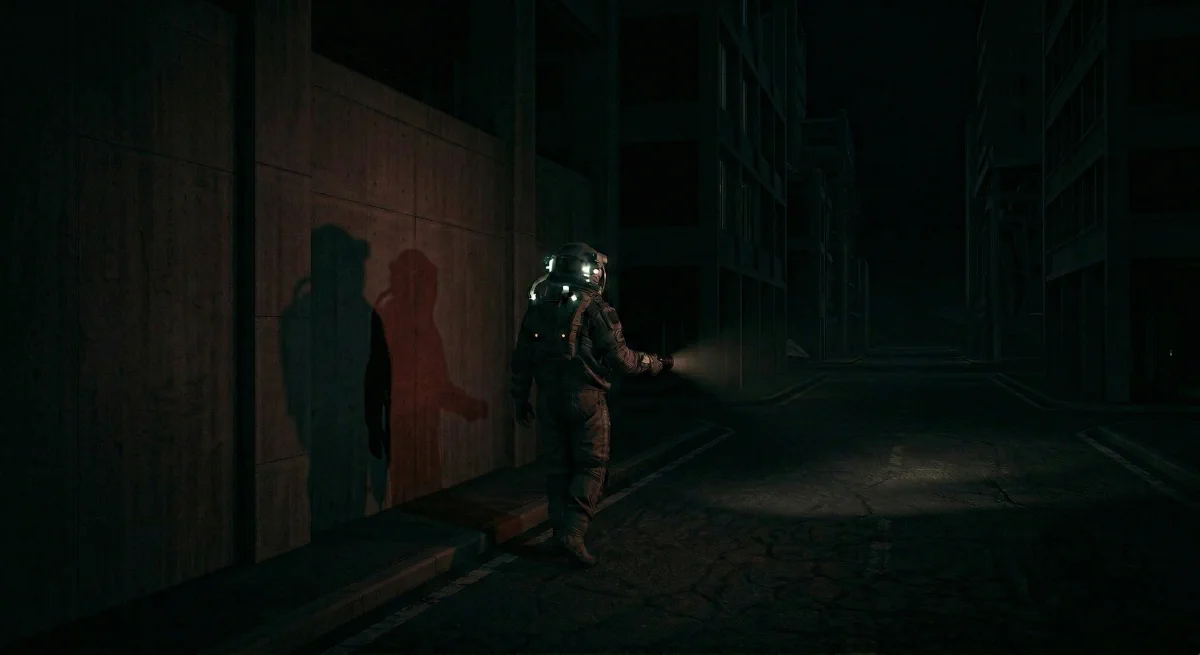
The squad lit up. Ten beams of bright white cut into the red twilight, sharp and directional against the ambient glow. The beams were almost shocking in their cleanness, in the way they carved hard lines through light that came from everywhere at once. Like bringing a lamp into fog.
The contrast revealed something Khouri had been too overwhelmed to notice: how dim the accretion light actually was. Standing in it alone, your eyes adjusted and forgot. The moment the flashlights came on, the twilight deepened around the beams, and the world outside each cone of white fell away into reddish murk. They would need the lights for everything.
Khouri thumbed his own flashlight on and swept it across the ground. Two shadows stretched from his feet.
Two shadows. One sharp and dark, thrown by the flashlight, falling behind him and to the right. The other softer, longer, reddish at the edges, cast by the accretion disk’s glow, angled off to the left. They didn’t overlap. They didn’t cancel. They lay side by side on the rock like two copies of himself, flattened at different angles.
He moved his hand. Both shadows moved. He stepped left. Both followed. Just optics. Two light sources, two shadows. The same thing happened in any room with two lamps.
“Gear check,” Morrow called, and the moment passed.
The squad gathered at the base of the ramp for final equipment checks before the walk. Packs adjusted, weapons confirmed, comms tested. The military members ran through it the way musicians ran scales, their hands knowing the sequence before their conscious minds engaged. Khouri watched Okafor’s fingers move across his rig without looking down, tightening and testing and confirming by touch alone. Morrow circled through, a brief press on each person’s shoulder as he passed, checking straps and seals. Quick, efficient, thorough. It reminded Khouri, as it always did, that he was just a visitor in a world these people had lived in for years.
His own equipment was a different rig. Sampling kit, field scanner, specimen containers, the tools of a xenobiologist who had trained for eighteen months to use them under field conditions and still hadn’t quite found the muscle memory. He got the scanner case latched on the third try. The specimen containers slid into the side pouch cleanly. But the chest strap fought him. A standard quick-release buckle, the kind on every pack in every inventory, and his fingers fumbled the clasp.
Vasquez leaned over. He was close enough that Khouri could see his face through the helmet visor: dark eyes, the start of a grin.
“That’s what we call a ‘buckle,’ Doc. Revolutionary technology. You push the thing into the other thing.”
Khouri gave him a flat look.
Somewhere behind, someone snorted. Okafor, probably. It was a small sound, barely a sound at all, and it was the first moment since landing that Khouri felt like he existed in the squad’s awareness as something other than cargo.
He pushed the thing into the other thing. It clicked.
“There you go” Vasquez said. “Easy as pie.” He clapped Khouri on the shoulder, firm, the way he’d clap any of them, and moved on to something else, already talking.
Engel appeared at Khouri’s side a moment later. She checked his pack without asking, the way she checked everyone’s, but when she found the chest strap she tugged it once, nodded, and said, “Scanner’s within reach if you need it on the walk. Left side pocket.” Then she moved on to Navarro.
No joke. No condescension. Just one professional making sure another professional’s tools were accessible.
Khouri noted the difference.
“Column formation,” Yoon ordered. “Okafor, you have point. Two-meter spread. We stay together, we stay lit. The city is one point four klicks northwest. Navarro.”
Navarro looked up from her handheld. She’d been reading numbers since the ramp lowered, her face lit from below by the screen’s glow, and Khouri recognized the expression: data that wasn’t fitting its models.
“Bearing is approximate, sir. Instruments are drifting. Compass unreliable, gyroscope unstable. I can give you a heading based on visual landmarks, but I would not trust anything electronic for navigation.”
“Frame dragging,” Park said, mostly to herself.
“Frame dragging,” Navarro confirmed. “The black hole’s angular momentum is warping local spacetime enough to affect our inertial instruments. They’re measuring correctly. Space is just rotating underneath them.”
A beat of silence on the comm. The kind that formed when ten people absorbed something that was technically comprehensible and physically unsettling in equal measure.
“Visual landmarks it is,” Yoon said. He looked at the sky. Not a tactical scan this time. He looked at it the way anyone would look at it, if they let themselves. “The city is visible. We walk toward it. Move out.”
They moved.
Okafor took point, his flashlight sweeping a slow arc across the ground ahead. The terrain was bare, a flat expanse of dark rock that stretched from the ship to the city without interruption. No vegetation, no rubble, no features. Just ground and sky and the glow and the void above and the geometry of buildings on the horizon.
Khouri fell into his place near the back of the column and watched them walk.
The military members had a shared cadence. Not a march, not synchronized, but a rhythm that came from years of moving together under weight. Yoon’s stride was economical: no wasted motion, each step placed. Calder matched his pace but kept her beam low, sweeping the ground ahead rather than the skyline, checking footing and cover in a place where the squad had neither. Morrow walked with the wider gait of a man whose loaded pack had become part of his skeleton, something the body accounted for without asking. Okafor was steady at point, methodical, his beam a slow metronome. Vasquez walked with his flashlight aimed wherever his attention landed, which meant the beam jerked and swept in the restless pattern of a man who couldn’t stop scanning, couldn’t stop narrating, even when the narration was just light. Tan moved beside him, quiet in his steps the same way he was quiet in everything else, contained, occupying exactly the space his body required and no more.
Navarro walked just ahead of Khouri, her attention split between the handheld and the sky. She kept looking up, then down at her data, then up again, as if checking the sky against its own specifications and finding discrepancies. He didn’t blame her. He kept looking up too.
Nobody talked about it. The void, the ring, the bent river of fire. It hung above them, enormous and impossible. To talk about it would be to admit the scale of what was over their heads, and admitting that was admitting how far from anything they were.
Khouri watched the squad ahead of him. Morrow’s settled shoulders. Vasquez’s restless beam. The way none of them glanced over a shoulder toward the ship. Not once. Not even the casual look-back of a soldier checking an exit.
People leaving base always looked back. Researchers leaving a station always turned to make sure the safe place was still there, still reachable. These people walked forward as if there were nothing behind them worth turning for.
There wasn’t.
One hour on this surface, roughly one year out there. Ahead of him, Morrow reached over and adjusted a strap on Tan’s pack without breaking stride. Tan didn’t flinch, didn’t turn. The gesture of someone who’d been doing it for years, and the acceptance of someone who expected nothing less. Nobody mentioned home. Nobody talked about after. Whoever these people had been to anyone outside this column was already past tense.
Khouri had signed the same waiver. But he’d said goodbye to an institution. They’d said goodbye to people.
He was inside the bubble. And he was still on the outside of the circle.
He walked.
The city grew.
It had been a line of geometry on the horizon when they started, too regular to be natural, too dark to be lit. As they closed the distance, it resolved. First the skyline: shapes against the dim halo of the accretion disk, angular, vertical, clearly constructed. Then the scale: tall structures, clustered in a density that said urban, said populated, said tens of thousands once lived here. Then the detail, emerging from the twilight as they drew closer: smooth surfaces where human architecture would have had hard edges, curves where there should have been corners. Openings in the walls that were probably windows but sat at wrong heights and wrong proportions. Built by hands (or something like hands) that held a different geometry in mind.
It was beautiful.
Khouri caught himself thinking it and didn’t correct it. The accretion glow gave the buildings a warmth they probably didn’t deserve, smoothing the alien lines into something almost inviting, the way any skyline looked better at sunset. Against the impossible sky, the void and the fire, the city looked like the last thing still trying to make sense. Solid. Grounded. Built for reasons that were probably the same reasons anyone built anything: shelter, proximity, the need to put walls between yourself and whatever lay outside.
No lights. No movement. Nothing in the openings, nothing between the structures. The city sat in the red glow the way a theater sat in the dark after the audience had left: still arranged for presence, still shaped by the expectation of occupation, but empty. Profoundly and entirely empty.
“Contact?” Okafor asked. Just the one word. His beam held steady on the nearest structures.
“Negative,” Park said. She’d been monitoring instruments for the duration of the walk, head down, reading data in the glow of her screen. “No electromagnetic emissions, no thermal differentials, no signal activity. Structural mass reads solid, but there’s no active anything.”
“Survey data showed the same,” Navarro said. “The atmosphere here preserves. No weathering, no decay.”
“Orbital scans also said no biosigns,” Morrow said.
“… Within detection range,” Khouri corrected him.
The silence that followed was a fraction too long. The squad adjusting to the civilian having spoken. Khouri felt the shift without seeing it: a redistribution of attention, brief and impersonal.
“The drone surveyed from orbit,” he continued. “Atmospheric biosigns, thermal imaging, spectral analysis. It wasn’t designed to detect remains at the surface level. If anything died in those buildings, it wouldn’t have shown up.”
Morrow glanced back. Not hostile, not inviting. Assessing.
“That’s why you’re here, Doc,” Yoon said. Neutral. A fact, not a compliment.
The squad moved on. Vasquez said something to Okafor on the comm, quick and offhand, and Khouri caught Okafor’s quiet exhale that might have been a laugh. Inside the circle.
They reached the city’s edge.
It wasn’t a wall or a gate. The flat rock simply gave way to built surfaces: paving, dark and seamless, fitted so precisely that Khouri’s flashlight beam couldn’t find a gap between the sections. The transition was gentle. First the paving, then low structures on either side (storage, utility, impossible to tell), then taller buildings, the space between them narrowing as the city thickened around them.
Yoon raised a fist. The column stopped.
“Okafor, take us in slow. Park, start recording everything. Everybody stays in formation, nobody enters a structure without my authorization.”
Park’s acknowledgment was immediate and professional. A small red indicator lit on her helmet rig, the recording system active, cataloguing everything the squad’s cameras could see from the first step.
Okafor moved forward. The column followed.
The flashlights cut into the first street. The beams hit walls, the smooth curves of alien construction, openings that weren’t quite windows, and bounced back in flat white that made the spaces behind each structure go ink-dark by contrast. The accretion glow reached in from above, reddish, softer, finding the surfaces the flashlights missed, filling the gaps between beams with a dim warmth that had nothing warm about it.
The two-shadow effect multiplied in the enclosed space. Every wall, every protrusion, every surface that blocked a beam threw a sharp white shadow on the ground behind it. The accretion light, angled from above and to the side, threw its own set: longer, softer, reddish. The street had two layers of dark, overlapping and offset, like a photograph printed twice on the same paper with the plate shifted between exposures.
Khouri swept his beam across a wall and watched his flashlight shadow slide across the paving while his accretion shadow held still behind him, pointed in its own direction, indifferent to his lamp.
Two light sources. Two shadow sets. Everywhere they went on this planet, that would be true.
He turned his attention to the architecture. The proportions were clearer at close range. Doorways (archways, really, with no visible hinges or frames) stood too tall and too narrow for a human body to walk through comfortably. The openings in the walls, which he was now fairly sure were windows, sat at heights that favored an eye line roughly forty centimeters above his own. Whoever had built this place had been taller than humans, and narrower, with proportions that extended vertically rather than filling out horizontally.
He wanted to stop. Wanted to press his scanner against every surface, catalogue the material composition, the construction techniques, whatever biological traces the atmosphere had preserved in the structure. He wanted to do the work he’d crossed four hundred light-years to do. But the squad was moving, and he was not the one who decided when they stopped.
The street opened ahead of them into a broader space. A plaza, or a junction, or whatever served the same function in a city built by something other than human hands. The buildings pulled back and the sky opened up, the accretion glow falling more fully into the open, unobstructed by walls. In the wider light, the city was visible in every direction: structures and streets extending into the red distance, intact, dark, silent. Scale upon scale. This hadn’t been a settlement or an outpost. It had been a city in the fullest sense of the word, the kind of density that only a thriving civilization could produce, and it was standing here, empty and perfect, in the twilight of a star that wasn’t a star anymore, on a world that had no sun, at the edge of a hole in the universe.
“Hold here,” Yoon said. “Park, full scan. Navarro, positional fix relative to the ship, best you can manage. Everyone else, perimeter. Eyes up.”
The squad spread into the plaza with the easy discipline of people who had done this a hundred times. Okafor took one approach, Vasquez another, their beams crossing in the open space. Morrow positioned himself where he could see both of them. Tan found a wall, put his back to it, and scanned outward without a word. Calder had already turned to face the way they’d come in, her beam tracing the street behind them, mapping the route back before anyone had talked about needing one.
Khouri stood at the edge of the plaza. His flashlight beam reached into the open and faded before finding the far side. Two shadows stretched from his feet, one white and crisp, one red and soft, pointing in different directions into the city.
He watched the squad work. The practiced efficiency of it, the unconscious coverage pattern, the way ten flashlight beams swept ten directions and together built a sphere of visibility around the group. Eight of those beams moved in a coordinated geometry that came from training and shared time. Khouri’s beam went where his curiosity pulled it, and Navarro’s went where her instruments pointed, and the gaps they left were gaps the squad had already learned to cover around them.
His beam caught a side street. It reached maybe fifty meters before diffusing into the general dark. The accretion glow was weaker in there, shadowed by the buildings themselves, and the passage receded into reddish murk he couldn’t parse into detail. Structures, shapes, the suggestion of geometry continuing deeper into the city’s interior. Doorways standing open. Interiors dark. Everything still arranged for the presence of someone who wasn’t there anymore.
“Khouri.” Engel, on a private channel. “Anything?”
“Visual observations only. The structural proportions suggest builders with a taller, narrower body plan than human. I’d need to get inside a structure for more.”
“You’ll get your chance,” she said. There was an ease in her voice, the assumption that they were in this together, that his curiosity and her practical concerns were two halves of the same project. Of the entire squad, Engel was the only one who used the word “doctor” as something other than a gentle substitution for “civilian.”
“Park,” Yoon said on the open channel. “Readings?”
“Same as the walk, sir. No emissions, no thermal activity, no signals. If anything’s alive in here, it’s not producing energy.”
Yoon looked at the streets ahead. At the buildings, the open doorways, the dark.
“We proceed as planned. Standard movement, building-by-building clearance when we reach a site of interest. Stay together, stay recorded. We’re here to learn something. Let’s go learn it.”
Vasquez’s voice came from the far side of the plaza, his beam sweeping up the face of a building. “Cozy,” he said. “Real cozy. Very welcoming. I love what they’ve done with the place.”
Nobody answered, but the tension in the column eased by a fraction. That was what Vasquez did. He said the thing nobody else would say, and the saying of it made space for everyone else to feel it without having to name it.
Yoon gestured forward. Okafor moved. The column reformed.
Ten flashlights cut deeper into the streets, white beams reaching into the dark of a city that something had built, that something had filled, that something had left, and that nothing had touched since.
They walked in. Ten people. Twenty shadows.