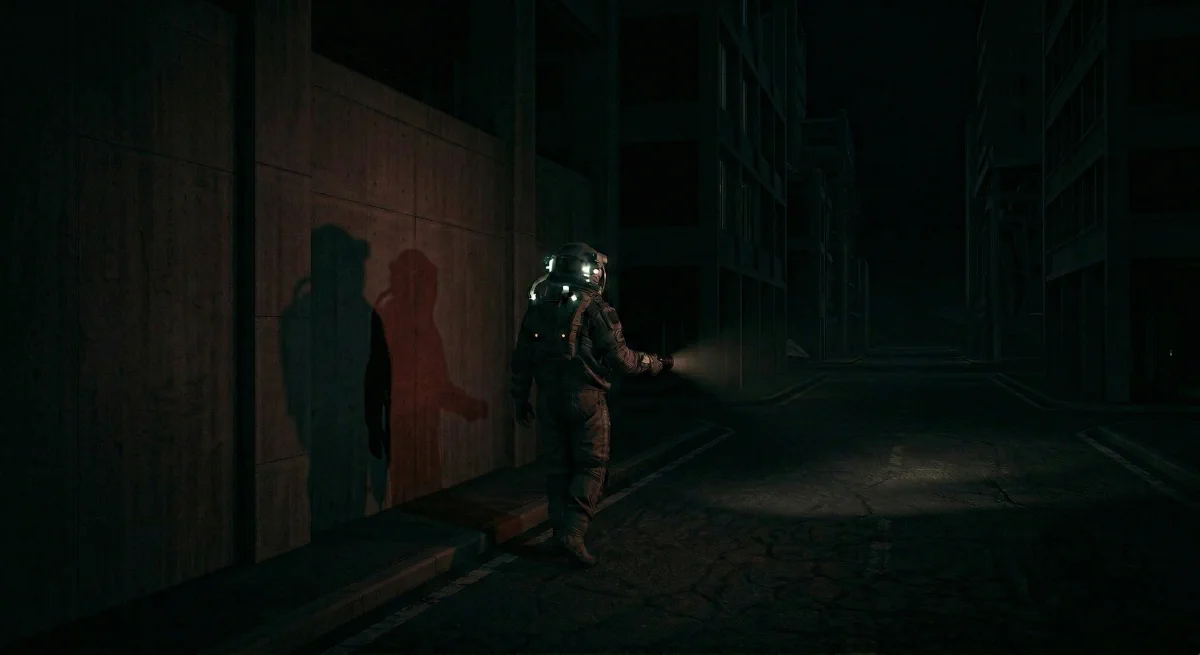
Chapter 2: The Dead City
The city swallowed their flashlight beams.
On the open ground, the light had reached far, cutting clean lines to the horizon. In the streets, it hit surfaces within twenty meters and stopped. The beams pooled in doorways, scattered off curved walls, disappeared into openings that led to interiors Khouri couldn’t see. The effect wasn’t claustrophobic, exactly. The streets were wide enough, built for beings who needed more vertical clearance than humans and who apparently shared the same instinct for navigable space. It was the proximity of the dark that had changed. On the plain, the dark had been at a distance. In here, it started at the edge of each beam.
Yoon kept them in formation. The column adjusted for the tighter space, the two-meter spread compressing to one and a half, Okafor still on point with his methodical sweep. They passed building after building in the first few minutes, all similar in basic architecture: curved walls, the too-tall archways, openings at irregular heights. Some rose two stories. Some climbed to five or six. The scale suggested different purposes (residential, commercial, institutional) without offering enough context to distinguish them. A city was a city. The grammar of habitation was legible even when the vocabulary was alien.
Vasquez’s beam swung up a wall and lingered on a row of openings three stories up. “Balconies,” he said, to no one in particular. “Or windows. Or murder holes. Hard to say with alien architecture.”
“Stay focused, Vasquez,” Morrow said, but without heat.
The first structure Yoon selected was set back from the main street, broader and lower than its neighbors. Two stories. Ground-level archways spaced evenly along the front face, wide enough for the taller inhabitants to pass through in groups. Something about the layout read as public. A market, a gathering place, a hall. Whatever it had been, it had multiple entrances and a visible interior, and Yoon’s choice was practical: clear sightlines, multiple exits.
“Stack up,” Yoon ordered. “Standard clearance, modified for recon. Okafor, lead. Vasquez, follow. Morrow, hold the entrance.”
The squad shifted into entry formation with automatic precision. Okafor moved to the left side of the nearest archway. Vasquez took the right. The rest of the column arranged itself behind them in a sequence that had been drilled into muscle memory.
Khouri hung back. He stood three meters from the doorway, out of the line, unsure where in the formation a xenobiologist was supposed to be. The entry procedure was a language he could recognize but not speak. There was a position for every body in the stack, a role for every person, and no role for the one trained to study what they found inside rather than how they got there.
Vasquez noticed. He always noticed.
He reached back, grabbed a handful of Khouri’s pack strap, and pulled him into position behind Engel: inside the stack, tucked against the wall, part of the sequence.
“This is called ’not standing in the doorway.’ Advanced stuff. You’ll get there.”
Khouri let himself be positioned. Engel glanced back at him and gave a small nod. Welcome to the formation.
Okafor went in.
The interior was dark until their flashlights entered it. No accretion glow here. The walls blocked it entirely, and the space inside was the first true darkness they’d encountered on the planet: pure black until a beam touched it, shadows thrown in a single direction by a single light source. One set of shadows instead of two. The absence of the reddish second set was, for a moment, a relief Khouri couldn’t quite explain.
The room was large, open. A central space with lower platforms at regular intervals, surfaces at what would have been waist height for the taller inhabitants. Counter-analogues, maybe. Display surfaces. The platforms were smooth, bare, empty. Whatever had been on them was gone or had been too organic to survive even the preserving atmosphere.
“Clear,” Okafor called.
“Clear left,” Vasquez added, his beam already probing a secondary space behind a curved interior wall.
“Clear,” came from Tan, somewhere deeper in.
Yoon entered. “Park, log the structure. Khouri, you have five minutes.”
Five minutes. Khouri pulled the scanner from his left side pocket (where Engel had told him it would be, and where it was) and began.
The floor was the same dark material as the exterior paving, seamless, dust-free. The walls curved inward at the ceiling in a way that suggested a load-bearing design different from human construction. Everything was smooth to the touch. No ornamentation, no markings, no visible text or signage. If this civilization had written language, it wasn’t on the walls of this building.
He was recording surface composition readings when Vasquez said, from the secondary room, “Got something.”
The squad went quiet. Not tense. Attentive.
“Remains,” Vasquez said. His voice had shifted. Still Vasquez, still the same man who’d been naming balconies thirty seconds ago, but the performance had dropped out of it. “We’ve got remains in here.”
Khouri went to the secondary room. Engel was already moving.
The flashlight beams converged on the floor. The remains were in the corner, near one of the lower platforms. A figure, seated against the wall, legs extended, one arm resting on the platform surface as if reaching for something when it stopped.
Humanoid. Clearly humanoid. The posture, the proportions, the basic architecture of a body built for bipedal life. But not human. Khouri saw it immediately, the way his training had taught him to see: not as a single impression but as a series of departures from the template his eyes wanted to impose.
The limbs were longer. Not grotesquely, not dramatically, but measurably. Forearms and lower legs that were fifteen, maybe twenty percent longer than human proportions would predict for a torso of that size. The hands (and they were hands, five digits, an opposable grip structure designed for manipulation) were narrower, the fingers longer, the joints articulated at slightly different angles. The skull was the most striking departure. Elongated along the anteroposterior axis, broader at the temporal regions, with a facial structure that flattened where a human face would project. The orbital ridges were deeper, the nasal aperture wider. Not monstrous. Not even ugly. Just different, the way a greyhound’s skull is different from a bulldog’s: built for the same world with different priorities.
The atmosphere had preserved it beyond what Khouri would have expected. Desiccated, yes. The soft tissue had long since reduced to a tight, leathery covering over bone. But the skeletal structure was intact, the posture maintained, the relative positions of every joint still legible. He could read this body like a text. The only problem was that the text didn’t have an ending.
He knelt beside it and began recording.
“Eli.” Engel was beside him, her own scanner out. They’d shifted to first names without either of them deciding to. “What are you seeing?”
“Bipedal, upright, symmetrical body plan. Skeletal structure consistent with a gravity well similar to this one, possibly slightly higher. Long bone ratios different from human, limbs proportionally longer. Five-digit hands with opposable thumb-analogue. Skull elongated, different cranial volume distribution.” He moved his scanner along the torso. “No obvious trauma. No fracture lines, no impact damage, no signs of disease in the bone structure at this resolution.”
Engel leaned in and examined the desiccated tissue at the neck and chest. “No hemorrhaging. No discoloration pattern consistent with toxicity. The tissue preservation is good enough that a pathology should be readable.”
“It should be.”
“And?”
Khouri sat back. “Nothing. I can tell you what this individual looked like, how they were built, roughly how they moved. I can’t tell you what killed them.”
The figure sat against the wall, arm on the platform, in a posture so natural it looked like rest. Like someone who had sat down and simply not gotten up.
They found more.
The next room held three. Seated around a circular surface at the center, objects between them (small, geometric, made of the same dark material as everything else, purpose unknown). Their postures were casual, oriented toward each other. A meeting. A meal. A game. Whatever they’d been doing, they’d been doing it together, and they’d stopped at the same time.
The upper floor held more. A corridor lined with smaller rooms (residential, Khouri thought, based on the sleeping platforms and the personal-scale storage), and in several of them, remains. One in a sleeping posture, curled on its side on the platform. One standing in a doorway, frozen mid-step, leaning forward with the momentum of a walk that never completed. One seated at a surface covered in small objects arranged in a pattern Khouri couldn’t read.
Every one of them had stopped.
Every one of them showed no cause.
Khouri examined three in detail and scanned seven more. Engel examined two. They compared findings in the upper-floor corridor while the squad cleared the rest of the building.
“Same,” Engel said. “All of them. No trauma, no pathology, no observable cause. They just…” She paused. Khouri watched her search for the clinical term and fail to find one. “Stopped.”
“The one in the doorway,” Khouri said. “Mid-stride. The center of gravity was forward. If the body had been placed there postmortem, the balance would be different. That posture is only possible if the individual was alive and moving when it stopped.”
“Instantaneous?”
“Or close to it. Fast enough that the body didn’t have time to compensate.”
Engel was quiet for a moment. Her beam played across the corridor, touching the doorways of the smaller rooms, the remains visible inside each one. “How many so far?”
“Seventeen in this building.”
“Seventeen individuals. No cause of death.”
“Seventeen individuals of a species I’ve been examining for forty minutes.” He heard his own voice and recognized the tone: professional frustration, the careful bitterness of a scientist with data that refuses to resolve into meaning. “I can describe the morphology in detail. I can map the skeletal differences, catalogue the tissue preservation, measure the long-bone ratios. I have a thorough physical description of a species that died without explanation.”
Engel didn’t answer. There was nothing to answer it with.
They left the building and moved on.
The second structure was taller, narrower, residential. The squad cleared it in the same methodical sequence: stack, enter, sweep, clear. Khouri went in after the all-clear and found the same picture in different rooms. Remains on sleeping platforms, in corridors, at surfaces. All in casual postures. All mid-routine. Objects still in hands, positions maintained by the preserving atmosphere.
In one room, a smaller space at the end of a corridor, the platforms were lower and shorter. The remains were smaller. Khouri scanned and recorded with the same precision he’d applied to every other examination, and he kept his observations clinical, because the clinical distance was the only thing keeping his data clean.
The squad moved through more structures as the hours passed. Yoon maintained the protocol: clear, enter, sweep, catalogue. The rhythm became routine. Khouri stopped counting individual remains after the fifth building and started counting buildings instead. Every one held the same picture. Bodies at tables, on sleeping platforms, in corridors. Casual postures, mid-routine arrests, objects still in hand. The same absence repeated room after room until the absence itself became the finding.
Then Calder stopped the column.
She’d been scanning the next structure’s exterior while the squad prepared to enter, her beam tracking the walls and openings with the same ground-reading focus she brought to everything. Her beam paused.
“Sir,” she said. “The windows.”
Khouri looked. The openings on the upper floors (the too-high windows, set for an eye line forty centimeters above his own) were sealed. Not shuttered. Sealed. Material had been applied over them from the inside, a pale substance spread thickly across the openings, blocking them completely. The doorways on the ground level showed the same treatment: the archways narrowed with hastily built barriers, packed in tight, leaving only one still passable, and barely.
“Modifications,” Calder said. “Sealed from the inside.”
Yoon’s beam tracked the ground floor. The barriers were crude compared to the original construction. The same dark material, but applied roughly, in uneven layers, as if speed had mattered more than craft. And on the walls flanking the remaining open archway, something else: a reflective coating, applied in streaks, catching the flashlight beams and throwing them back in flat bright flashes.
“What is that?” Morrow asked.
Khouri stepped closer. The reflective material was applied to the wall surface in broad, overlapping strokes. No pattern. No design. Just coverage, as much as possible, as fast as possible. He ran his scanner across it. Metallic compound, locally sourced (the composition consistent with materials found elsewhere in the city), refined and applied as a coating.
“Reflective,” he said. “Metallic compound. Applied to the surface. Like a mirror.”
“Why would you coat your walls with a mirror?” Park asked. The red indicator on her helmet rig blinked steadily as she swept her recorder across the facade, capturing the sealed windows, the barriers, the reflective streaks. Cataloguing.
No one had an answer.
They went in single file through the one remaining archway. Morrow had to turn sideways. The interior was darker than the previous buildings, the sealed windows blocking even the traces of accretion glow that might have filtered through. Pure flashlight dark. One shadow set.
The remains were inside.
Khouri found the first three in the ground-floor room. Seated against the far wall, close together, postures that suggested they’d been facing the sealed doorway. One had its hands positioned on what looked like a tool, held across its lap.
More upstairs. In every room with a sealed window, remains. The same postures. The same absence of cause. Some near the sealed openings, as if they’d been working on the barriers when they stopped. One was frozen in the act of spreading the reflective coating, the material still on its hands, the streak on the wall ending where the hand had stopped moving.
Khouri knelt beside the figure with the reflective material on its hands and scanned it. Same readings. Same morphology. Same complete absence of pathological cause. He recorded the data, noted the reflective material, noted the posture. Moved on to the next.
Engel crouched beside him a moment later, examining the preserved hands, the coating dried into the creases of the long, narrow fingers. “The urgency is in the application,” she said, her voice low. “Look at the coverage. This wasn’t maintenance. This was a response to something.”
They worked in silence after that. The kind of silence that settles between two people who have reached the same observation and have no framework to put it in.
They came back out into the street. The accretion glow settled on them again, reddish and diffuse, and Khouri’s second shadow stretched from his feet, pointing in its own direction. They’d been in single-shadow darkness for hours. The return of the second set was briefly disorienting, like stepping from a windowless room into afternoon light and finding the world still there, still strange.
Navarro was outside, her attention not on her handheld but on the building’s facade. The sealed windows. The reflective streaks flanking the archway. She’d been studying them while the squad was inside.
“Khouri.” She didn’t look at him. “The accretion radiation drops to zero inside these structures. Completely. The wall material blocks it.” Her gaze tracked the sealed windows, the reflective coating. “And this compound. It’s consistent with deflecting ambient radiation. Improvised. Not original construction.”
“They were trying to block the light,” Khouri said.
Navarro was quiet. She looked at the sealed facade the way she’d looked at her handheld during the walk from the ship: data that should have resolved and hadn’t. The building that someone had locked from the inside, coated in mirrors, and died in anyway.
“I don’t have an explanation for why,” she said. “The radiation at these levels shouldn’t be biologically harmful. Not by any model I have.”
“Your models are built for human biology.”
“The physics is the physics. The intensity at this distance is low. There shouldn’t be a mechanism.”
She stood there. Her handheld hung at her side, screen still lit, and for a few seconds she didn’t look at it. Then she lifted it, checked a reading, and her attention folded back into the numbers. But slowly.
Yoon called a consolidation point at a smaller plaza deeper in the city. The squad gathered under the open sky.
Tan stood at the edge of the group and said nothing. He’d said almost nothing all day. His silence wasn’t notable (Tan’s silence was his baseline) but against the backdrop of what they’d been finding, it fit the city too well.
“Findings,” Yoon said.
Khouri spoke first. It was his role now. The civilian who fumbled his buckle had become the person with the relevant expertise, and the squad had shifted around that fact without anyone announcing it.
“Humanoid species. Bipedal, upright, roughly similar body plan to human but distinct in every measurable dimension. Longer limbs, different cranial structure, different skeletal proportions. They built this city. They lived in it. And they died in it, all of them, simultaneously or near-simultaneously, in whatever they were doing at the time.” He paused. “No cause of death. I’ve examined over forty individuals across multiple structures. No trauma, no disease markers, no pathology. The preservation is good enough that I should be finding something. I’m not.”
“Engel?” Yoon said.
“I concur. Same findings. Same absence of findings. The tissue preservation is consistent with sudden cessation of biological function. Not decay, not disease. Cessation.”
“Navarro?”
“The building interiors block accretion radiation completely. Several structures show modifications consistent with attempts to further reduce exposure: sealed openings, reflective surface treatments. Improvised, not original construction.” She paused. “I don’t have an explanation for why. But the inhabitants considered it worth doing.”
Yoon let the silence hold for three seconds. The silence of a commander absorbing a briefing that doesn’t contain a threat he can plan against.
“We continue,” he said. “Wider survey. Same protocol. We don’t know enough yet to know what we’re looking for.”
The squad reformed. Park swept her recorder across the plaza in one last steady arc before they moved, the red light blinking on her helmet rig. Every room, every surface, every set of remains since the first archway. Cataloguing because cataloguing was the only response available when the data refused to explain itself.
Okafor moved to point. Vasquez fell in beside him, and as they started forward, Okafor reached over and tapped him on the shoulder. Not the open-palm clap Vasquez gave everyone. A tap. The quiet version.
Vasquez had been quieter all day. Not silent (Vasquez was never silent) but his narration had shifted register. Fewer jokes. More inventory. “Another one,” he’d say, entering a room. “Three in here,” moving to the next. He was still filling the silence, but the silence had gotten larger.