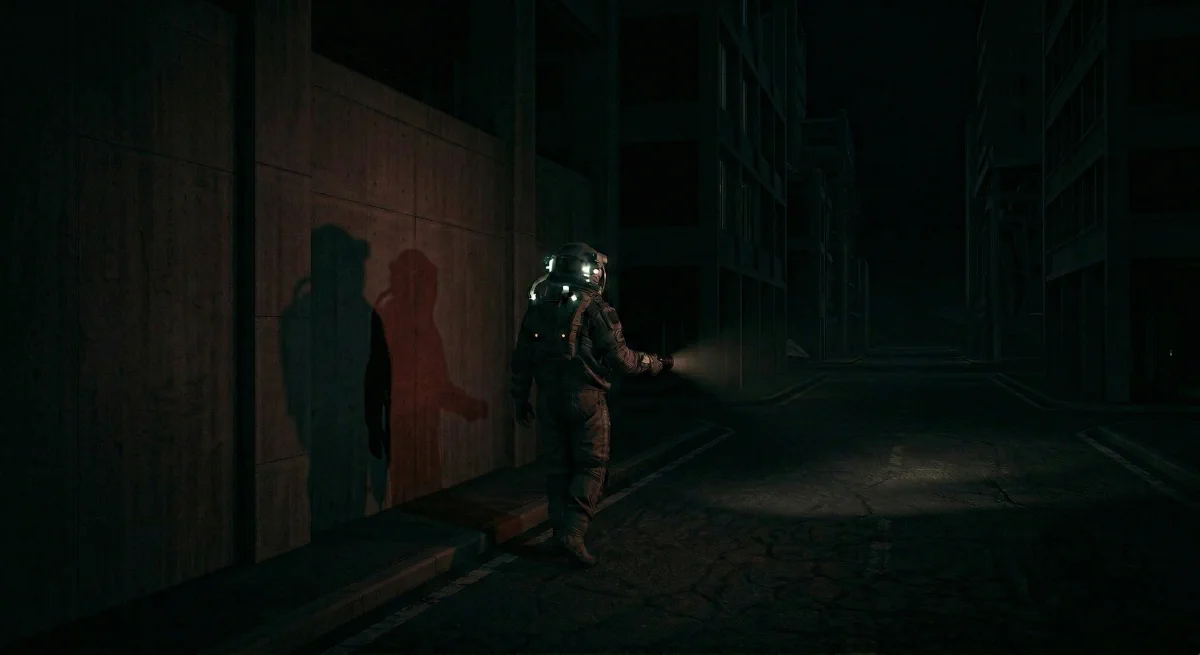
Chapter 3: Disconnection
The sky came back.
They emerged from the last street into a plaza, the buildings pulling away on all sides, and the sky opened above them. After hours inside structures (hunched over remains in the single-shadow dark, clearing room after room where the same absence repeated itself), the open was a physical change. The accretion glow fell into the plaza without obstruction, reddish and diffuse, painting everything the same exhausted color Khouri remembered from the walk to the city. Both shadow sets returned: sharp white from the flashlights, soft reddish from the disk’s glow, stretching from every figure in the squad.
Khouri hadn’t realized how much he’d missed the sky until it was back. The buildings had enclosed everything, focused the attention downward (surfaces, remains, rooms), and the sudden width of the plaza was like stepping from a corridor into a cathedral. Space in every direction. The city’s geometry visible to the horizon. The void above, the ring, the bent river of fire, all of it still there, still wrong, still too large to look at directly for more than a few seconds.
The squad spread into the plaza with the same discipline but different postures. Looser in the open. Okafor’s sweep was steady but his shoulders were lower. Morrow stood with his pack settled rather than cinched. Even Yoon’s scan carried something like ease, the head turning left to right in its practiced arc but slower than the morning, the way a rhythm slows when a body lets its guard down by a fraction. Hours of the same finding in the same dark rooms had worn a groove, and the open broke it.
Vasquez felt it first.
He’d been doing inventory all day. “Another one.” “Two in here.” “Clear.” The narration stripped to function, the performance packed away somewhere behind the flat delivery and the steady beam. But the plaza was different. The sky was different. The open ground and the full accretion glow and the two shadow sets were the conditions from the walk to the city, and something in the return fired the old instinct.
His flashlight beam swung up the face of a building on the far side of the plaza. The restless sweep that had been muted all day inside the buildings came back, the beam jumping and probing the way it had on the open ground, a man who couldn’t stop scanning even when the scanning was just light. He was looking at something on the upper stories, some feature of the architecture, and Khouri saw the shift happen in real time: the shoulders straightened, the posture opened, the performance came back online.
“See that up there?” Vasquez pointed his beam at a row of openings on the third story of the structure across the plaza. The openings were wider than the standard window-analogues, set in a pattern that suggested a continuous space behind them. “That’s a balcony, Doc. Or a terrace. Or a really elaborate way to fall to your death. One of the three.”
Khouri looked up at the openings. Vasquez was already moving, walking backward, his beam still aimed at the upper levels, narrating for an audience of one.
“Notice the spacing. Very deliberate. They wanted a view. Or they wanted to be seen. Hard to say. But that’s either for sitting outside and enjoying the ambience” (he gestured at the accretion glow, the void, the river of fire in the sky) “or for watching what’s happening down here. Given the ambience, I’d pick the second one.”
Khouri almost smiled. The rhythm was back. After a full day of inventory, of “another one” and “three in here” and the silence growing larger room by room, Vasquez had found his register again. The open space had returned it, the way a familiar room returned a familiar posture.
“Vasquez,” Morrow said. Without heat. The same mild correction from the first street, the tone of a man who’d been listening to this for years and didn’t actually want it to stop.
Vasquez turned back toward the plaza, his beam dropping from the upper levels to a cluster of low structures at the near edge of the open space. Squat, broader than the residential buildings, with wide archways at ground level. He pointed.
“Now that, Doc, that’s what we call a—”
Vasquez dropped.
No stagger. No cry. No clutch at chest or throat or head. No warning at all. He was standing, he was talking, his right hand extended in the pointing gesture of the translation bit, and then he was on the ground.
His flashlight hit the paving and rolled. The beam spun in a wide arc across the plaza, catching legs, walls, the dark seamless ground in a strobing sweep. The restless light that had never stopped moving since the ramp lowered, that had probed every surface and chased every shadow, spinning without direction for the first time. Random. The light Vasquez had carried like an extension of his attention, going nowhere.
The silence was physical. It had weight and shape and it filled the space Vasquez’s voice had occupied, and the space was larger than Khouri had realized. Vasquez had been filling it since the first step off the ramp, and the silence where his voice should have been was not empty. It was present. The punchline that wasn’t coming was louder than any sound.
Engel moved first.
She was beside Vasquez in three steps, dropping to her knees, scanner out, hands on his neck. Clinical, fast, the sequence of a medic who had drilled the response past the point of thought. Her fingers found the carotid. Her scanner tracked across his chest.
“Nothing,” she said.
She repositioned her hands. Adjusted the scanner. Ran it again.
“Nothing. No pulse, no neural activity, no cardiac function.” Her voice was steady in the way a voice was steady when the alternative was not being steady. “He’s dead.”
Okafor was standing three meters away. He hadn’t moved.
Yoon’s voice came through the comm, flat and procedural. “Engel, confirm.”
“Confirmed, sir. No vitals. Cessation is complete.” She looked up from the body. Her hands were still on Vasquez’s chest. “No cause. No visible cause. The same presentation as…” She stopped herself. Everyone heard what she didn’t say.
Khouri was looking at the ground.
He was looking at Vasquez’s shadows.
The flashlight on the paving still spun, its beam tracing a slow circle as the roll bled momentum. The white shadows it cast from Vasquez’s body shifted with each rotation, stretching and contracting, sharp and directional. Flashlight shadows. Vasquez’s body had flashlight shadows.
His accretion shadow was gone.
Khouri looked at his own feet. Two shadows. One white, one reddish. He looked at Engel, kneeling beside the body. Two shadows. He looked at Okafor, standing still. Two shadows.
He looked at Vasquez.
One set. The flashlight set. The spinning beam throwing white shapes that wheeled and slid across the paving. The reddish shadow, the soft one, the one cast by the accretion disk’s glow, the one that had stretched from Vasquez’s feet since landing, was not there. The body lay in the full glow of the accretion light and cast one set of shadows where it should have cast two.
“His shadow,” Khouri said.
Nobody responded. The word didn’t register. They were looking at a dead man who had been talking two seconds ago.
“His accretion shadow is gone.”
Engel looked up. Her gaze went to the ground around the body, then to the ground around her own knees. Two shadows under her. One shadow under Vasquez. The clinical part of her mind caught it before the rest did. Her hands stopped moving.
“Perimeter,” Yoon said. “Now. Everyone in tight. Morrow, Calder, cover.”
The squad closed around the body. Training held, the automatic response to threat, but the threat was nothing anyone had drilled for. Cover which direction. Watch for what. The movements were right but the purpose was wrong.
“We need to get inside,” Calder said. Her beam was already tracking the nearest building, the nearest doorway. She’d been mapping exits since the first plaza. “Sir. We need to get off the open ground.”
Yoon looked at the body. At the plaza. At the open sky and the accretion glow falling over everything.
“Move him. Nearest structure with a solid interior. Go.”
Okafor and Morrow lifted Vasquez. Okafor took the shoulders without a word. His face was visible through the visor and there was nothing on it. A man whose body was performing a task while whatever was behind the face had shut down.
Tan held the doorway of the nearest building (wide archway, two stories, same dark material and smooth curves). The squad went through in a sequence that was faster and rougher than the practiced stacks of the morning. Inside, the accretion glow cut off. The walls blocked it completely, the same way they’d blocked it in every structure since the first. Pure flashlight dark. One shadow set. The relief Khouri had felt in the first building, hours ago (the absence of the reddish second set, briefly welcome, briefly unexplained), returned as something else. Not relief. Shelter.
They put Vasquez down in the center of the ground-floor room. Flashlights converged on him from multiple angles, throwing overlapping white shadows across the floor. One set from each light source. The normal physics of a body under multiple lamps.
Okafor stood at the edge of the light and said nothing.
Engel knelt beside the body again. She ran every scan she had. Khouri watched her work and saw the same examination sequence she’d applied to the alien remains all day: the same methodical progression through vital checks, tissue readings, neural scans. She was looking for the thing she hadn’t found in forty examinations of a dead civilization, and she wasn’t finding it in Vasquez either.
“Same,” she said. Her voice had gone flat. The clinical steadiness from the plaza was gone, replaced by something worse: precision without affect. “The same presentation as the inhabitants. Sudden cessation of biological function. No trauma, no pathology, no observable cause.” She sat back on her heels. “He just stopped.”
The room held the silence the way the buildings held the dark: completely.
“Park,” Yoon said. “Footage.”
Park had been standing near the back of the room, the red indicator on her helmet rig blinking. Recording since the city’s edge. Seven structures of footage from the day’s exploration. And whatever her camera had captured in the plaza.
She pulled the display from her rig and held it where the squad could see. Her fingers moved across the controls with the same precision she’d brought to every catalogue entry, every surface scan, every steady arc of the recorder. The footage rewound.
The plaza appeared on the small screen, seen from Park’s helmet angle. The squad spread across the open space. Two shadow sets visible on every figure. Accretion glow painting everything reddish. Vasquez walking, beam sweeping up the far building, the pointing gesture, the turn back toward the low structures.
Park slowed the playback.
Frame by frame.
Vasquez mid-sentence. His right hand extended. His body leaning forward into the next step. His white flashlight shadow and his reddish accretion shadow both stretching from his feet across the dark paving.
Next frame. The reddish shadow shifted. Not the way a shadow shifts when a body moves. It moved independently. A lateral separation so small it could have been a compression artifact, a trick of the light, anything.
Next frame. The separation was wider. The reddish shadow was no longer attached to Vasquez’s body. It stood beside him, offset by half a meter, still shaped like him, still oriented in the same direction.
Next frame. Vasquez was falling. His body had started the collapse, the legs buckling, the weight going forward. The reddish shadow was not falling. It was standing. It was completing the step Vasquez had been taking. The shadow’s right foot was forward, planted, bearing weight that shadows don’t bear.
Next frame. Vasquez was on the ground. The flashlight was rolling. The reddish shadow was walking. Upright, steady, crossing the plaza with the stride of a figure that had somewhere to be. It did not look back.
Park let the footage play forward at half speed. The shadow crossed the plaza in a straight line. Past the low structures. Past the columns of reddish light between buildings. At the far edge of the frame, it joined other shapes moving in the accretion glow. Other reddish shadows, walking, standing, going about routines in the dim light that the squad’s flashlights had been drowning out since they arrived.
Park stopped the footage.
Nobody spoke.
Park rewound to the wide shot of the plaza. The full frame, showing the open ground and the buildings on every side and the squad in the center.
“I counted the accretion shadows,” she said. Her voice was flat. The precision of a cataloguer applied to something no catalogue was built for.
She paused. The screen held the frozen frame: the plaza, the buildings, the reddish glow, the shapes on the ground.
“Forty-seven.”
The number sat in the room.
“There are ten of us,” Park said. “There were ten of us. Forty-seven accretion shadows in the frame.”
Calder spoke first. “How many before we entered the plaza?”
Park checked. Rewound further. The street approaching the plaza, the column in formation, the buildings close on both sides. She counted.
“Twelve in the approach street. The ten of us and two others.”
Before the plaza. Before the death. Two shadows that hadn’t belonged to anyone in the column, walking beside them since the street.
“Two others,” Navarro said. She was standing near the wall, her handheld at her side, the screen dark. She hadn’t touched her instruments since Vasquez dropped. The physicist who lived in numbers had stepped away from them.
“The radiation at these levels shouldn’t be biologically harmful,” she said. “I said that. This morning. The physics is the physics. The intensity at this distance is low.” She was looking at Park’s screen. The forty-seven shadows. “There shouldn’t be a mechanism.”
Nobody answered. The footage held its frozen frame. Forty-seven shadows on the paving, thirty-seven of which belonged to nothing the squad could see. The number didn’t explain what had happened. It didn’t tell them how or why. It just made the scope of it visible.
The sealed buildings. The reflective coating. The figure frozen mid-application, hands still covered in the metallic compound. They’d been trying to block the light.
Yoon stood at the center of the group. The same command posture from every briefing, every formation call since the ramp lowered. But he was looking at Park’s screen the way he’d looked at the findings at the consolidation point: the face of a commander absorbing information that didn’t contain a threat he could plan against. Except now it contained a body.
“We hold here,” he said. “No one goes outside. Artificial light only. Park, I want every frame of footage from today reviewed. Every shadow counted. Navarro, I want a model for what we just saw. Engel, full examination of Vasquez. Khouri, assist.” He paused. The pause of a man reaching for the next line of protocol and finding the page blank. “We stay inside. We stay lit. We figure out what this is.”
Okafor hadn’t moved from the edge of the light. He stood where he’d stood since they’d put Vasquez down, and his silence was not the silence of Tan (who was also silent, who had been silent all day, who was now pressed against the far wall with his flashlight aimed at the floor and his face unreadable through the visor). Okafor’s silence was the shape of something missing. The space beside him, the space Vasquez had filled since they’d been paired, the space where the voice and the restless beam and the open-palm shoulder clap had lived, was empty. Okafor stood at the edge of it and said nothing, and his face through the visor showed nothing, and that was worse than anything he could have said or shown.
Khouri sat against the wall. His flashlight lay on the floor beside him, beam angled at the ceiling. One shadow stretched from his body across the dark surface. The flashlight shadow. The only kind that belonged to the light source you could point and control and turn off.
Through the archway, past Morrow’s silhouette where he’d positioned himself facing out, a strip of the plaza was visible. Reddish glow on dark paving. And in that strip, shadows passing. Reddish shapes, soft-edged, upright, moving at the pace of routine. Walking. The way anything walked that had somewhere to be and no reason to hurry.
Forty-seven.
He watched them until Morrow shifted his weight and the strip narrowed to a sliver. The shapes still moved through it. The reddish light that cast them did not care who was watching, and it did not stop.