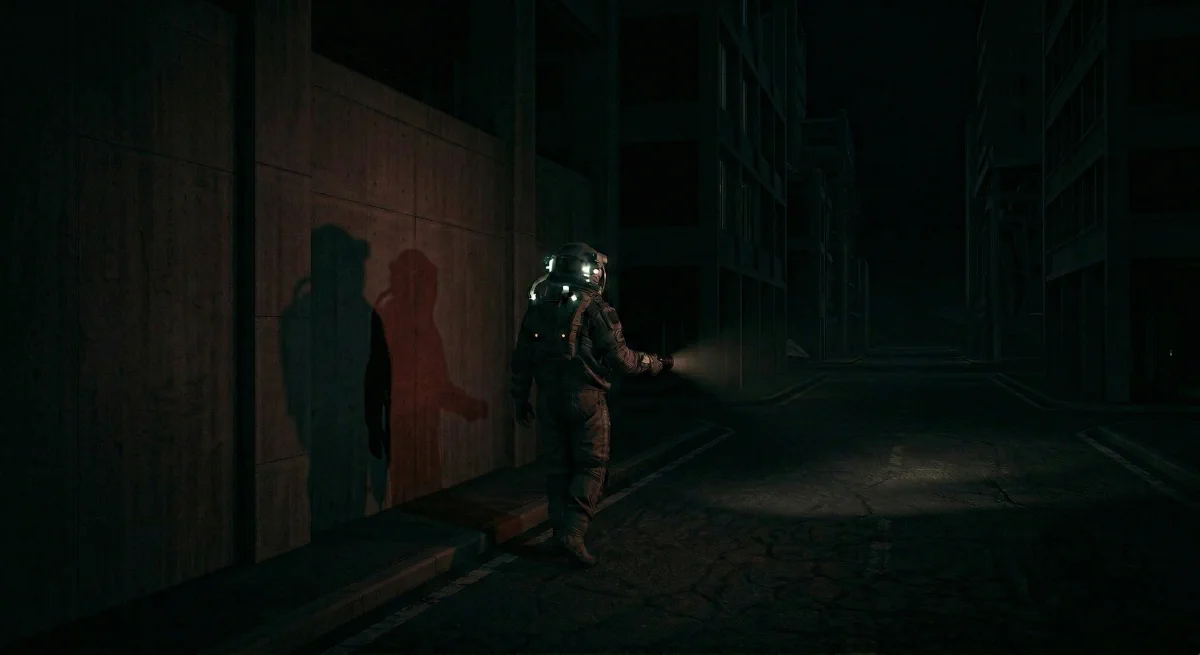
Chapter 4: The Writing on the Wall
Engel started with the hands.
She’d done a field check in the plaza (the emergency vitals, the scanner across the chest, the pronouncement that had taken two tries to believe). Now, under the controlled light of the shelter, she ran the full examination. Vasquez lay on the floor where they’d placed him, three flashlights arranged around the body in converging beams, and Engel worked her way from extremities to center, systematic, the same progression she’d applied to forty alien remains in the buildings outside.
Khouri knelt across from her. His scanner read what her scanner read. Different instruments, different training, same data. The convergence was the point: two disciplines confirming the same absence.
The hands showed nothing. No discoloration, no vascular collapse, no cellular disruption. She moved to the forearms, the chest, the neck. Her scanner tracked the cardiac tissue, the neural pathways from brainstem to cortex, every system that should indicate the mode of failure. Each one was intact. Structurally complete, functionally inert. The heart hadn’t failed. The brain hadn’t hemorrhaged. The lungs hadn’t collapsed. The body hadn’t died of anything. It had stopped being alive.
“Identical,” Engel said. She didn’t need to specify to what. They’d both examined the remains. The same presentation across species, across what might be centuries, across a gulf of biology that should have made a common cause of death impossible. “Eli. Whatever killed them killed him.”
Khouri set down his scanner. He’d been forming the observation for hours, since the first examination in the first building, and Vasquez’s body had confirmed it.
“The bodies don’t show function failure,” he said. “They show function absence. Every system is structurally intact. Nothing broke. Nothing was attacked. The coordination that makes tissue alive, the thing that distinguishes a person from the molecules that make up a person, that’s what’s gone. Not degraded. Not damaged. Absent. As if it was removed.”
Engel looked at him across Vasquez’s body. Two colleagues on either side of a finding they wished they could disprove.
“Removed how?” she said.
He didn’t have an answer.
She nodded once and began documenting the findings on her scanner.
Around them, the shelter held its dark.
Yoon had divided the nine of them between security and investigation. Morrow stood at the main archway facing out, the same position he’d held since they entered, his silhouette blocking most of the reddish glow that leaked past the edges. Calder had taken a secondary corridor that led deeper into the building’s interior, her beam sweeping the passage at intervals. Okafor sat near the archway with his weapon across his knees, eyes on the middle distance, present in body. Tan was at the far wall, flashlight aimed at the floor, contained and still.
Park worked at the back of the room. Her display showed footage running at quarter speed, the red indicator on her helmet rig blinking as she scrolled through hours of recordings. Counting. Every frame, every shadow, every structure since the city’s edge. The data Yoon had ordered was building into something, though Park hadn’t said what yet.
Navarro sat apart from both groups, her back against a column, her handheld the only non-flashlight glow in the space. She was running numbers. Khouri watched her expression in the screen light: focused, cycling through frameworks the way a locksmith cycles through keys. Trying each one. Discarding it. Trying the next. Accretion radiation measurements (the zero inside structures, the full exposure outside), the sealed buildings, the reflective coatings, Park’s shadow counts. The data had to fit something. She was looking for what.
Engel finished her documentation and stood. “I want to check the seals,” she said. “The secondary corridor. If we’re relying on the walls to block accretion radiation, I want to know the walls are solid.”
It was the kind of practical thinking Engel brought to everything. Check the equipment. Verify the assumptions. Make sure the safety is where you think it is.
“Take a light,” Khouri said.
“I have a light, Eli.” A half-smile, barely visible through the visor. Then she walked toward the secondary corridor, her beam tracking the walls, and turned the corner, and was gone.
Khouri couldn’t have said how much time passed. He was processing the examination data, cross-referencing Vasquez’s readings with the alien remains, building the case for information absence as the common finding. Navarro’s handheld cast its glow. Park’s footage scrolled. The flashlights held their positions. The shelter was a lab, and the lab was quiet, and the quiet was the sound of people working a problem because working was the only thing left.
He looked up and Engel wasn’t back.
He checked the time on his scanner. She’d been gone too long for checking seals.
He didn’t announce it. He picked up his flashlight and walked toward the secondary corridor.
The corridor was narrow. The same dark material, the same smooth curves, the same too-tall proportions as every other interior space in the city. His beam reached ten meters before the corridor turned. He followed it.
Around the corner, Engel was on the floor.
Her flashlight lay beside her, still on, beam pointing at the ceiling. The light made a circle of white on the smooth surface above. She was on her side, one arm extended, the posture of someone who had been walking and wasn’t anymore. The particular stillness of a body that had stopped being a body.
He knew before he knelt. He knelt anyway and pressed his scanner to her neck and the readings were the same readings he’d been taking all day. No pulse. No neural activity. No cardiac function. Cessation. Complete.
Same as the inhabitants. Same as Vasquez.
He ran the full scan. The same progression she’d used on Vasquez an hour ago: extremities to center, each system checked, each finding logged. His scanner tracked the cardiac tissue, the neural pathways, the brainstem activity that should have been there and wasn’t. Structurally intact. Functionally absent. The forty-second body he’d examined on this planet, and the first one whose scanner had been next to his all day, whose readings he’d been cross-referencing, whose voice on the private channel had said his name over the data the way you said a colleague’s name when the work was the thing that connected you.
He set his scanner down. The corridor was quiet. Engel’s flashlight held its circle on the ceiling, a white eye on the dark surface, steady and pointing at nothing.
Then he looked up.
Above the corridor, where the interior wall met the exterior wall near the ceiling, a thin line of reddish light seeped through. A seam, a junction between wall sections that had shifted by millimeters over centuries, opening a gap no wider than a finger. The accretion light outside, constant and patient, had found it and entered.
A narrow stripe of reddish glow fell across the corridor floor. Engel’s body lay at the edge of it. In that stripe, her body should have cast a faint reddish shadow. It didn’t.
She had come to check the seals. The seals had not held.
He told them. He stood in the main room and said, “Engel is dead,” and the words were flat and the room was flat and nothing in the sentence surprised anyone and that was the worst thing about it. He told them about the gap, the seam where the wall junction had shifted, the thin line of reddish light that nobody had known was there.
Yoon sent Morrow and Calder to seal it. They packed the gap with equipment cases and fabric, blocking the thin stripe of light until the corridor was dark again. One shadow set.
Nobody moved Engel.
Khouri went back to his data. He didn’t go back to the corridor. The scanner on Engel’s belt held her examination files, Vasquez’s readings, the documentation she’d completed before she went to check the seals, and he pulled the data onto his own scanner and kept working because working was the thing she would have done and stopping would mean the room was different now in a way that working could keep at the edges.
He worked. Her documentation was on his screen now, her notations alongside his, the shorthand she used for negative findings that he’d learned to read across forty examinations. He started a new recording. “Subject forty-three, scan cross-reference with” and his voice stopped. His hand was shaking. He watched it shake the way he’d watched clinical signs all day, noting the tremor, the frequency. He set the scanner down and pressed both hands flat against the floor until they were still. The private channel was silent. The space across from him, where she had knelt over Vasquez’s body, where she had said “Eli” the way a colleague says a name they’ve earned, was empty. He picked the scanner back up. He kept his attention on the data and didn’t look at it. He worked.
Navarro worked. Park counted.
Navarro came to him later. She crossed the room and sat beside him and held her handheld where he could see the screen.
“I have a framework,” she said. “I need your biology to confirm it.” She paused. “I don’t know how to say this without it sounding insane.”
“Tell me.”
She started, stopped. Pulled up radiation measurements on her screen. Spectral data, energy levels, spatial distributions. Closed the display. Opened it again.
“The accretion light,” she said. “It’s not just illumination. The spacetime here is warped enough that the radiation passing through it picks up encoding properties. It carries information.” She looked at him. “It writes.”
“Writes what?”
“Everything. Physical structure. Neural patterns. The organized information that constitutes a living system.” She was watching his face. “You know the holographic principle?”
Distantly. A theoretical framework at the edges of graduate physics. “Information on a boundary surface. The idea that a three-dimensional space can be described by its two-dimensional boundary.”
“That’s the clean version. The version that lives in textbooks and stays there because nobody has spacetime curved enough to make it operational.” She pulled up another display. “Here, we do. Near this black hole, the curvature is extreme enough that the principle isn’t theoretical anymore. It works. At macro scale.” She stopped. “It shouldn’t. Every model I have says this is a quantum-scale phenomenon. The math is written for ordinary spacetime, for event horizons, for conditions nothing like a planetary surface. But the radiation data doesn’t match my models. It matches the principle.”
Khouri looked at the readings on her screen. “So the light is irradiating them. Like a toxin. Cumulative exposure until the tissue fails.”
“No.” She shook her head. “That’s what I thought at first. But there’s no tissue damage. You’ve seen it yourself. The bodies are intact. Every system structurally complete.” She leaned forward. “It’s not destroying anything. It’s copying. Every second the accretion light falls on a three-dimensional body, it encodes that body’s information onto the two-dimensional shadow the light casts. Progressively. Cumulatively.” She let the word sit. “The shadow becomes a more complete information record of the person than the person is.”
Khouri sat with it. The bodies he’d examined. The intact systems. The absent coordination. The thing he’d told Engel: not degraded, not damaged, removed.
“And at the threshold,” he said.
“The shadow has more of you than you do. The body doesn’t have enough organized information left to function. It compensates for partial loss until the process of compensating runs out of information to run on, and then everything stops at once. Not because something attacked it. Because there’s not enough of it left to be alive.”
The mechanism. Every second in the accretion light counted. None of them could be taken back.
“The shadows in the footage,” Khouri said. “Walking. Going about routines.”
“Because they are the people. Informationally. The neural patterns that produced those routines are encoded in the shadow. The shadow continues because it has the information. The body stops because it doesn’t.”
Khouri looked across the room. The flashlights. The walls. The shelter that worked by blocking the light, that had worked for every second they’d been inside, except for the seam in the corridor where the light had found a gap no wider than a finger and had been enough.
“The inhabitants,” he said. “The sealed buildings.”
“They knew,” Navarro said. “They understood something. They tried to block it.”
They sat with that. Two civilians in a dark room, the only people in the squad who could read both halves of the evidence, and between them the full picture: the light writes people onto their shadows, and the writing is permanent, and the math only moves in one direction.
They presented it together. Two civilians standing in the center of the room, the squad’s flashlights angled inward, every remaining face turned toward them.
Khouri went first.
“Vasquez and Engel died the same way the inhabitants died. Same presentation across species, across centuries. The bodies are structurally intact. Every organ, every system, everything that should indicate a cause of death shows nothing.” He paused. “What’s missing isn’t function. It’s information. The organized patterns that make tissue alive rather than dead. In every body I’ve examined, that information is absent. Not degraded. Not damaged. Removed.”
Navarro stepped forward.
“The accretion light is the mechanism.” She held her handheld up, the screen showing the radiation data. “Near a supermassive black hole, the curvature of spacetime allows the holographic principle to operate at macro scale. The accretion radiation doesn’t just cast shadows. It encodes. Every second of exposure transfers the body’s three-dimensional information onto the two-dimensional shadow. Physical structure, neural patterns, everything. Cumulative. Irreversible. At a threshold, the shadow contains more information than the body. The body stops.”
Silence. The kind of silence that settled when a room of trained people absorbed something they couldn’t train against.
Calder spoke first. “We’re inside. The walls block it.”
“Yes.”
“Then how did Engel die?”
“A gap in the wall seam. The light found a way in.” Navarro paused. “The inhabitants sealed their buildings. Coated them in reflective material. Blocked every opening they could find. The light found ways in there too.”
“Can we calculate exposure?” Yoon asked. The same flat tone, but the question beneath it was different from any he’d asked before. Not how do we proceed. How much time do we have.
“I can estimate,” Navarro said. “With Park’s shadow data and our time logs. But the threshold is unknown. I don’t know what the inhabitants’ threshold was. I don’t know if ours is the same.”
“Every minute we spent outside,” Morrow said. He hadn’t moved from the archway. The sentence came over his shoulder. “From the ship to the city. In the streets. The plaza.”
“All of it counts,” Navarro said.
The room absorbed it. Khouri watched the crew calculate, each of them running the same arithmetic in their heads: the walk from the ship (twenty minutes in open accretion light), the streets and plazas (hours of movement where the glow reached between buildings), the transit from structure to structure. The interiors had been safe. The transit between them had not. Every door they’d walked through, every open space they’d crossed, every moment the sky had been visible.
Calder was looking at Yoon. The pragmatist calculating. The field officer who’d pushed to get inside now running the distance back to the ship: how far, how long in the open, how much more exposure.
“So the inhabitants knew,” Park said. She had stopped her footage. The screen was dark. Her voice carried the flatness of someone stating a conclusion rather than asking a question. “They understood the mechanism. They sealed their buildings. They tried to block the light.”
“Yes,” Khouri said.
“And they died anyway.”
Nobody answered.
Khouri looked at the corridor entrance. Morrow and Calder had packed the gap with equipment cases and fabric, blocking the seam the way the inhabitants had sealed their windows: with whatever was at hand, as fast as possible. The same response, centuries apart.
Engel had crouched beside the figure in the sealed building, the one with the reflective compound dried into the creases of its long fingers. “This wasn’t maintenance,” she’d said. “This was a response to something.”
Now they knew what. And Engel was in the corridor with the same nothing in her body, and the gap was packed with the same urgency, and understanding had been the difference between dying informed and dying ignorant, and that was all the difference it was.