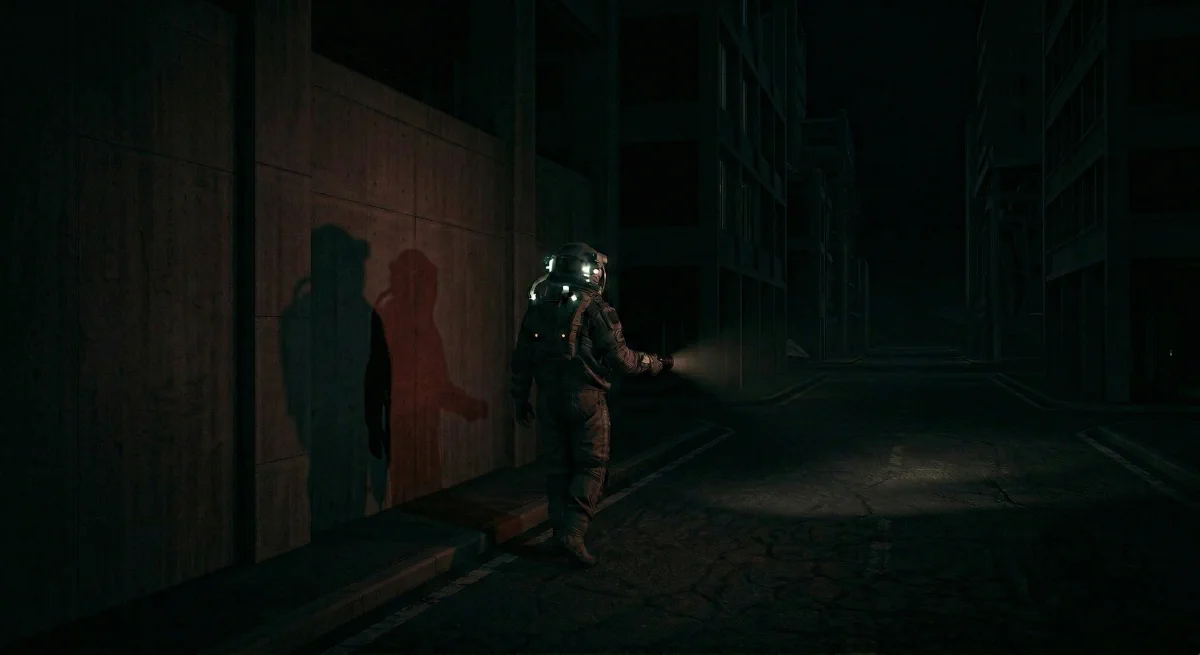
Chapter 5: Exposure
Nobody slept.
The mechanism was understood. The walls blocked the light. The sealed corridor gap was packed with equipment cases. The shelter was dark, one shadow set, and everyone in it knew exactly what was outside and exactly what it did and exactly how much of it they’d already absorbed. Nobody slept.
Khouri watched the room the way he’d watched the squad since the ramp lowered: from the near-outside, noticing what the people inside the circle didn’t notice about themselves. Eight people carrying the same knowledge, and each carried it differently.
Navarro sat at her column with her handheld, running calculations. Not the investigation anymore. The investigation was done. This was estimation: exposure logs, cumulative figures, threshold approximations that might or might not resolve into something useful. Park leaned in at intervals, murmuring figures from her shadow counts, her display still scrolling footage. The physicist and the cataloguer had built a working partnership in the hours since the presentation, numbers flowing one way and data the other.
Yoon maintained protocol. Watches, rotations, perimeter checks. The structure of command applied to a room where the only threat was outside the walls, and the walls were handling it, and there was nothing else for command to do. He paced at intervals, checked positions, gave orders that everyone followed because following was easier than sitting still.
Calder sat against the far wall and didn’t pace. She watched Yoon. Her beam stayed low, the same ground-reading focus she’d had since the walk from the ship, but there was no ground to read in here. She was calculating something else.
Okafor hadn’t moved. The same position near the archway, weapon across his knees, eyes on nothing. Whatever had been behind his face since the plaza was still behind it, deeper now, the kind of absence that becomes its own presence when it goes on long enough.
And Tan was at the wall.
Khouri had been watching him without deciding to. Tan’s posture had changed since the presentation. He was still at the far wall, still in the contained stillness that was his baseline, but he wasn’t still anymore. His left hand moved. Slowly, deliberately, he extended it into his flashlight beam and watched the shadow it cast on the floor. The flashlight shadow responded instantly, tracking each movement with the precision of optics.
Then he shifted. Along the wall, toward the main archway, where Morrow stood facing out, where traces of reddish glow leaked past the edges of Morrow’s silhouette. In that thin band of leaked light, near the archway’s edge, a second shadow was visible. Faint. Reddish.
Tan extended his hand again. Two shadows fell from his fingers: one sharp and white from his flashlight, one softer and dimmer from the accretion glow. He moved his hand. Both followed. He curled his fingers. Both responded. He held still. Both held.
He did it again.
And again.
Khouri saw Park glance up from her display, note Tan’s position near the archway, and look back down. Navarro’s gaze tracked sideways, held for a second, returned to her screen. Everyone in the room could see what Tan was doing. The question he was asking with every repetition was the question nobody would say aloud.
“I’m going to scout the route back to the ship,” Yoon said.
The room shifted. Not the silence of agreement. The silence of objections forming.
“Short excursion. Nearest streets to the open ground, confirm line of sight, then back. Morrow, with me.”
Morrow looked at him. Not the instant acknowledgment of the first days. A beat. A half-second where the spine of the squad assessed the order before following it.
“Yes sir.”
“Captain.” Calder’s voice was level. “We know where the ship is. Every second outside is cumulative and irreversible. Your words.”
“We need to know the route is clear. I’m not running blind when we leave.”
“When we leave,” Calder said. Not a question. A marker.
“When we leave.”
Calder held his gaze. Then she looked away. Not acquiescence. Calculation.
Yoon and Morrow moved to the archway. The blocking material was pulled aside, the reddish glow spilling into the first meter of the room before the dark absorbed it. The accretion light. The same patient glow that had painted everything since they landed. Two figures stepped through and into it, and two shadow sets appeared at their feet. They moved up the street, and the reddish light held them, and they were gone.
The archway stayed open. Accessible for their return.
Khouri was reading his data when it happened. The same readings. The same absence. The screen was a place to look that wasn’t the archway, and he looked at it because looking at the archway meant watching the thin band of reddish glow that leaked through it and thinking about what every second of that glow was doing to the traces it touched.
He looked up.
Tan was not at the wall.
His gaze swept the room. Navarro at her column. Park at her display. Calder at the far wall, already half-risen. Okafor at his position. The archway, open, reddish glow leaking in.
Tan was outside.
Khouri reached the archway in four steps. Okafor was at its base, weapon across his knees, facing the plaza. He had watched Tan walk past him and had not moved.
The plaza opened beyond the archway, dark paving under the accretion glow, and Tan was twenty meters out. Walking. Not running, not stumbling. Walking with the contained, measured gait that had been his gait since the ramp lowered, the gait of a man who occupied exactly the space his body required and no more. His flashlight was off. He carried nothing. He walked into the accretion light the way you walk toward something you’ve already decided about.
Two shadow sets stretched from his feet. One long and faint from the shelter’s light behind him. The other reddish, softer, cast by the accretion glow, falling ahead of him toward the far side of the plaza.
The reddish shadow slid.
The same lateral shift Khouri had seen on Park’s footage of Vasquez. The separation. The shadow moving independently, stepping ahead, disconnecting from the body with the smooth inevitability of something that had been coming since the first second of exposure. It kept Tan’s gait. It kept his posture. It walked the way Tan walked, contained and exact.
Tan crumpled. Mid-stride, the body going down the way every body on this planet went down: sudden, total, silent. He hit the paving and didn’t move.
The shadow kept walking. Across the plaza, steady, unhurried, joining the shapes that moved in the reddish glow at the edges of Khouri’s vision. One more figure among the others. At a distance, in silhouette, indistinguishable.
Tan lay on the dark paving in the accretion glow. His body cast no reddish shadow.
Khouri stood in the archway and did not go to him.
He told them. Tan is dead. Walked out. Shadow disconnected. The words carried less each time he spoke them, not because they meant less but because the form was becoming routine, and routines didn’t carry weight.
Nobody went to retrieve the body.
The question formed without anyone asking it. Khouri could see it on every face that wasn’t Okafor’s (Okafor’s face was the same absence, the same elsewhere). Calder looked at Park. Park looked at Navarro. Navarro looked at the archway where the reddish glow still leaked in.
Tan had been checking his shadow. They’d all seen it. The hand extended, the fingers curled, the repetition near the archway where the accretion light leaked through. If he’d seen the lag, if he’d known his threshold was close, he’d said nothing. He’d walked out without a word, the same way he’d done everything: contained, silent.
And if Tan had known and said nothing, the question was no longer what was outside the walls. The question was what was happening inside the people beside you.
Khouri caught himself looking at Okafor’s hands. At Calder’s flashlight. At whether anyone else was watching the thin band of reddish glow at the archway’s edge the way Tan had been watching it.
Everyone was.
Morrow appeared in the archway first. He came through fast, beam sweeping the room in the automatic scan of a man returning to a secured position. His gaze found Khouri and held for a beat longer than debrief required. He’d passed through the plaza. He’d seen Tan.
Behind him, Yoon.
Yoon stopped in the archway. The reddish glow that spilled past the edges fell across him, and two shadow sets stretched from his feet into the room: the sharp white from the flashlights inside, the soft reddish from the accretion light behind. He stood facing the squad, weapon slung, the posture of a commander reporting back.
“Route is clear,” he said. “Last street opens directly onto the plain. Line of sight to the ship. Distance is approximately one point—”
He stopped.
Not a pause. Not a hesitation. Not the trailing off of a thought losing its thread. His voice ceased the way a signal ceases when the transmitter is switched off. His body settled forward and down, folding at the knees, going to the floor.
His accretion shadow didn’t follow. It stayed standing in the reddish fringe of the archway. Upright. Facing the room. The posture of a man still reporting to a squad that was looking at the body on the floor.
Morrow turned. “Sir.”
Nothing.
“Captain.”
Khouri was already moving. He knelt and pressed his scanner to Yoon’s neck and pulled it away before the display finished loading. He didn’t need to read it. The readings had become the only finding this planet offered.
Yoon’s shadow stood in the archway. His body lay at its feet. The report delivered. The mission successful. The route clear.
Morrow stood over him and said nothing for a long time.
Calder stood.
She looked at the room. At Morrow, still standing over Yoon. At Okafor, who hadn’t moved, whose face showed the same nothing it had shown since the plaza and who might never show anything else. At Park, whose display was dark and whose hands were still. At Navarro, whose handheld glowed in her lap with the calculations she’d been running for hours. At Khouri, who was the one who checked the dead because there was no one else left to do it.
The transition was so immediate it seemed like it had already happened, like Calder had been in command since the moment she’d pushed to get inside and everything since had been confirming what everyone already knew.
“We’re running for the ship,” she said.
Not a question. Not a vote. A statement from the person in charge, and she was in charge because she was the person who had been right at every step, and right was the only qualification that still meant anything.
Morrow turned from Yoon’s body. His attention shifted to Calder with the wordless realignment that had held the squad together since the first day. The spine followed the commander. The commander had changed. The spine adjusted.
The room held six people and two bodies. The corridor held one. The plaza held one. The light outside held everything.
“Everyone,” Calder said. “Now.”
Navarro stopped her.
“Not yet.”
Calder was facing the archway, her body carrying the momentum of a decision that wanted to become distance. Navarro’s voice caught it.
“We need the numbers first.”
The room held. Six people, two bodies. In the archway, standing in the reddish fringe of accretion light that leaked past the edges, Yoon’s shadow. Upright. Facing inward. The posture of a captain still reporting to a squad that had moved on without him.
Calder turned back. She looked at Navarro, and whatever she read there made her stop. Not deference. Arithmetic. Running without knowing who could survive the run was not running.
“How long?”
“Ten minutes.”
Park’s display came back on. Timestamps, shadow counts, exposure logs from every minute since the ramp. Navarro pulled the data and started running it, and the room went quiet in the way a room goes quiet when the only thing left to do is math.
Khouri watched them work. Park murmured figures. Navarro ran them. The physicist and the cataloguer, heads together over their screens, building the instrument nobody wanted to use. The partnership that had been growing for hours (numbers flowing one direction, data the other) converging into a single output.
Navarro looked up.
“Cumulative exposure for each of us,” she said. “Time logged outside shelter since landing. Walk from the ship. Streets. Plazas. Transit between structures.” She paused. “The threshold is approximate. Four data points, two species, wide confidence interval. But the relative ordering is clear.”
She didn’t stand. She sat at her column with the handheld in her lap and gave the numbers the way she’d given navigation bearings on the walk from the ship: precisely, without inflection, as if the figures were coordinates rather than verdicts.
Khouri watched people receive their numbers.
He had the most margin. He heard his estimate and understood it as fact before he understood it as meaning. The hours inside buildings, bent over remains under artificial light while the squad patrolled the streets outside. The time apart. Always inside. Always alone in rooms where the walls blocked everything. His exclusion from the circle showing up in Navarro’s model as distance from the threshold, and the widest distance in the room.
Calder had margin. She heard her number and her expression didn’t change. Every decision she’d made since Vasquez had minimized time in the open. The numbers confirmed what her instincts had already calculated.
Okafor’s number was closer. He didn’t look up. It went behind the same absence on his face where everything had been going since the plaza.
Morrow heard his. His shoulders didn’t move. His posture didn’t shift. But something settled in his face, the way a structure settles when a load it already carried finds its final weight. The excursion with Yoon. The streets, the route confirmation, the minutes in the open. Minutes that had been necessary and could not be given back.
Park heard hers and kept scrolling. Her fingers didn’t pause. The model had produced a verdict on the person who’d fed it every data point, and she received it the way she received every other entry in the catalogue.
Navarro didn’t read her own number. She didn’t need to.
The math was done. Six people with six numbers, and the numbers had rearranged the room into something simpler and worse. Rank was gone. Personality was gone. The hierarchies that had organized them since the ramp (commander, spine, point, medic, physicist, cataloguer, xenobiologist, the ones inside the circle and the one outside it) had collapsed into a single axis: minutes in the light. Distance from the line.
“The run to the ship adds twelve to fifteen minutes in the open,” Navarro said. “The question is whether each person’s margin holds.”