Chapter 7: Shadows
They ran.
Calder went first. Yoon’s shadow stood in the archway where it had stood since he fell, upright, facing inward, and she ran through it without slowing. Into the street at a pace that was not a jog and not a sprint but the measured, ground-eating stride of a person who had calculated the distance and the time and had set her body to the speed that would cover one without exceeding the other. Okafor followed. Then Navarro. Then Khouri, at the back of the column, in the place he’d been since the ramp lowered, the place the formation had always put him.
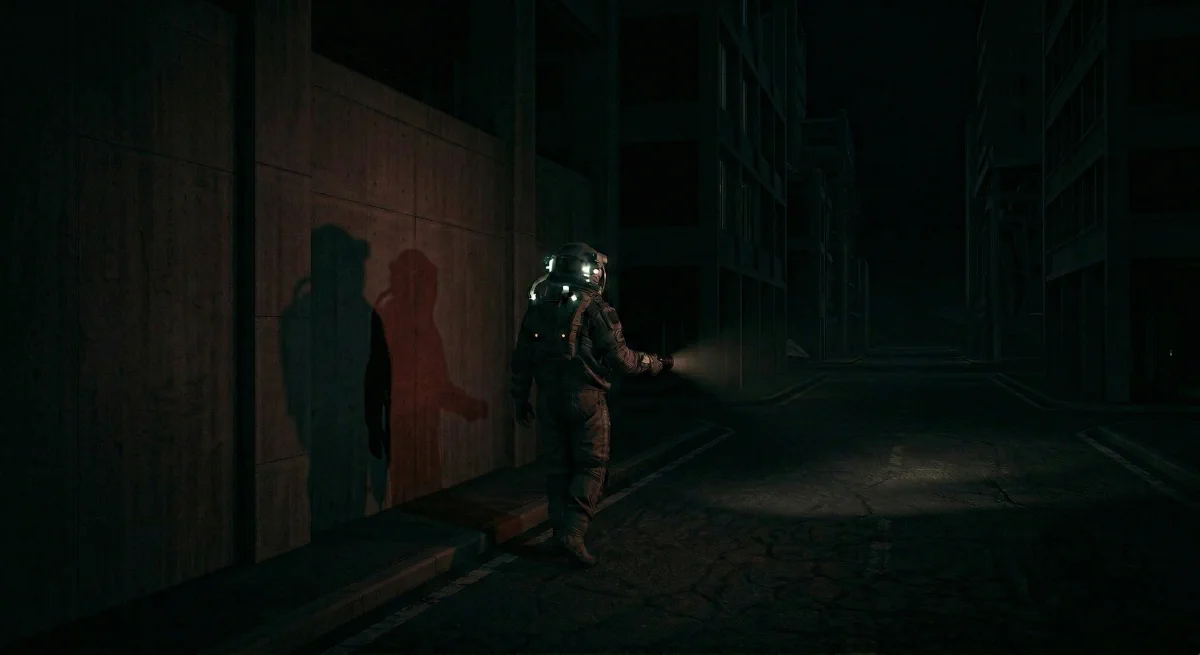
The accretion glow was on them the moment they cleared the first wall. Reddish, diffuse, falling from everywhere at once, the exhausted twilight that had painted the surface since landing. It found them and it held them. Two shadow sets stretched from each runner across the dark paving: the sharp white from their flashlights, the softer reddish from the disk’s glow. Eight shadows moving through the streets. Four people.
Every second counted. Every second was cumulative and irreversible and they were spending them now, the four of them, running through streets that the squad had walked through on the first day in formation with Okafor at point and Vasquez beside him and the beams sweeping in coordinated arcs and nobody glancing back toward the ship. The same streets. The same geometry. Smooth alien walls and too-tall archways and the buildings pulling close on both sides. Different now. Not because the city had changed. Because the city had never been what they thought it was.
The flashlights cut ahead of them but the accretion glow rendered them secondary, the beams reaching into a twilight that was already lit by something else, something larger, something that filled the streets from above and from the sides and from every gap between structures. In the first days the flashlights had been the primary light source and the accretion glow had been background. Now, running through the open streets with their beams bouncing ahead of them, the relationship reversed. The glow was everywhere. The flashlights were small things carried by small figures moving through it.
And in the glow, the city moved.
Khouri saw them in the first thirty seconds. Reddish shapes at the edges of vision, in the side streets, in the spaces between buildings, at the periphery of every intersection they crossed. Shadows. Not the flashlight kind, not the sharp white silhouettes thrown by a point source. The other kind. The accretion kind. Soft, reddish, upright, walking. Dozens of them. More. They walked in the dim light with the unhurried gait of people going about routines, turning corners, crossing open spaces, standing at the entrances of buildings. The inhabitants. The city’s population, still here, still going about the patterns that had been encoded into their shadows centuries ago.
The forty-seven Park had counted in the plaza had been one intersection. This was the city.
They were everywhere. In every street the runners passed through, shadows moved. Some walked in groups. Some stood alone. Some crossed the street directly ahead, close enough that the shape of them was clear: roughly humanoid, taller, narrower, the same proportions Khouri had mapped in the remains. At a distance, in the reddish glow, the silhouettes were indistinguishable from human ones. Just figures, walking. Just figures, walking. Somewhere to be and all the time in the world to get there.
The city was not empty. It had never been empty. The flashlights had drowned the glow and the glow had been where the inhabitants lived, and now, running through it with the beams bouncing uselessly ahead, the scale was visible. Hundreds. The streets were populated. The plazas were populated. Every space the accretion light reached held the shapes of the people who had built this place and filled it and died in it and kept walking.
Khouri ran. The shapes passed at the edges of his vision and he kept his eyes on Navarro’s back ahead of him and his feet on the paving and his breath inside the rhythm of the stride. Don’t look. Don’t stop. Don’t think about what forty-seven in one plaza meant multiplied across every intersection in a city built for tens of thousands.
Calder set the pace. Her stride was steady, efficient, the same ground-reading focus that had been her mode since the first day applied to a new problem: covering distance without stopping. She didn’t look sideways. She didn’t sweep the side streets with her beam. She looked forward, at the route, at the next intersection, at the geometry of the streets that would lead them to the plain and the ship beyond.
Okafor ran behind her. Silent. The same silence that had been on him since the plaza, since the moment Vasquez stopped being alive, the silence that wasn’t absence but weight. He ran with his weapon up and his beam tracking the ground ahead and whatever was behind his face was behind his face.
They crossed an intersection. Shadows moved through it, reddish shapes walking perpendicular to their path. Khouri’s beam caught one directly, the white light falling on the dark paving where the shape walked, and the shadow was visible in the beam for a fraction of a second: a figure, upright, mid-stride, carrying the posture of someone who had walked this street a thousand times. The beam passed through it and hit the far wall and the shadow kept walking.
Another intersection. Another plaza opening to the left, the buildings pulling back, the accretion glow falling in fully. More shapes. More shadows walking in the reddish light, filling the open space with the density of a crowd. Khouri glanced and saw dozens, scores, the plaza populated with the unhurried movement of a city at midday, and all of them shadows, all of them the reddish silhouettes of people who had been alive here and whose information still walked the streets it had known.
He looked forward. Navarro’s back. Calder’s form ahead. Okafor between them.
They reached a wider plaza.
The buildings pulled away on all sides and the sky opened above them, the void and the ring and the bent river of fire. The same sky that had broken Khouri on the first day, the same impossible geometry that the squad had walked beneath without talking about because talking about it would mean admitting the scale of what was over their heads. The accretion glow filled the plaza without obstruction. Every surface reddish. Every shadow visible.
The plaza was full.
Shadows moved across the open ground in patterns that looked like commerce, like routine, like the midday activity of a functioning city. They walked between the low structures at the edges. They stood at the entrances of buildings. They crossed the open space in groups and alone, reddish shapes in the reddish light, and among them the four runners were the only solid things.
Okafor stopped.
Khouri didn’t see it happen. He saw the result. He was running, watching Navarro’s back, and then Navarro was past where Okafor had been and Okafor wasn’t running anymore. He was standing in the middle of the plaza, weapon lowered, beam pointing at the ground, looking at something.
One of the shadows.
It moved differently. Not the measured alien gait, the unhurried stride of the inhabitants’ routines. This one was restless. The posture shifted, swept, scanned. A body that couldn’t stop looking, couldn’t stop checking, a silhouette that carried the pattern of attention Khouri had watched for days on the walk from the ship and in the streets and in every room they’d entered. The restless beam. The sweep that was narration made into motion.
The shadow walked the way Vasquez walked.
Calder’s voice cut through the comm. “Okafor, move!”
He didn’t move. He stood in the accretion glow with the shadows of the city moving around him and his eyes on the one that carried the pattern of the man who had filled every silence since the ramp, whose voice had been the constant texture of the squad, whose absence had been the loudest thing in every room for days. The shadow swept and scanned and went about its restless routine twenty meters from where Okafor stood watching it.
“Okafor!” Calder again. Not a command now. Something rawer.
Khouri slowed. Navarro slowed. The three of them had stopped or nearly stopped and Okafor was twenty meters back, standing still in the full light, and the seconds were accumulating.
He didn’t turn. He didn’t move. He stood in the plaza the way the inhabitants had been found in their rooms, in their corridors, at their surfaces, in the postures of whatever they’d been doing when the light finished its work. Okafor’s posture was the posture of watching. He was watching the shadow that moved like Vasquez, and Khouri understood in the span of a heartbeat why Okafor had chosen to run when staying had seemed more natural for a man whose face had shown nothing since the plaza, who had sat near the archway with his weapon across his knees and his eyes on the middle distance for days. He hadn’t been running for the ship. He had been running for this.
Khouri looked back.
Okafor was standing. And then Okafor was not alive.
There was no collapse. No fall. He had been still already, and the stillness simply changed from one kind to another. The body remained upright for a long second, balanced on feet that had stopped needing to balance, and then gravity found the change and he settled forward and down, not the sudden total drop of the others but a slow folding, the way a structure comes down when the thing holding it up is removed gently rather than knocked away.
His reddish shadow kept walking. It joined the others, the shapes in the accretion glow, the population of the plaza. At a distance, in silhouette, indistinguishable. One more figure among the hundreds that moved through the reddish light of the city that had been full all along.
Calder was already running. “Move!”
Navarro moved. Khouri moved. Three people, six shadows, and the plaza behind them, and Okafor in it, and the shadow that walked like Vasquez somewhere among the others, and the silence where Calder’s voice still echoed in the comm.
The streets narrowed and then opened and then the city ended.
The last buildings fell away on either side and the plain stretched out ahead, flat and bare and dark, the same featureless expanse they had crossed on the first day. The ship sat on the rock a kilometer and a half out, visible in the accretion glow as a shape that was too regular to be natural. The ramp facing them. The hull catching the reddish light.
Open ground. No buildings. No walls. No shelter of any kind between the city’s edge and the ship. Just the plain, the glow, and the distance.
Calder didn’t pause. She adjusted her stride for the open terrain and kept running. The ground was hard under their boots, flat striated rock, unchanged from the first walk, and Khouri felt each step the way he’d felt the first steps off the ramp: solid, real, the planet indifferent to what walked on it.
Three people running across open ground under a sky with a hole in it. The void above, the ring, the bent river of fire. The accretion glow painting everything its exhausted color. Two shadow sets from each of them stretching across the rock, long in the low light, reaching ahead of them toward the ship.
Navarro ran beside him. Her stride was steady, her arms pumping, her breath audible through the comm in the controlled rhythm of someone managing effort against time. She had no weapon, no pack, just the handheld clipped to her belt and the numbers she carried in her head, the numbers she had calculated for everyone including herself, the number she had not read aloud.
Calder was ahead. Pulling away. The stronger runner, the lower number, the person who should bring them home.
Khouri found a pace and held it. His legs worked. His lungs worked. The distance between him and the ship contracted with each stride. Half the plain behind them, the city receding, the shadows in the streets visible at a distance as a general movement, a population going about its day in the reddish glow. Ahead: the ship. The ramp. The inside.
Navarro dropped.
Mid-stride. Running, and then not. The same sudden, total, silent collapse that Khouri had seen four times now and would see in his sleep for however long the years ahead lasted. Her body went forward and down with the momentum of the run still in it, hitting the rock and sliding. The handheld broke free of her belt clip and skittered across the dark paving, the screen still lit, the numbers she’d calculated for everyone still on it. The sound was boots and fabric and the flat report of a body meeting stone at speed. His legs kept running. His eyes found Calder’s form ahead. The sound stayed behind him with everything else he couldn’t stop for.
He did not stop.
He did not stop. The physicist who had understood the mechanism better than anyone, who had delivered the numbers that told six people how close they were to the line, who had looked at her own number and seen what it meant and had packed her handheld and walked through the archway anyway. She knew. She knew the math and the math was right and she ran anyway.
Two people. Calder ahead, Khouri behind. Four shadows on the dark rock. The ship growing with each stride.
Calder reached the ramp.
The ship sat on the plain where it had sat since landing, the hull in the accretion glow, the ramp extended. Calder hit the ramp running, her boots finding the metal surface, the incline taking nothing from her stride. She was on it. She was climbing it. She was there.
She collapsed three steps from the top.
Her body folded the way every body on this planet folded: sudden, total, silent. She went down on the ramp and didn’t move. Her flashlight clattered against the metal and rolled to the edge and wedged there, its beam pointing sideways into the glow. She lay across the ramp, blocking the entry, her body angled from one rail to the other.
Khouri reached the base of the ramp and stopped.
Calder lay above him, three meters up the incline. The ramp was narrow enough that her body blocked most of the passage. Her arms were extended, one forward (reaching for the top, reaching for the threshold she almost crossed), one back. The woman who had been right about everything. Who had pushed to get inside when it mattered. Who had taken command when Yoon fell. Who had called the run, who had set the pace, who should have been the one to walk through the door she was lying across. Almost. The cruelest word on the planet.
He climbed the ramp.
His hands found her shoulders. The contact went through his gloves and into his body. The body under his hands was still warm (the atmosphere preserved, the metabolism had been running seconds ago, the heat hadn’t had time to leave).
He moved her.
He pulled her to one side, working her body against the incline, her boots dragging on the metal surface. The sound of it. The friction of dead weight on the ramp. He got her to the edge, against the rail, enough space to pass. Her arm fell from the rail and hung over the side, pointing down at the rock below, and he left it there because there was nothing else to do with it and the seconds were accumulating and every one of them was cumulative and irreversible and he was standing on a ramp in the accretion light touching a dead woman because she was between him and the door.
He stepped over her legs. He reached the top of the ramp. He went through.
Inside, the light cut off. The hull blocked the accretion glow completely, completely, every wall on this planet opaque to it, and the interior of the ship was flashlight dark. One shadow set. The relief he’d felt in the first building, the same relief the inhabitants must have felt behind their sealed windows, the shelter of artificial light in a world where the natural light killed you.
He found the ramp controls. The panel was where the briefing materials said it would be, where someone had shown him during the pre-mission walkthrough that he’d only half attended because the systems were meant for someone else’s hands. He pressed the sequence. The ramp began to close.
Through the narrowing gap he could see Calder’s body on the ramp, sliding slowly as the incline shifted, and beyond her the plain, and beyond the plain the city, and in the city the shadows still moved. The ramp sealed. The gap closed. The accretion glow disappeared. The ship was shut.
He stood in the dark. His flashlight threw one shadow from his feet across the deck, sharp and white and alone.
The cockpit was forward. He walked to it through a corridor lined with equipment racks and storage compartments and the empty stations where Navarro’s instruments should have been running and Park’s recordings should have been cataloguing and Engel’s medical readouts should have been scrolling. The ship was designed for ten. The stations were designed for specialists. Every surface was built for hands that knew what they were doing, and the only hands left were the hands that had fumbled a chest strap on the first day.
He sat in the pilot seat. It was Yoon’s seat, or it was whoever was meant to fly (Morrow, maybe, the spine of the squad, the man who handled everything), and it was too wide for Khouri in too wide for him in the way all military equipment was, built for a frame that carried armor and certainty in proportions he didn’t share.
The harness hung from the seat back. A five-point system, straps converging on a central buckle at the chest. Standard quick-release mechanism. Standard across every piece of equipment in the ship’s inventory.
His hands found the buckle.
The mechanism was the same. The clasp, the slot, the alignment that required the two parts to meet at the right angle before the lock engaged. His fingers held the pieces. One in each hand. The configuration he’d fumbled on the first day, on the flat ground beside the ship, while the squad ran their gear checks with the muscle memory of people who’d been doing it for years.
His hands paused.
The cockpit was quiet. The ship was quiet. The silence where the voice should have been, the voice that would have said something, that would have leaned over and said the thing that made the fumbling bearable, that made the incompetence human, that turned a civilian’s failure into a moment of belonging. The silence was there and it was not empty. It was the shape of the voice, preserved the way the atmosphere preserved everything on this planet, intact and recognizable and not there.
He pushed the thing into the other thing. It clicked.
He tightened the straps. His hands moved across the harness with a competence they hadn’t had on the first day, the muscle memory of days spent inside equipment he’d never been trained to wear, and the click was just a click and the silence was just silence and neither of those things was true.
The launch sequence was in the manual. It was also in his memory, filed under the contingency briefing they’d all sat through during transit, the one where an instructor had walked them through basic flight operations on the assumption that any one of them might need to bring the ship home alone. The assumption had seemed paranoid. It had been the most practical thing anyone had done for them.
His hands moved across the console. The inputs were labeled. The sequence was logical. Power, propulsion, navigation, thrust. He followed it the way he’d followed examination protocols on this planet: step by step, reading each indicator, confirming each response. The ship’s systems came online around him, lights and screens and the low vibration of engines warming. Some of the displays showed readings he didn’t understand (Navarro would have understood them, Navarro would have read the numbers and known what the ship’s instruments were telling them about the spacetime they were leaving). He ignored what he couldn’t read and followed what he could.
The engines engaged. The ship shuddered. The vibration climbed from the floor through the seat and into his chest, a physical tremor that was the ship disagreeing with what he was asking it to do, or agreeing reluctantly, or simply responding to inputs that were close enough without being right.
He throttled up. The ship lifted.
The ground fell away. The paving, the plain, the dark rock that had been under his boots since the ramp lowered. He felt the separation as weight, the gravity shifting, the planet releasing him or him releasing the planet, and the ship climbed.
It climbed badly. The trajectory was steep where it should have been gradual, the thrust uneven, the corrections late. The controls responded to his hands the way an instrument responds to a student: producing the right notes in approximately the right order with none of the fluency that would make it music. Physics didn’t care. The thrust was sufficient. The angle was survivable. The ship went up because up was where he pointed it and the engines had enough to get there.
The seats behind him were empty.
Nine seats arranged in the configuration the squad had occupied during transit, back when ten people had filled them and the ship had been a vehicle rather than a coffin. Yoon’s command position. Morrow’s station. Calder’s. The paired seats where Okafor and Vasquez had sat with the proximity of people who shared a fire team and a silence and everything that went into both. Engel’s medical station. Park’s comms array. Navarro’s instrument panel. Tan’s seat at the back, contained, occupying exactly the space his body required.
Empty. All of them. The straps hanging loose, the displays dark, the stations unmanned. The silence in the ship was not the silence of an empty room. It was the silence of a room that should have been full, where the absence of each person had a specific shape and a specific location, and Khouri could map every one of them the way he’d mapped the remains in the city’s buildings: this is where this one sat, this is how they held the space, this is the posture that is missing.
He flew.
The ship climbed and the planet shrank beneath it. The surface receded in the viewport, the dark rock giving way to the wider view, the geometry of the city visible now as a pattern against the flat terrain. Small. Getting smaller. The buildings and streets and plazas that had swallowed them for days, that had held the dead and the shadows and the light that wrote people onto surfaces, contracting into a shape on a sphere in the reddish glow.
The sky changed as they climbed. The accretion disk shifted, the perspective altering, the bent horseshoe of dim fire tilting as the ship rose above the orbital plane. The black hole held the center. The void, the ring, the nothing that took up space by being the place where space stopped. The same sky that had broken him on the first day, seen now from the inside of a ship that was climbing away from it, one person in a space for ten, the controls under hands that weren’t trained for them and the trajectory imperfect and the planet falling away below.
He looked at the viewport.
The planet was a dim sphere in the reddish glow. The surface was visible, barely, the flat terrain and the dark rock and the geometry of the city catching the accretion light in angles and planes. From this height the city was a smudge, a texture on the surface, the kind of detail that an orbital survey would catalogue and flag and send a team to investigate.
The shadows were still moving. He couldn’t see them individually, not from this altitude, but the city had a quality of motion, a shimmer in the reddish glow, the aggregate movement of hundreds of shapes walking their streets and crossing their plazas and going about the routines they had been going about since their bodies stopped. The population, still there. Still full. Seven more of them now, two more coming.
The planet receded. The light didn’t stop. The shadows didn’t stop. They had been there before the squad arrived and they would be there after, walking in the reddish glow of a star that wasn’t a star, on a world that had no sun, at the edge of a hole in the universe. The city held them the way it held everything: without effort, without attention, without the slightest indication that it noticed or cared that one ship was climbing away from it, carrying one person and the silence where nine others should have been.
The planet shrank in the viewport. The glow dimmed. The city was a point, then a texture, then gone.
Khouri flew.