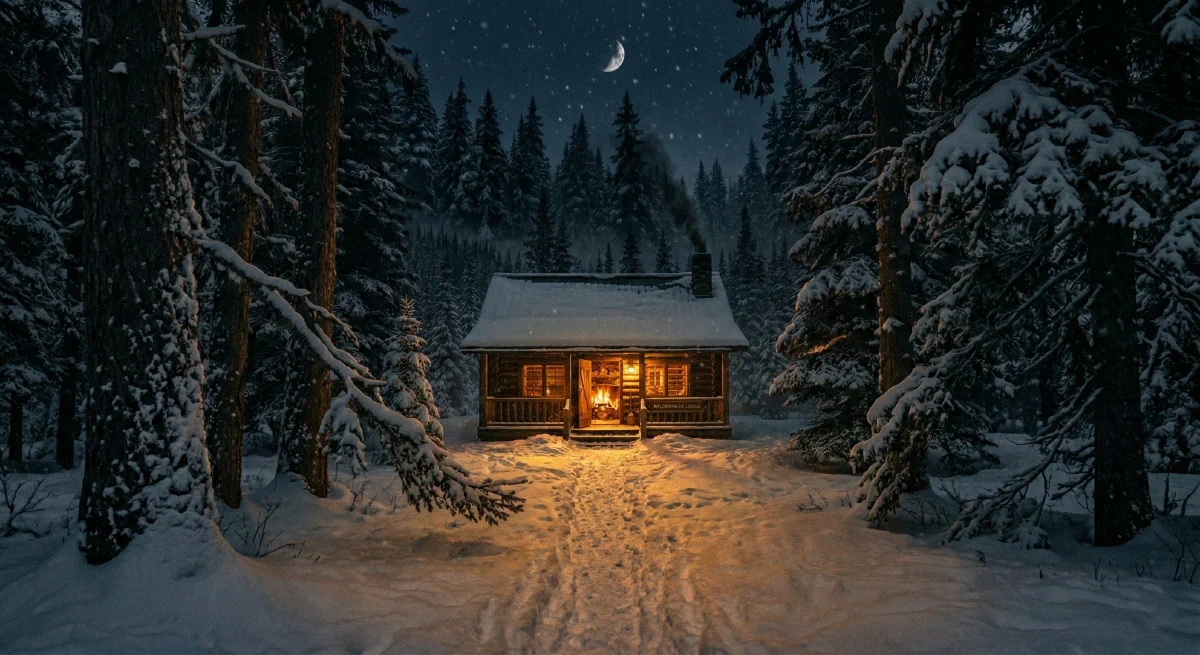
Cabin
Isolation, silence, and the voices that fill it
It has been two years since they died. One year since I moved into this cabin in the middle of nowhere. Three months since the voices started. One day since I started answering them.
It was no one’s fault. The newspapers had proclaimed it “purely accidental,” as if those two sterile words could contain the annihilation of everything I had ever loved. Wrong place, wrong time. A cosmic alignment of tragedy. Perhaps it would have been easier to endure if there had been a villain in this story, some malevolent force I could have directed my anguish toward. But the universe had offered me no such mercy. The only variable that could have altered the equation was my own presence in that car, my own body added to the wreckage. Perhaps that would have been for the better.
When the earth swallowed them, I sold the house. Our house. The walls had become a mausoleum of memories, each room an exhibit of happiness I could no longer access. Good memories, yes, but memories are just ghosts that haven’t learned to leave. I could not bear to walk through hallways haunted by the echoes of what was, what could have been.
I retreated to a cramped apartment in the city, believing that anonymity might offer absolution. But every muffled footstep from above, every fragment of conversation bleeding through the thin walls, became a cruel deception. My fractured mind transmuted these sounds into evidence that Jenny and Violet were merely in the next room. Just out of earshot. Just beyond my reach. I would catch myself frozen mid-breath, waiting for Violet to come bounding in on her chubby feet, arms outstretched for an embrace that would never come. The anticipation was a knife. The silence that followed was the twist.
The constant oscillation between desperate hope and crushing despair became unbearable. Each cycle carved away another piece of whatever remained of me. I needed to go somewhere untouched by human presence. Somewhere the world could not remind me of what it had stolen.
I purchased the most remote cabin the realtor could find. No electricity. No running water. No neighbors for miles. Just myself and the vast, indifferent wilderness. The forest did not care about my suffering. The mountains did not mourn. Nature was cold and uncaring and unforgiving. The complete antithesis of my Jenny.
I brought little with me. Most possessions I had already discarded, unable to tolerate the weight of their associations. But the photographs I could not surrender. I could not allow the precise architecture of their faces to fade from my memory. The way Violet had inherited my eyes. The identical crinkle in their noses when laughter overtook them. The infinitesimal details that composed the whole. These fragments I guarded like sacred relics.
The solitude was absolute. Beyond the cabin’s weathered walls, civilization had ceased to exist. Had I possessed any knowledge of wilderness survival, I would have preferred to exist without even this modest reminder of the human world. But I was a man shaped by cities and convenience, woefully unprepared for the primal demands of this exile.
The first night, I could not coax fire from wood. I had never known such cold. It burrowed into my bones and crystallized in my blood. Yet there was a grim poetry in it. For the first time since the accident, my exterior matched my interior. Both frozen. Both dying.
Through trial and punishment, I learned. I evolved from a helpless creature shivering in darkness to something marginally more capable. Friction-born sparks became flames. Gathered sticks became felled trees. There was something darkly poetic about the pristine forest being sacrificed to sustain my hollowed existence. My grief was a contagion, and I was infecting everything I touched, killing the woods one tree at a time. But I could not perceive the metaphor then. I perceived nothing. I simply moved through the motions of survival like an automaton, days consumed by foraging and preparation, nights devoted to studying their faces by firelight. Their frozen smiles gazed back at me. My own face, reflected in tears, contorted in perpetual anguish.
I cannot pinpoint the exact moment the voices began. They infiltrated my consciousness gradually, the way frost propagates across glass. Initially, I attributed the sounds to wind threading through gaps in the cabin walls. Then I convinced myself it was the language of trees. Their ancient branches scraping and groaning, speaking in some primordial tongue I was only beginning to decipher.
But wind does not whisper your name.
“David.”
The sound was impossibly soft. Unbearably familiar. I would spin around, my heart slamming against my ribs, fully expecting to find Jenny standing in the doorway wearing that gentle, knowing smile she always offered when she caught me lost in contemplation. But there was only the empty cabin. The dying fire. The photographs watching me from where I had propped them against the wall, their eyes following me like icons in a church.
I manufactured explanations. The mind, I had read somewhere, could conjure auditory phantoms when deprived of human contact. It was neurology. Explainable. Manageable. A symptom to be dismissed.
Then I heard Violet laugh.
That effervescent, uncontainable giggle that had once filled our home with warmth and light. It erupted from somewhere beyond the tree line, bouncing between the frozen trunks. I threw myself into the snow without coat or boots, pursuing the sound through drifts that swallowed my legs, my lungs burning in the frigid air. I chased the phantom until my feet became senseless blocks of ice, until my breath emerged in ragged, desperate gasps. I found nothing but the indifferent silence of the forest, the trees standing as mute witnesses to my unraveling.
When I finally staggered back to the cabin, my body trembling so violently I could barely work the latch, I discovered something unexpected. I was smiling. For those few desperate moments, racing through the frozen wilderness in pursuit of a ghost, I had felt something other than the hollow void that had become my constant companion.
I hungered to feel it again.
The voices grew emboldened after that night. They no longer confined themselves to the liminal space between sleep and waking. They spoke to me while I split wood, the axe biting into timber. While I melted snow for drinking water. While I sat motionless for hours, watching shadows elongate across the cabin floor like dark fingers reaching toward me.
Jenny’s voice was always tender, a caress of sound. She told me she missed me. That she had been waiting. That we could be reunited if I simply surrendered, simply let go.
Violet begged me to play. To come find her. She was hiding, she said, her voice a melody of mischief. She was so good at hiding.
I understood, on some level, that they were not real. Some functional remnant of my psyche recognized that these voices were emanating from within my own fractured architecture, echoes reverberating off the walls of an emptiness too vast to comprehend. But knowing something and believing it are different creatures entirely. And I had ceased believing in anything the day I identified their bodies in the morgue, their faces peaceful in a way that mocked my devastation.
One morning, I answered them.
“I’m coming, sweetheart,” I called out to Violet’s giggling voice. “Daddy just needs to finish his breakfast.”
The words felt foreign on my tongue. I had not spoken aloud in months. My voice had become rough, unrecognizable, like hearing a stranger speak from within my own throat. But the moment those words escaped my lips, I felt a peace I had not known since before the accident settled over me like a warm blanket.
After that, I could not stop.
I have begun setting three places at the small table. I speak to them about the minutiae of my days. What I have foraged. How the weather is turning. Whether the creek will freeze solid before spring. Jenny always listens with infinite patience, the way she always did. Violet interrupts with questions, her curiosity boundless, exactly as I remember.
The photographs no longer offer comfort. The faces imprisoned within them are frozen, static, fundamentally wrong. They cannot capture the way Jenny tilted her head when lost in thought, or how Violet’s entire body seemed to vibrate with uncontainable excitement over the smallest discoveries. But the fire can.
In the dancing flames, I see them now. Not mere suggestions or phantom flickers in my peripheral vision. I see them with absolute clarity. Jenny’s face materializes in the amber glow, her features shifting and rippling like a reflection in disturbed water, but undeniably, irrefutably her. Violet’s small hands reach out from between the burning logs, beckoning me closer, inviting me in. The photographs could never capture them the way the fire does. The fire grants them movement. The fire makes them alive.
I have taken to building the fire larger each night. The cabin transforms into a furnace, sweat cascading down my face as I feed log after log into the ravenous flames. The heat becomes unbearable, oppressive, but I am beyond caring. The larger the fire, the clearer their forms become. The closer they feel. The more real.
Jenny’s voice emanates from the flames now, warm and crackling like the fire itself. She tells me she misses me. That she has been waiting so patiently. That we could be together again if I would simply let go.
Violet begs me to come play with her. She is hiding in the fire, she says, her laughter dancing between the sparks. She wants me to find her.
My supplies are nearly exhausted. I rationed poorly, and the winter has proven longer and more brutal than I anticipated. The logical course would be to hike to the nearest settlement. It would take two days, perhaps three in these conditions. I could resupply. I could survive.
But survival has revealed itself to be an empty proposition. Out there, I would be alone again. Out there, the voices would fall silent, and their faces would dissolve back into the ordinary flames of ordinary fires.
I have made my decision.
I have blanketed the cabin floor with kindling. The dried leaves and bark I had collected for starting fires now carpet every corner in a layer of tinder. The remaining logs are stacked against the walls like offerings. I have anointed it all with the lamp oil I discovered in the cellar, the acrid smell filling my nostrils with the perfume of what is to come.
The photographs rest in my hands. I study them one final time. The frozen smiles. The captured moments that could never capture enough. I place them gently in the center of the floor, faces turned upward, so they can bear witness.
The fire in the hearth is burning strong tonight, stronger than ever. Jenny’s face glows within the flames, more beautiful than memory could ever preserve. Violet dances between the tongues of fire, her laughter rising like smoke toward the blackened ceiling.
“I’m coming,” I tell them, my voice steady for the first time in years. “Daddy’s coming.”
I reach into the hearth and withdraw a burning log. The flames lick at my hands, but the pain feels distant, irrelevant. The heat feels like holding her hand again. Like coming home.
I touch the torch to the kindling.
The flames spread with hungry velocity, rushing across the oil-soaked floor in rivers of orange and gold. The heat becomes immediate and immense, a living thing embracing me, but I do not move from where I sit. Smoke billows and thickens, but through the haze I can still see them. Jenny is stepping out of the hearth, walking toward me through the inferno, her arms open wide. Violet runs circles around me, her laughter ascending with the flames, pure and joyful and real.
I close my eyes and feel their arms enfold me at last.
I am finally warm.