Chapter 2
“Are you eating?” her mother asks.
“Yes, Mom. There’s a diner on the corner. I’ve been going there.”
“A diner.” Helen’s voice carries the particular weight she gives to words that mean I’m imagining what you’re eating and I don’t like it. “What do they have?”
“Eggs.”
“Nora.”
“And other things. Toast. Salads. It’s a nice diner.”
Four o’clock on a Sunday. The hotel room is small, clean, anonymous: a queen bed, a desk, a window that looks out at the brick side of the next building over. Government rate. Nora sits on the bed with her phone on the pillow beside her and her laptop open, not because she’s working (she hasn’t started yet, doesn’t have access yet, doesn’t know what she’ll be working on beyond the shape of what Calloway told her) but because the open laptop is a habit, a resting state. Screen open, brain on.
“Where are you again?”
“New York. I told you.”
“You said you were traveling. You didn’t say New York.”
“I’m saying it now. It’s a work trip. Temporary.”
“How temporary?”
“A couple months. Maybe less.”
The pause that follows is different from their usual silence. This one has a question in it. Helen knows the rules of her daughter’s career: there are things Nora can’t say, and the gaps in what she does say are not invitations to probe. Helen has spent years learning to navigate around the classified absences in Nora’s life, treating them the way you treat a piece of furniture you keep bumping into in the dark: you learn where it is, you move around it, you don’t complain. But two months in New York is a bigger gap than usual.
“Is everything OK?” her mother asks.
“Everything’s fine. It’s just a project.”
“You’d tell me if it wasn’t fine.”
“I would tell you if it wasn’t fine.”
This is a lie, and they both know it, and neither of them says so. It’s the same lie it’s always been: the promise that Nora will reach out if she needs help, offered by a woman who has never in her adult life reached out to anyone for help, accepted by a woman who knows this about her daughter and has chosen not to fight it. The lie is load-bearing. It holds up the structure of their calls, their relationship, their careful, performed closeness. Without it, they’d have to talk about things neither of them knows how to talk about.
“OK,” Helen says. “Take care of yourself. Find a good grocery store. You can’t live on diner eggs.”
“I’ll find one.”
“Love you.”
“Love you too, Mom.”
She ends the call. The hotel room settles into its quiet. Outside, somewhere, a siren moves through the streets and fades.
Monday morning. Calloway sends a car.
This is not something that happens in Nora’s professional experience. At the NSA, you drive yourself, badge yourself in, and sit at your own desk. Cars are for directors and diplomats and people whose time has been deemed too expensive to spend in traffic. The car is black, government plates, driven by a man in a dark jacket who knows her name but doesn’t offer his.
They drive south through Manhattan and then east, into a part of the Lower East Side where the streets narrow and the buildings press together. The car turns onto a block that’s been closed off. Concrete barriers. Temporary fencing. Two checkpoints, both manned. The street beyond the barriers has been cleared of civilian traffic. She can see construction equipment (idle, shut down) and temporary structures (trailers, a generator, floodlight rigs) and, at the far end, a larger building that looks like it was erected in weeks rather than months: prefabricated walls, steel frame, the functional ugliness of something built for purpose rather than permanence.
Badge. Biometric scan. A third checkpoint inside the outer building, this one with a security officer who examines her credentials with the slow thoroughness of someone paid to be suspicious.
Calloway is waiting for her on the other side. Same grey suit. Same blue tie. She wonders if he owns multiples or just the one.
“Welcome to the project, Ms. Keene. How was the hotel?”
“Fine.”
“We’ll get you into longer-term housing this week. There’s a building the programme uses, two blocks north. Nothing fancy, but better than a hotel.” He gestures for her to follow, and they walk through a corridor of temporary walls and fluorescent light. The air smells like new drywall and ozone. “Before we go any further, we need to read you in. There’s some paperwork, and then I’ll walk you through what we have.”
The paperwork takes forty minutes. NDAs she’s signed versions of before, but with additional clauses specific to this programme: restrictions on communication, on personal devices, on the retention of notes or materials outside the facility. She reads every word (a habit from her father, a contracts lawyer, dead since she was nineteen; he taught her that the things people don’t want you to read are the things you most need to). The compartment designation is one she’s never encountered. The classification level is one she didn’t know existed.
She signs. Calloway leads her to a conference room, small and windowless (she is going to spend a lot of time in windowless rooms; she can feel this already), and closes the door.
“I’m going to tell you what was found,” he says. “And then I’m going to take you down to see it.”
He opens a laptop and turns the screen toward her. On it, a photograph: an underground space, shot from above with industrial lighting. The image is clear, high-resolution, and for a moment Nora’s brain tries to categorise what she’s seeing as architecture. A room. Carved stone. But the proportions are wrong. The angles are too precise. Not approximately right, not skilled-craftsman right. Mathematically right. The kind of precision that doesn’t exist in human construction because human construction is built by hands and tools and gravity, all of which introduce variance. This has no variance. Every surface, every angle, every dimension is exact.
“In October,” Calloway says, “a tunnel boring machine on the Second Avenue line broke through into a void at approximately sixty metres below street level.”
The Second Avenue line. The subway articles. The construction shutdown, the geological anomaly, the language shifting from “assessment” to “national security” over the course of a week. The data points she filed and moved on from, because they didn’t connect to anything. They connect now.
“The void turned out to be a chamber,” Calloway continues. “Roughly twelve metres by eight, with a ceiling height of four metres. The geometry is regular. The walls, floor, and ceiling are continuous rock, with no seams or joints.”
She looks at the photograph. Her mind is already doing what it does: sorting, categorising, looking for the framework that makes the image legible. “What kind of rock?”
“That’s where it gets complicated.” He taps the screen, and a second image appears: a close-up of the chamber wall. Dark stone, dense, with a glassy quality. And on the surface, symbols. Dozens of them, hundreds, covering the wall in rows and clusters and configurations that look, at first glance, like text. But they aren’t. She can see that immediately, even in a photograph, even without training. Text has regularity: repeated characters, spacing patterns, the visual rhythm of a language. These symbols have structure, but it’s not the structure of language. It’s something else.
“The surrounding rock formation doesn’t match any known local geology,” Calloway continues. “Manhattan sits on schist and gneiss. This is something else. The geological team ran isotope dating, and the results…” He pauses, and she watches his face. This is the first time she’s seen him hesitate, and the hesitation is small, controlled, but real. “The results place the formation in the Precambrian. We’re talking about rock that’s approximately two billion years old.”
Two billion years. Nora lets the number sit. Two billion years ago, the most complex life on Earth was single-celled. There were no plants, no animals, no multicellular organisms of any kind. The continents were in different positions. The atmosphere had a different composition. And sixty metres below the streets of Manhattan, someone (something?) carved a chamber with mathematical precision and covered it in symbols.
“The symbols,” she says.
“Not carved. Not painted. Not applied by any process we can identify.” He brings up another photograph, a magnified cross-section of the wall. The symbols are visible in the cut-away: they extend into the rock. Not incised on the surface but integrated into the mineral structure itself, as if the stone crystallised around them. As if they were there first, and the rock formed later. Or as if the distinction between symbol and stone doesn’t apply.
“We’ve had seven analysts work on the symbols over the past six weeks,” Calloway says. “Linguists, mathematicians, computer scientists. Three from NSA, two from DARPA’s information sciences division, one from the Institute for Advanced Study, one from our own DOE cryptanalysis unit.” He pauses again. “None made meaningful progress. The symbols don’t conform to any known writing system, any known mathematical notation, any known encoding scheme. Standard frequency analysis returns noise. Structural analysis identifies local patterns but no global grammar. Machine learning models trained on the symbol set produce internally consistent but mutually contradictory interpretations.”
“And the analysts themselves?”
Calloway looks at her. It’s a sharp look, brief, appraising. She’s asked the question he didn’t expect.
“What do you mean?”
“You said none made meaningful progress. You didn’t say all seven are fine.”
He is quiet for a moment. Then: “Two reported persistent insomnia during their assignment. One developed migraines that resolved after she left the project. One resigned from his position three weeks after returning to his home agency. He didn’t give a reason.”
“Did anyone ask?”
“He declined to discuss it. His exit interviews were… unrevealing.” Calloway closes the laptop. “I want to be transparent with you, Ms. Keene. This is not a normal assignment. The material is unlike anything any of these analysts have encountered before, and the work environment is unusual. You’ll be spending extended periods underground, in a space that some people find uncomfortable. We provide psychological support. I encourage you to use it.”
“But you think I’ll be different from the others.”
“I think you have a specific cognitive profile that may be suited to this particular problem. Your doctoral work in cryptanalysis at MIT focused on non-linguistic symbolic systems. Your assessment scores are among the highest we’ve recorded. And frankly, Ms. Keene, we’ve exhausted the conventional approaches. We need someone who can look at this differently.”
There it is again. Differently. David’s word, from the other side of a career she’s already beginning to think of as her previous life.
“When can I see it?” she asks.
He introduces her to the team first.
The analytical staff work in a room on the sub-surface level, one floor above the chamber. It’s a converted staging area: long tables, monitors, whiteboards, the accumulated debris of weeks of focused analytical work. Printed photographs of the symbols cover one entire wall, arranged in a grid that maps their position in the chamber. It’s the first time Nora sees the symbols at scale, and even in photographs, something in the arrangement catches her attention. Not a pattern. Not yet. Just a sense that there is more structure here than is immediately visible.
“Nora Keene, Eli Navarro.”
Eli stands from his workstation to shake her hand. He is about her age, maybe a year or two younger, with dark hair and the kind of face that smiles easily and often. His desk is covered in papers, most of them printouts of symbol groupings annotated in a small, precise hand. He has the energy of someone who is genuinely excited about what he’s doing, the kind of enthusiasm that Nora recognises because she’s felt it, the pull of an unsolved problem.
“I’ve heard about you,” Eli says. “The timing channel. That was impressive.”
“Word travels.”
“In a team this small, everything travels. Welcome aboard. I’ve been doing the structural cataloguing, so if you need orientation on the symbol set, the spatial mapping, any of the baseline data, I’m your person.” He gestures at the wall of photographs. “Six hundred and forty-three distinct symbols, as far as we’ve been able to identify. Some appear once. Some appear dozens of times. The distribution doesn’t match any known frequency pattern for natural language.”
“What does it match?”
Eli pauses. Smiles again, but differently this time, the smile of someone who’s been asked the question they’ve been waiting for. “Nothing. That’s the problem. And the fun.”
The second introduction is quieter.
Dr. Maren Asher is in a smaller office down the corridor, a space that feels deliberately separate from the main analytical room. She is in her late forties, lean, with short grey-streaked hair and a stillness about her that Nora notices immediately. Not calm, exactly. Contained. The kind of stillness that comes from effort rather than ease.
“Dr. Asher was our lead analyst before you arrived,” Calloway says. “She’s shifted to an advisory role and will be available if you need historical context on the analytical approaches that have been attempted.”
Maren stands and shakes Nora’s hand. Her grip is firm, brief. Her eyes stay on Nora’s face a moment longer than the introduction requires.
“Welcome to the project,” Maren says. Her voice is measured, precise. “Calloway tells me you’re NSA.”
“Twelve years.”
“And before that?”
“MIT. Mathematics.”
Maren nods. Something passes across her face, too quick to read. “I was Princeton. Applied mathematics, then DOE. I’ve been with this project since the beginning.” She pauses. “If you have questions about the symbol set, the chamber environment, the previous analytical frameworks, I’m happy to brief you. My notes are thorough.”
“I appreciate that.”
“One thing.” Maren’s voice doesn’t change. Her posture doesn’t change. But something in the space between them shifts, a subtle tightening, like a change in air pressure. “Take breaks. The work is absorbing. It’s easy to lose track of time down there. Set alarms if you have to.”
Nora recognises the shape of the advice, if not its specific weight. Senior analysts, especially women, often pass down practical wisdom to the new arrival: drink water, eat lunch, don’t let the problem eat your weekends. It’s care dressed up as professionalism. She’s heard versions of it before.
“I will,” she says.
Maren looks at her for another moment. Then she nods and sits back down, and the meeting is over.
The descent takes seven minutes.
An elevator, industrial and oversized (built to move equipment, not people), drops them from the sub-surface level to the tunnel level. Then a corridor, narrow, reinforced, lit by caged fluorescent bulbs spaced too far apart, so that they walk through alternating pools of light and shadow. The air changes as they go deeper. Not temperature (the climate control is working, holding the tunnel at a steady eighteen degrees) but quality. It thickens. Nora becomes aware of her breathing in a way she wasn’t before, not because it’s difficult but because each breath feels like it has more substance, as if the air itself has density, texture, weight.
The corridor ends at a pressure door. Steel, heavy, with a wheel lock that Calloway turns with both hands.
“The chamber is through here,” he says. “Take as long as you need.”
He opens the door, and Nora steps through.
The first thing she notices is the sound. Or rather, the absence of it. The corridor behind her had the normal acoustic properties of an underground space: echoes, the hum of ventilation, the small sounds of her own movement bouncing off walls. The chamber absorbs all of that. Her footsteps land and go nowhere. The air doesn’t carry sound so much as receive it, take it in, close around it. She speaks without meaning to, just a breath, a half-formed syllable, and her own voice comes back to her flattened, stripped of resonance, as if the room has removed something from the sound that she can’t name but can feel the absence of.
The second thing she notices is the geometry.
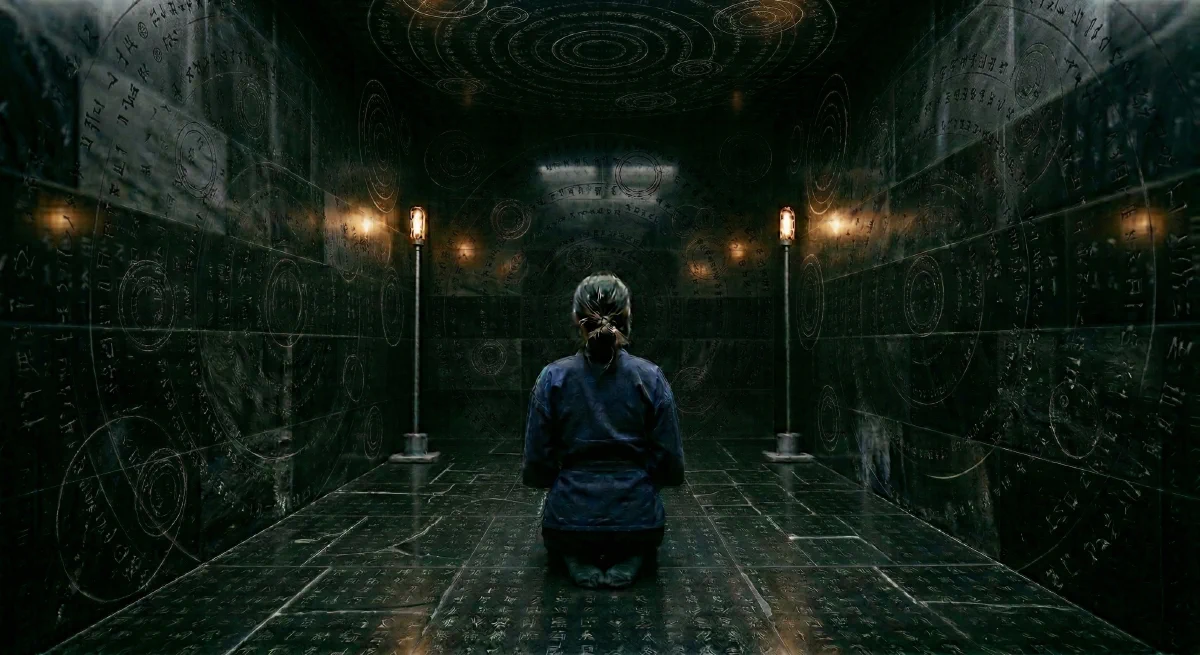
The chamber is twelve metres long, eight metres wide, four metres high. These are the numbers Calloway gave her, and they are correct, and they are wrong. Not wrong in the sense that the measurements are inaccurate. Wrong in the sense that no room she has ever stood in has felt like this. The proportions are exact. Not approximately exact, not within-tolerance exact. Exact in the way that a mathematical proof is exact: every dimension, every angle, every surface stands in a relationship to every other that is precise beyond any method of construction she knows. The walls meet the floor and the ceiling at angles that her eyes tell her are ninety degrees but that her body, some part of her body that she doesn’t have a name for, insists are something else. Something that uses ninety degrees the way a word uses letters, as components of a larger expression.
The stone is dark, dense, with a glassy quality that catches the industrial lighting and returns it at angles that seem inconsistent. Not reflective. Not refractive. Something between the two that her vocabulary doesn’t cover.
And the symbols.
They cover everything. Every wall. The ceiling. The floor (she is standing on them, she realises, and the thought produces a physical reaction she doesn’t expect: a contraction in her chest, not fear, not quite, but something adjacent to it, something older). They are not carved into the stone. They are not painted on. They are the stone, or part of the stone, or the stone is part of them. In the photographs she saw differences of shade, lighter marks on darker rock. In person, the distinction is more complex. The symbols seem to exist at a slightly different depth than the surrounding surface, not raised, not recessed, but offset, as if they occupy a plane that is almost but not quite coincident with the wall. The effect is subtle. It makes her eyes ache if she focuses on a single symbol for more than a few seconds.
There are hundreds of them. She turns in a slow circle, taking in the walls, the ceiling, the scope of it. Six hundred and forty-three, Eli said. She believes it. They vary in size from a few centimetres to nearly a metre across. Some stand alone. Some cluster in groups that suggest (but do not confirm) sequential arrangement. The shapes are complex: curves, angles, intersections, nested forms that fold into themselves in ways that seem to resist two-dimensional interpretation. They are not letters. They are not numbers. They are not any kind of notation she recognises.
And they are not random.
She knows this immediately, with the same certainty she felt when the timing channel emerged from the signal data. Beneath the complexity, beneath the unfamiliarity, there is structure. She can’t see it yet. She can’t name it, can’t describe it, can’t point to the specific feature that tells her it’s there. But it’s there. The way a locked door tells you there’s a room behind it, not by what you can see through it but by the fact that it’s locked at all.
She stands in the chamber for a long time. She is aware, distantly, that Calloway is standing by the door, watching her. She is aware that the air is dense and still and that her breathing has slowed without her choosing to slow it. She is aware that the silence has a quality she has never encountered: not the absence of sound but the presence of something that is not sound, a frequency below hearing, a pressure that registers not in her ears but in the architecture of her attention.
She looks at the symbols, and the symbols do not look back, because they are not alive, and they are not aware, and they do not have intention. She knows this. She is a scientist and a rationalist and she does not believe in mystical properties of ancient rock.
But she cannot stop looking.
And somewhere beneath the complexity, beneath the impossible age and the wrong geometry and the silence that is not silence, she feels it: the first faint pull. Not understanding. Not even the promise of understanding. Just the shape of a space where understanding might live, if she is patient enough, and careful enough, and willing to sit with it until it yields.
She has felt this before. With the cipher. With the timing channel. With every system she has ever cracked. The quiet tug at the edge of comprehension, the sense of something waiting to be seen.
She turns to Calloway. “I’d like to start tomorrow,” she says.
He nods, as if he expected nothing else.