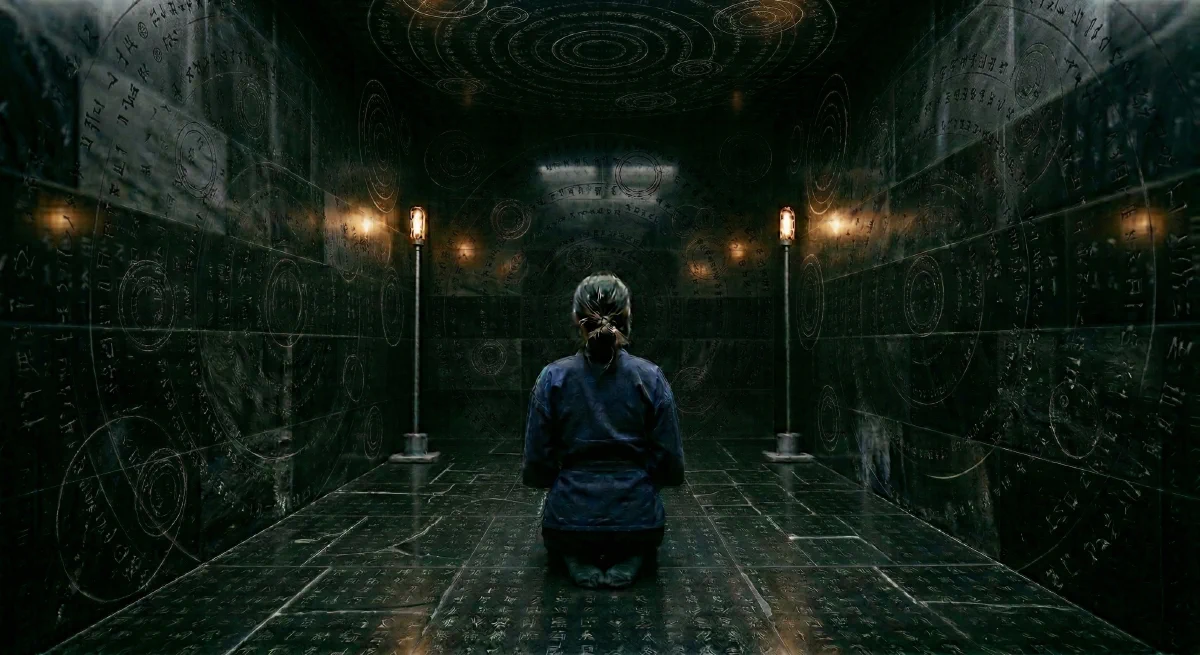
Chapter 3
Tuesday. She starts with the data.
Eli has been thorough. His cataloguing system maps every symbol in the chamber: position (measured to the millimetre from a grid of reference points laser-etched into the floor), size, orientation, nearest neighbours, cluster membership. Six hundred and forty-three symbols, each one documented in a spreadsheet that runs to thousands of rows. The photographs on the wall of the analytical room are keyed to this data, each one labelled with coordinates and cross-references in his small, precise hand.
Nora reads through it all. Then she reads the previous analysts’ reports.
There are seven, ranging from twelve pages to over a hundred. The linguists treated the symbols as a writing system: looked for repeating characters, spacing patterns, directional flow, the structural signatures of language. Found nothing. The mathematicians tried encoding schemes: substitution, transposition, modular arithmetic, higher-dimensional mappings. Found nothing. The computer scientists ran pattern-recognition algorithms, neural networks, statistical models. The models produced results, lots of them, and the results contradicted each other comprehensively. Seven analysts. Seven frameworks. Seven failures.
Nora reads them all twice. Not for their conclusions (which are uniformly some variation of “the symbol set does not conform to any known analytical framework”) but for their assumptions. Every analyst began with a premise: the symbols are language, or code, or mathematical notation, or some hybrid. Every approach assumed that the fundamental unit of meaning was the individual symbol. Each one asked: what does this symbol mean?
On her second reading, she makes a list of what wasn’t tried. The list is short, but it has one item that interests her.
Nobody mapped the spaces.
Not the symbols themselves, but the relationships between them. The distances. The angles. The geometry of how they sit in relation to each other, to the walls, to the chamber as a whole. The previous analysts catalogued what the symbols were. None of them systematically analysed where the symbols were.
She brings this to Eli on Wednesday morning.
“I want to map the spatial relationships,” she says. “Not the symbols. The gaps. The geometry between them.”
He’s at his desk, coffee in hand (he drinks it constantly, terrible cafeteria coffee that he seems to enjoy in direct proportion to how bad it is), and he looks at her with the expression she’ll come to recognise as his thinking face: eyes slightly narrowed, head tilted, the smile held in reserve while the analytical part of him works.
“Nobody’s done that,” he says.
“I know.”
“The spatial data is in my catalogue. Position, orientation, nearest-neighbour distances. But a full relational map…” He sets down the coffee. “You’re talking about pairwise distances? All six hundred and forty-three?”
“Pairwise distances, angles, adjacency patterns. And not just nearest neighbours. All of them. Every symbol to every other symbol.”
Eli does the maths in his head. She can see him doing it: six hundred and forty-three symbols, the combinatorial explosion of pairwise relationships. “That’s over two hundred thousand pairs.”
“Two hundred and six thousand, four hundred and three.”
He stares at her. Then he grins. “I’ll pull the positional data for you. Give me a day.”
She moves into the programme housing that evening. The apartment is on the sixth floor of a building that looks, from the outside, like every other residential building on the block: brown brick, fire escapes, a bodega on the ground floor. Inside, it has the particular quality of a space that is occupied without being inhabited. Furnished by someone with a budget and a checklist: bed, desk, chair, small kitchen, bathroom. Everything functional. Nothing personal. The walls are white. The window faces east, toward a water tower on the next roof over.
She unpacks in twenty minutes. Clothes in the closet. Laptop on the desk. Toiletries in the bathroom. She stands in the middle of the room and waits, again, to feel something about the space she’s in. She doesn’t, particularly. It’s a place to sleep. She has lived in places to sleep before.
She makes eggs. Eats them standing at the counter, looking out the window. The water tower is black against the darkening sky, its shape familiar and strange at the same time, the way things look when you’re somewhere new and your eyes haven’t learned to skip over the ordinary yet.
She thinks about the spatial data. Two hundred and six thousand, four hundred and three pairs. Each one a relationship, a line of connection between two points in a three-dimensional space. She thinks about what a map of those relationships would look like, and something in the back of her mind hums, the low vibration of a problem that has begun to move.
She washes the plate. Goes to bed. Falls asleep quickly. She always does.
Thursday. Eli delivers the positional data, cleaned and formatted and tagged with his usual meticulous precision. Nora loads it into a custom analysis framework she spent Wednesday evening building and begins.
The first pass is brute force: compute every pairwise distance, every angle, every adjacency metric. The calculations take hours. She runs them on her workstation in the analytical room while she goes down to the chamber.
This is her first time in the chamber alone. With Calloway, on that first visit, there had been the social fact of another person, a witness, someone to tether her attention to the normal world. Alone, the chamber is more itself. The silence is deeper (or she is more aware of it, which amounts to the same thing). The air settles around her like something patient. The symbols on the walls seem both closer and more distant than she remembers, as if the room has adjusted itself in the night to accommodate her presence.
She stands in the centre with her tablet and begins measuring. Not the symbols, not yet, but the chamber itself. The proportions. The angles. She confirms what the geological team reported: every dimension is exact. But she also notices something they didn’t note, or noted and didn’t emphasise. The ratios between the dimensions aren’t arbitrary. Twelve by eight by four. Three-to-two-to-one. And the spatial distribution of the symbols respects this ratio. The density of symbols per square metre of wall is not uniform, but it varies in a pattern that relates to the chamber’s proportions. Denser near the floor, sparser near the ceiling. Denser in the corners, sparser at the centres of the long walls. As if the symbols know what room they’re in.
She records this. Climbs the stepladder that someone (Eli, probably) has left against the south wall and photographs a section of ceiling symbols she hasn’t seen up close. From up here, the floor is a field of dark stone covered in marks, and the marks look different from above: less like individual characters and more like a network, a web, lines of relationship drawn in some medium she can’t yet identify.
She loses track of time. She knows this because Eli appears at the pressure door at some point and says, “It’s been four hours,” and she looks at her watch and he’s right. She would have said one, maybe two.
“Calloway wants you to log your chamber time,” Eli says. “Protocol. In and out, on the sheet by the elevator.”
“I’ll remember.”
“You won’t,” he says, without judgment. “Nobody does, the first week. I’ll remind you.”
She climbs down from the ladder and follows him out. The corridor feels loud after the chamber. Not actually loud (it’s the same hum of ventilation, the same fluorescent buzz) but textured, layered with small sounds that the chamber had absorbed. She feels them against her skin almost as much as she hears them.
The analysis takes shape over the next week.
She works in two modes. Mornings in the analytical room, at her workstation, running computations and studying the results. Afternoons (and sometimes evenings) in the chamber, measuring, observing, sitting with the symbols. She develops a routine: coffee from the cafeteria machine (bad, but she barely tastes it; she’s drinking it for function, not pleasure), down to the chamber by ten, back up for lunch (if Eli reminds her), down again by two, up by six (if Eli reminds her).
Eli reminds her. This becomes a thing between them, a small recurring joke that is also not a joke. He sets an alarm on his phone (labelled, she’ll learn later, “extract Nora”) and comes to the pressure door and knocks twice and says, “Surface,” and she surfaces. He doesn’t push. Doesn’t lecture. Just appears and says the word, and she comes up, and they eat whatever has been delivered to the facility that day (sandwiches, usually, or sometimes soup from a deli three blocks north that Eli claims is the best in the neighbourhood and that Nora accepts without opinion because food, for her, has become fuel rather than experience, though she hasn’t noticed this shift yet, and won’t for weeks).
They talk while they eat. Eli talks easily and well, and Nora finds that she enjoys listening to him in a way that surprises her slightly. He tells her about his path to the project: a mathematics degree from Berkeley, three years at a defence contractor doing “work I can’t describe and you’d find boring,” then a lateral move to DOE, then a phone call from Calloway. He was one of the first analysts assigned, brought on when the project formalised in late October, a month before Nora. He knows the data cold. He has his own theories about the symbols, careful ones, hedged with the appropriate qualifiers, but she can hear the excitement underneath.
“I think they’re dimensional,” he says one afternoon, pushing his sandwich aside to draw on a napkin. “Not in the sci-fi sense. In the mathematical sense. The symbol set has properties that don’t resolve in three dimensions. Some of the adjacency patterns only make sense if you assume the symbols are projections of a higher-dimensional structure onto the chamber surfaces.”
“That’s consistent with what I’m seeing,” she says.
He looks up. “You’re seeing something?”
“I’m seeing patterns in the pairwise distances. Not random. Structured. But the structure doesn’t map to any three-dimensional framework I’ve tried.”
“Higher-dimensional.”
“Maybe. Or a different kind of spatial logic entirely.”
They look at each other. The excitement is the same, she realises: the pull of an unsolved system, the sense that they’re standing at the edge of something that hasn’t been seen before. She likes Eli. The thought arrives simply and without complication, the way facts arrive for her. He is good company. He is smart. He cares about the work the way she cares about it, and he is kind in a way that doesn’t require reciprocation, which is the only kind of kindness she’s ever been fully comfortable with.
“Show me the pairwise data when you have something,” he says.
“I will.”
Sunday. Four o’clock.
“Are you eating?”
“Yes, Mom.”
“Real food?”
“There’s a deli near the office. I’ve been eating there.”
“A deli. That’s better than the diner, I suppose.”
“It’s the same neighbourhood. I just moved apartments.”
“Apartments? You were in a hotel.”
“They put me in a longer-term place. An apartment. It’s fine.”
“Is it nice?”
“It’s functional.”
“Nora, that’s the saddest word you could use to describe a home.”
“It’s not a home. It’s a work apartment. It’s temporary.”
Helen makes a sound, and Nora categorises it without thinking: concern dressed as exasperation, the version of worry that her mother uses when she wants to say something but knows it won’t be received. “How’s the project?”
“It’s good. Interesting. I’m making progress.”
“What kind of progress?”
“The kind I can’t talk about.”
“Of course.” Helen’s voice softens. “You sound focused.”
“I am focused.”
“You sound… I don’t know. Somewhere else.”
Nora registers this. Her mother is not wrong. Nora is sitting on the bed in the programme apartment with her laptop open to the pairwise analysis, and she has been looking at a cluster of distance values in the lower-left quadrant of the matrix while her mother talks, and she has heard every word Helen has said but has processed them at a slight delay, the way you process background music when you’re reading.
“I’m here,” she says. “Just tired. Long week.”
“It’s only been…” Helen pauses, counting. “Two weeks?”
“A lot happens in two weeks.”
“How’s Carol?” Nora asks, redirecting.
“Oh, she’s fine. Walking on the new knee already. She says it hurts but she’s showing everyone at church how far she can bend it, so I think she’s enjoying the attention more than the pain.”
Nora smiles. She is aware that she smiles, and aware that her mother can’t see it, and aware that the phone call is a performance of connection that substitutes for the thing itself, and she has always known this but today the knowing has a sharper edge, a crispness, as if the gap between the performance and the reality has come into slightly better focus. She files this away. Doesn’t examine it.
“Love you, Mom.”
“Love you too, sweetheart. Eat something green.”
She ends the call. Looks at the laptop. The cluster of distance values is still there, and the pattern she was half-seeing before the call is still half-visible, hovering at the edge of resolution, not quite formed. She stares at it for another twenty minutes. Then she closes the laptop and goes to bed.
She falls asleep quickly. She always does.
The pattern in the pairwise distances clarifies on Tuesday of the second week.
She’s in the analytical room, running a new clustering algorithm, when the results come back and she sits very still and looks at them for a long time.
The distances between symbols are not random. She knew this already, had seen the local patterns. But the clustering algorithm has found something larger: a global structure. The six hundred and forty-three symbols can be grouped into clusters, and the clusters have a geometric relationship to each other that is not three-dimensional. The clusters are arranged in a way that implies a topology she hasn’t seen before, something that curves through more dimensions than the chamber provides.
She brings the results to Eli. They spend the afternoon going through the data together, Eli checking her methodology (thorough, precise, a little obsessive about edge cases, which she appreciates) and running his own verifications.
“This is real,” he says, finally. He’s standing at the whiteboard, where they’ve drawn a simplified version of the cluster map, and his voice has a quality she hasn’t heard from him before: quiet, almost reverent. “Nora, nobody’s found this. Seven analysts, weeks of work. Nobody found this.”
“They weren’t looking for it.”
“Because they were all looking at the symbols as units. As characters in a text. You’re the first person to treat the space as the message.”
She doesn’t correct him. But the formulation isn’t quite right. She isn’t treating the space as the message. She’s treating the relationships as the message. The symbols and the space are the same thing. The distinction between symbol and surface that she noticed in the chamber on her first visit (the way the symbols seem to exist at a slightly different depth, not quite coincident with the wall) isn’t an optical effect. It’s structural. The symbols aren’t on the surface. They aren’t in the surface. They’re part of the geometry of the space itself.
She doesn’t say this to Eli because she can’t prove it yet, and because the idea, when she tries to put it into words, loses something. It’s clearer in the mathematics. It’s clearest in the chamber.
Calloway requests a briefing the next morning. She gives him the cluster analysis, the dimensional topology, the preliminary findings. He listens with the attentive stillness of a man who is hearing what he hoped to hear. His questions are administrative, not scientific: timelines, resource requirements, what she needs to continue.
“More time in the chamber,” she says. “And access to the full geological survey data. I want to know if the chamber dimensions relate to the symbol distribution in the way I think they do.”
“Done,” Calloway says. “Whatever you need.”
He means it. She can see that he means it. And something about the speed of his agreement, the absence of any cautionary pause, registers in a part of her mind that she doesn’t attend to. She has asked for more time underground, in a space that made two analysts insomniac and one resign, and the man responsible for the project has said whatever you need without blinking.
She files this. Moves on.
Maren finds her in the corridor on Thursday afternoon.
Nora is on her way down to the chamber, tablet in hand, mind already below ground. Maren steps out of her office as Nora passes, and for a moment Nora thinks it’s coincidence, but Maren’s posture says otherwise. She’s been waiting.
“Do you have a minute?”
“Of course.” Nora stops. Waits.
Maren looks at her. The same look from their first meeting, the gaze that stays a beat too long, but this time Nora can read more in it. Not hostility. Not condescension. Something that looks, from where Nora stands, like the careful evaluation of someone deciding how much to say.
“How many hours are you spending in the chamber?”
“Four to six a day. Sometimes more.”
“More than the other analysts averaged. Most of them kept it to two or three.”
“I’m working on spatial relationships. It requires direct observation.”
“I know what you’re working on. Eli’s been keeping me updated.” Maren pauses. “You’re getting results.”
“Yes.”
“That’s good. Genuinely. What you’ve found with the cluster topology is significant.” She pauses again, and the pause has weight, the deliberate silence of someone choosing their next words. “I want to ask you something, and I’d like you to answer honestly.”
“OK.”
“Does the work follow you home?”
Nora considers the question. It’s precise, and she respects precision. “I think about the symbols when I’m not in the chamber, if that’s what you mean.”
“That’s not what I mean.” Maren’s voice doesn’t rise. Her posture doesn’t change. The stillness that Nora noticed in their first meeting is still there, the stillness that comes from effort. “I mean: do you see them? When you close your eyes. When you’re falling asleep. When you’re doing something unrelated. Do the patterns show up where they shouldn’t be?”
“No,” Nora says.
This is true. The patterns don’t show up where they shouldn’t be. They show up where she’s looking for them, which is everywhere, because the spatial relationships she’s mapping in the chamber have structural echoes in other mathematical systems she’s familiar with, and noticing those echoes is just good analytical practice. She’s not seeing things. She’s seeing connections.
“And the chamber itself,” Maren says. “How does it feel to you now, compared to the first time?”
“I’ve gotten used to it.”
“Used to it how?”
“The silence doesn’t bother me. The air. I can work without noticing them.”
Something moves across Maren’s face. Not the too-quick-to-read expression from their first meeting. Something slower, more exposed. It looks like recognition.
“I had that too,” Maren says. “The getting used to it. The first two weeks, the chamber made me uncomfortable. Not afraid, just… off. Something about the proportions, the sound. My body didn’t like the space. By the third week, I didn’t notice anymore. By the second month, I preferred it.” She pauses. “I preferred it to being above ground. The facility, the street, my apartment, they all felt thin. Insufficient. Like a low-resolution version of the space I actually wanted to be in.”
Nora listens. She files what Maren is saying the way she files all data: systematically, without immediate judgment.
“I started having trouble with pattern recognition,” Maren continues. “Not losing the ability. The opposite. Seeing patterns in everything. Wallpaper. Traffic flow. The rhythm of people’s breathing in a meeting. Patterns that weren’t meaningful, that I knew weren’t meaningful, but that my mind kept assembling anyway. As if the analytical process had become self-sustaining. Running without input.”
“What did you do?”
“I stopped. I pulled myself off the direct analysis. Told Calloway I wanted to move to an advisory role.”
“And it went away?”
“Mostly. Over a few weeks.” Maren’s eyes hold hers. “I’m not telling you this to scare you. I’m telling you because I recognise what I’m seeing. You’re good at this, Nora. Better than I was. Better than anyone who’s worked here. And that’s exactly why I’m concerned.”
Nora stands in the corridor and feels, with perfect clarity, what Maren is asking of her. The request is not explicit, but it’s there in the structure of the conversation, the way Maren is laying out her own experience as a mirror: look at me, see yourself, be afraid.
And she doesn’t feel it. Not the fear. She understands Maren’s experience intellectually, can reconstruct the psychology of it (prolonged exposure to an unusual environment, cognitive immersion in a novel problem set, the brain’s pattern-recognition systems becoming hypersensitive). It’s not mysterious. It’s not supernatural. It’s a known cognitive phenomenon: when you train your attention on pattern recognition, the threshold for pattern detection drops, and you start finding patterns in noise. It happens to analysts, to researchers, to anyone who spends too long inside a single problem. What Maren is describing is burnout dressed in slightly more exotic clothes.
“I appreciate you telling me,” Nora says. “I’ll be careful.”
Maren looks at her for a long moment. Then she nods. “OK,” she says. There’s something final in the word, a door closing. She’s said what she came to say. If Nora doesn’t hear it, there’s nothing more she can do.
Nora watches her walk back into her office. The door closes. The corridor is quiet.
She turns and continues toward the elevator. Her mind is already in the chamber.
The breakthrough comes on a Friday, at the end of her third week.
She is in the chamber. It’s late, past eight. She knows this because she checked her watch when the thought occurred to her to check her watch, and the thought occurred to her because the industrial lights had shifted to their lower nighttime setting and the change in brightness registered as information rather than experience (the lights dimmed, therefore it is after seven, therefore she has been down here for six hours, therefore she should go up, but she’s close to something, and close is not a word she uses lightly).
She’s been working on the cluster topology for days, refining the dimensional analysis, and she’s hit a wall. The clusters are real. The topology is real. But it’s incomplete. The higher-dimensional structure she and Eli identified accounts for about sixty percent of the symbol relationships. The other forty percent appear random, noise, disconnected from the elegant geometry that organises the majority.
She has been staring at this forty percent for three days. Running every variation she can think of. Looking for the framework that makes the noise resolve into signal.
And tonight, sitting on the chamber floor with her tablet in her lap and the symbols on every surface around her, she stops trying.
Not deliberately. Not as a strategy. She just runs out of approaches. The analytical machinery in her mind, which has been grinding at the problem with the mechanical persistence that defines her, finally exhausts its repertoire. Every framework she knows has been applied. Every model has been tested. Every assumption has been challenged. She has nothing left to try.
She sits in the silence (the silence that is not silence, that has the quality of attention, that she has stopped noticing because it has become the water she swims in) and she looks at the symbols on the wall in front of her without looking for anything.
And the symbols look back.
Not literally. Not magically. Nothing moves, nothing changes, there is no moment of supernatural contact. What happens is simpler and more profound. She stops seeing the symbols as objects on a surface. She stops seeing the wall as a surface. She stops seeing the individual marks, the clusters, the local patterns, the partial geometry she has mapped over three weeks of work. All of that falls away, the way the melody falls away when you suddenly hear the harmony, the way the words on a page fall away when you stop reading and start understanding.
The chamber is not a room with symbols on the walls.
The chamber is one thing. One expression. One structure.
The symbols are not individual units. They are not clustered into groups. They are not even relational pairs, though that’s how she’s been mapping them, and the mapping isn’t wrong, but it’s incomplete in the way that describing a symphony as a sequence of chords is incomplete. The relationships she’s found are real, but they are the lowest-order component of something that operates at a level she hasn’t been looking at. Each symbol exists in relationship to every other symbol simultaneously. The meaning (if meaning is even the right word) doesn’t flow from one to the next. It arises from the total field. From the geometry of the whole.
And the forty percent that looked like noise, the relationships that didn’t fit the topology she and Eli found, aren’t noise at all. They’re the higher-order terms. The part of the structure that only becomes visible when you stop breaking it into pieces and see it whole.
She sees it whole.
The cluster map dissolves. Not visually (the symbols haven’t changed, the chamber hasn’t changed, nothing in the physical world has shifted) but conceptually, in the space behind her eyes where she holds the model of the thing she’s studying. The two-hundred-thousand-pair matrix she’s been analysing for weeks reorganises itself in an instant, every relationship clicking into place simultaneously, and the structure that emerges is not a map or a network or a topology. It’s a geometry. A single, coherent, higher-dimensional geometry that encodes itself across every surface of the chamber at once.
She can’t see all of it. She can see the shape of it, the way you can see the shape of a building when you’re standing too close to take in the whole thing. But the shape is enough. The shape tells her that the structure is complete, that it is self-consistent, that it is more densely ordered than anything she has ever encountered in mathematics or nature.
It is beautiful.
The word arrives without irony, without self-consciousness, without the slight remove that Nora usually applies to her own emotional responses. It is beautiful. The geometry is beautiful. The way the symbols resolve from chaos into order is beautiful. The feeling of comprehension, of a system yielding, of a lock turning, is the click, the click she has been chasing her entire career, but deeper, wider, not a single tumbler falling but an entire mechanism engaging at once, and the sound it makes (not a sound, not anything she can hear, but a resonance, a rightness, a perfect fit between the structure of the thing and the structure of the mind perceiving it) is the most satisfying thing she has ever experienced.
She sits on the floor of the chamber and she holds the shape of the geometry in her mind and she breathes and the air is dense and still and the silence wraps around her like a second skin.
She doesn’t know how long she stays there. When she finally stands, her legs are stiff, her tablet screen has gone dark, and the industrial lights are at their lowest setting. She walks to the pressure door on legs that feel distant, as if they belong to someone she’s operating from the inside.
The corridor is bright after the chamber. The fluorescent light buzzes and clicks. The elevator hums. The facility is empty, or nearly so (there is always someone, security or maintenance, the permanent infrastructure of a classified site). She walks through it and out into the night air and the cold is a shock, December now, she’s been here three weeks, and the city is above her, around her, loud and lit and ordinary.
It feels thin. The city, the air, the light, the sound. After the chamber, after the geometry, everything above ground feels like a sketch of itself. Adequate but imprecise.
She walks the two blocks to her apartment. Rides the elevator. Opens the door. The room is dark and functional and she turns on the light and stands in the kitchen and looks at the white walls and feels, very clearly, the difference between this space and the space she just left. This room has four walls and a floor and a ceiling, and the angles are approximately ninety degrees, and the surfaces are approximately flat, and the word approximately has never bothered her before but it bothers her now, because she has spent the evening inside a geometry that has no approximations, and the contrast makes everything else feel like a rough draft.
She doesn’t make eggs. She isn’t hungry. She brushes her teeth and gets into bed and lies in the dark and the symbols are behind her eyes, not as images but as relationships, as structure, as the ghost of a geometry that is more real to her right now than the pillow under her head.
She falls asleep eventually.