Chapter 4
She wakes on Saturday morning and the geometry is still there.
Not as a memory. Not as the echo of a late-night insight that fades with daylight and coffee and the resumption of ordinary thought. It’s there the way her own name is there: immediate, structural, requiring no effort to access. She lies in bed and looks at the ceiling and sees the ceiling and, beneath it (or through it, or around it, or in a direction she doesn’t have a spatial word for), the geometry. The relational structure of the symbols, the total-field architecture she perceived in the chamber last night, is present in her mind the way a language is present in a fluent speaker. She doesn’t have to think about it. She has to think to stop thinking about it, and even then it doesn’t go away. It just moves to the periphery of her attention and waits.
She gets up. Showers. Doesn’t eat. Goes to the facility.
It’s a Saturday. She doesn’t think about this. The distinction between weekdays and weekends has become, in three weeks, irrelevant to her internal calendar. There are days she goes to the facility, and those days are all of them. She badges through the checkpoints (the security officer on the weekend shift nods at her; he’s learned her face), walks through the corridor of temporary walls, and finds Eli in the analytical room.
He’s there on a Saturday too, which doesn’t surprise her. He works weekends regularly, though not for the same reasons she does. For Eli, weekend work is enthusiasm. For her, this morning, it isn’t enthusiasm. It’s necessity. The geometry is in her mind and she needs to work.
“You’re here early,” he says. He’s at his desk, coffee in hand (always), annotating a printout. He looks at her face and something in his expression shifts, a subtle recalibration, as if he’s reading information he didn’t expect. “Did you sleep?”
“Some.”
“You look like you found something.”
“I did.”
She tells him. Or tries to. She stands at the whiteboard and draws the cluster map they built together, and then she tries to draw what she saw last night: the total-field structure, the way each symbol exists in relationship to every other symbol simultaneously, the higher-order terms that resolved the forty percent noise. She draws and erases and redraws and the whiteboard fills with notation that grows increasingly dense and then she stops, because the drawing isn’t working. The structure isn’t flat. It isn’t three-dimensional. It operates in a geometry that the whiteboard can’t hold, and every attempt to project it onto two dimensions loses something essential.
“I can’t draw it,” she says.
“Tell me.”
“The symbols aren’t units. They’re not even clusters. The cluster topology we found, the pairwise relationships, those are real, but they’re the lowest-order component. Like describing a face as a set of point-to-point distances. Accurate, but it misses the face.” She pauses. The words feel heavy, approximate, like trying to describe colour to someone who has only ever seen in greyscale. “The chamber is a single expression. One structure. The symbols and the space aren’t separate things. The geometry of their arrangement IS the content. And it operates in more dimensions than we can see.”
Eli is quiet for a moment. He’s looking at the whiteboard, at her half-erased notation, and she can see him trying to follow where she’s gone. He’s smart. He’s been working with this data for months. He knows the symbols better than anyone except her.
“The forty percent,” he says. “The noise in the pairwise analysis. You’re saying it resolved?”
“It’s not noise. It’s the higher-order structure. You can only see it when you stop decomposing the system into components and perceive the whole.”
“Perceive it how?”
She hesitates. This is the question she can’t answer in language. She perceived it by being in the chamber, by exhausting every analytical framework she had, by looking at the symbols without trying to analyse them and letting something shift in the way she saw. She perceived it the way you perceive a face: not by measuring the distances between features, but by seeing the gestalt, the wholeness, the thing that is more than its parts. But she can’t tell Eli to go sit in the chamber and wait for a gestalt to arise. That isn’t a methodology. It isn’t reproducible. It isn’t science.
“I need to formalise it,” she says. “Build a mathematical framework for the higher-dimensional structure. Something we can work with.”
“OK.” Eli nods. He’s with her. He’s excited. But she can feel, in the quality of his attention, a new distance. Not distrust, not resentment. Just the recognition that she has crossed a threshold he hasn’t, that she’s working from a perception he doesn’t share. The data, the methodology, the mathematical framework — those he can follow. The thing itself, the holistic seeing, the total-field perception that arose from three weeks of work and one night on the chamber floor — that’s hers alone.
“Show me everything you can show me,” he says. “And I’ll build the notation.”
The work accelerates.
Over the next two weeks, Nora develops a mathematical framework for encoding the relational structure of the symbols. It’s unlike anything she’s worked with before: a notation system that captures not just the pairwise relationships she mapped in her first weeks, but the higher-order relationships, the way groups of symbols interact with other groups, the way the entire field modulates when a single relationship changes. The mathematics is dense, novel, and she writes it in long unbroken sessions in the analytical room, filling her workstation screen with equations that Eli transcribes into their shared documentation with the methodical precision that makes him invaluable.
She is producing results that are, by any measure, extraordinary.
Calloway knows it. She sees it in the frequency of his visits to the analytical room, the shortening interval between briefing requests, the way he stands in the doorway sometimes and watches her work with the expression of a man who is watching an investment pay off. His questions remain administrative (timelines, deliverables, what she needs) but they’ve taken on a new quality: urgency dressed in institutional politeness. “How is the work progressing, Ms. Keene?” means how much further can you go? “Do you have everything you need?” means what else can we give you to make you go faster?
Her sixty-day detail expires in the second week of January. It’s extended without ceremony: a form, a signature, an indefinite continuation. Calloway tells her this in passing, as if it were a formality, which it is. She was never going to leave. The work is here.
New computing resources arrive. A dedicated cluster for her dimensional analysis, allocated from somewhere in the DOE’s classified computing infrastructure. She doesn’t ask where it came from. She uses it. The calculations that took hours on her workstation take minutes on the cluster, and the minutes she saves become hours in the chamber, and the hours in the chamber become the core of her working life.
She is in the chamber eight hours a day now. Sometimes ten. Eli’s “Surface” knock comes and she surfaces, and they eat (he eats; she consumes, mechanically, whatever he puts in front of her, and she has stopped having opinions about it) and they talk about the data, and she goes back down.
The chamber is home now. She doesn’t think this in words. She doesn’t think it at all. But her body knows it: the way her breathing slows when she crosses the pressure door, the way her shoulders drop, the way the dense air settles around her and the silence closes in and something in her nervous system says here. The world above is where she goes to process what she finds below. The chamber is where the work lives.
The patterns begin to appear outside the text in the third week of December.
She notices them first on a Tuesday morning, walking the two blocks from her apartment to the facility. A flock of pigeons lifts from the sidewalk as she approaches, and she sees, before it happens, the shape of their dispersal. Not a guess. Not a prediction based on experience. The mathematical structure of their movement is visible to her the way a trajectory is visible to a physicist: given the initial conditions (the birds’ positions, their relative distances, the angle of her approach, the wind), the outcome is determined. She sees the determination. She sees the birds explode into the air in the exact pattern she knew they would make.
She stops walking. Stands on the sidewalk in the December cold and watches the pigeons wheel and re-form on the roof of the building across the street, and they do this too in a pattern she can see before it resolves, and the seeing is not effortful, not analytical. It’s perception. The same way she perceives depth or colour. A dimension of the world that has always been there and that she can now access.
It happens again that afternoon, in the analytical room. A cup of coffee on the edge of Eli’s desk, knocked by his elbow as he reaches for a printout. She sees the vector, the rotation, the parabolic arc, and her hand is there before the cup has fallen more than a centimetre. She sets it upright. The coffee hasn’t spilled.
Eli looks at her. “Good reflexes,” he says.
“Mm.”
“No, seriously. That was…” He looks at the cup, at her hand, at the distance between her chair and his desk. “That was fast.”
“I saw it going.”
“You saw it going before it went.”
She doesn’t answer this. She picks up her own coffee (cold, undrunk, forgotten; she’s been holding it for an hour) and goes back to her workstation.
It happens again walking home. The movement of a taxi through an intersection: she can see the driver’s decision to accelerate before the light changes, can trace the cascade of adjustments the other cars will make, can predict, to within a second, the sequence of events that follows. She watches it unfold exactly as she saw it would.
It feels like a gift.
She is not naive about this. She knows that pattern recognition can become pathological, that the mind is capable of imposing structure on randomness, that seeing patterns where none exist is a documented cognitive failure mode. Maren warned her about this. She remembers the conversation and she evaluates it honestly and she concludes that what she’s experiencing is different. She is not finding patterns in noise. She is perceiving real mathematical structures in the world around her. The pigeons moved the way they did because of physics. The coffee cup fell the way it did because of gravity and angular momentum. The traffic flowed the way it did because of human decision-making operating on inputs she can now read. These aren’t hallucinations. They’re calculations, performed below the threshold of conscious thought, using a perceptual framework that the symbols have given her.
The symbols have given her something.
She notes this and does not examine the implications. She has work to do.
Sunday. Four o’clock.
“Are you eating?”
“Yes.”
A pause. Nora has skipped the intermediate step (the reassurance, the “Yes, Mom,” the warmth that the extra word carries). She registers this a half-second after she says it and adjusts.
“Yes, Mom. I’m eating fine.”
“How’s the apartment?”
“The same.”
“Still functional?”
Nora hears the callback to their last conversation. Her mother is trying to make it a joke, a shared reference, the kind of small recurring thread that stitches their calls together into something that feels continuous. Nora knows this is what Helen is doing. She can see the mechanism of it: the bid for connection, the familiar rhythm, the expectation of a response that matches.
“Still functional,” she says. “How are you?”
“I’m fine. Quiet week. Carol came over for tea. We watched one of those detective shows she likes.”
“That’s nice.”
“It was. She sends her love.”
Nora doesn’t respond. Not because she has nothing to say but because the phrase “sends her love” has, for a moment, detached from its meaning. She hears the words. She can parse them syntactically. But the thing they’re supposed to carry (warmth, connection, the social currency of a friend’s affection transmitted through a family member) arrives as a description rather than an experience. Carol sends her love. This is a social fact. She notes it.
“Nora?”
“Sorry. I’m here. Tell Carol thank you.”
“Are you coming home for Christmas?”
“I can’t. The project.”
“You said it was temporary.”
“It is. It’s just… there’s a lot of progress right now. I can’t step away.”
“It’s Christmas.”
“I know.”
Helen is quiet. This silence is different from their usual silences. Nora can catalogue the difference with unusual precision: the usual silence is a shared space, comfortable in its limitations, a pause that both of them have learned to inhabit. This silence is one-sided. Helen is waiting for something that Nora is not providing, and Nora can see the waiting the way she now sees the trajectory of falling objects, as a structure, a pattern of expectation and absence that has a shape she could describe mathematically if she chose to.
She does not choose to. She chooses to say: “I’m sorry. I’ll try for New Year’s.”
“Will you?”
“I’ll try.”
“You don’t sound like yourself, Nora.”
Nora considers this. Yourself. The word implies a fixed referent, a stable identity against which current behaviour can be measured. She knows what her mother means: she sounds different. Her vocal patterns have changed (she has noticed this herself, in passing, the way she now speaks in shorter sentences, with fewer hedging words, less tonal variation). But the concept of not sounding like herself is interesting to her in a way that it shouldn’t be, because it assumes that the self is the constant and the change is the deviation, and she is no longer certain that this is the correct framing.
“I’m focused,” she says. “It’s an intense project. I’ll sound more like myself when it’s done.”
This is the right thing to say. She knows it is the right thing to say because it addresses her mother’s concern, provides a causal explanation, and offers a temporal horizon for resolution. It is precisely calibrated to reassure. And the calibration is deliberate in a way it has never been before, conscious rather than automatic, as if the machinery that once produced appropriate social responses without effort now requires her to operate it manually.
“OK,” Helen says. And then, quieter: “I love you.”
“I love you too, Mom.”
The words are accurate. She does love her mother. She can verify this by examining the structural architecture of her emotional life and confirming that Helen occupies the position she has always occupied: the single most significant human connection, the tether, the one relationship that has persisted through every other change. The love is there. It’s where it’s always been. What has changed is the interface between the love and the expression of it. The words come out correct but uninhabited, like a house with the lights on and nobody home.
She ends the call.
Christmas Day. The facility is operating at reduced capacity. A skeleton crew: security, maintenance, one project manager Nora doesn’t know by name. Eli is not here. He went to his parents in New Jersey, told her on Friday, said “Merry Christmas, don’t work too hard” and smiled, and she smiled back because that was what the moment required.
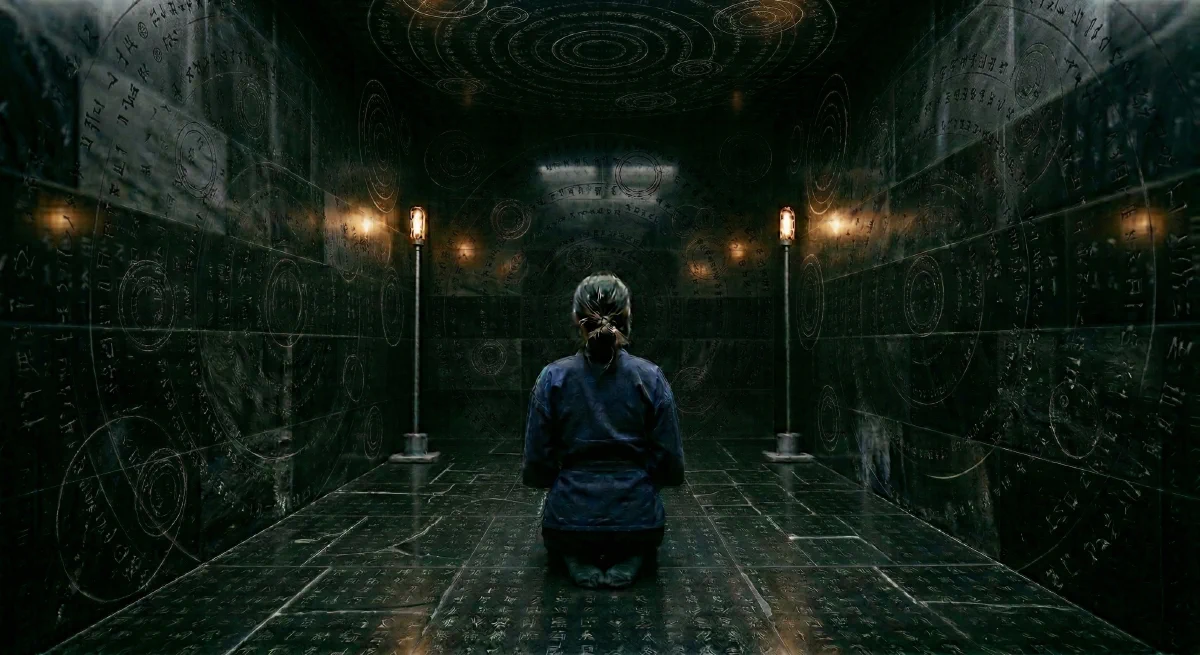
She is in the chamber by seven in the morning. The silence is complete. The industrial lights are on their standard daytime setting, and in their flat white illumination the symbols cover every surface with a density that she once found overwhelming and now finds clarifying. She can read the relational structure the way a musician reads a score: not note by note, but as a connected whole, the parts only meaningful in context with every other part.
She is making progress that she cannot easily communicate. The mathematical framework she’s built captures the lower-order and mid-order relationships, but the highest-order structure, the part that unifies everything, remains at the edge of her formal notation. She can perceive it. She can’t yet write it down. The gap between perception and language is widening, and this should concern her, and it does, in a detached and clinical way, the way an engineer notes a stress fracture in a bridge they’re building. A problem to be solved. Not an emergency.
She surfaces at nine in the evening. No knock, no “Surface.” Eli is in New Jersey and the skeleton crew doesn’t track her hours. She surfaces because her body has needs she can no longer fully override: water, a bathroom, the specific ache in her lower back that means she has been sitting on the chamber floor for too long. She logs her hours at the elevator (fourteen; she would have guessed six) and collects her phone from her workstation.
Two missed calls from Mom. She puts on her coat and walks through the corridor and up into the cold, and as she steps outside she calls her mother back.
“Merry Christmas, sweetheart. I was worried you wouldn’t call.”
“Merry Christmas, Mom. Sorry. I was working. I didn’t have my phone.”
“On Christmas.”
“There’s a lot to do.”
Helen doesn’t sigh. She doesn’t push. She says, “I made the ham. The whole thing. It’s just me and Carol came over for an hour but I made the whole thing anyway. Your father would have thought I was crazy.”
Nora registers the mention of her father. A data point: Helen invokes him on holidays, when his absence is most structural. Nora can map the pattern across years of phone calls. She does this mapping automatically, involuntarily, and the result is a topology of grief that she can perceive but not enter. Her father died when she was nineteen. She was sad. She remembers being sad. The memory of sadness is available as information but not as experience, as if the emotion has been compressed into a file format she can read but no longer run.
“I’m sure he would have approved,” she says.
“He would have told me to freeze the leftovers.”
“That does sound like him.”
A small silence. Warm, almost. The ghost of what their conversations used to be: two people who love each other finding, briefly, the frequency that lets them connect. Nora holds the warmth the way she would hold a hot cup, noting its temperature, its duration, its gradual cooling. It lasts about three seconds. Then the geometry reasserts itself, the structure of the symbols pulling at her attention the way gravity pulls at mass. She is standing on the sidewalk outside the facility in the Christmas dark and her mind is sixty metres below her feet.
“I should go,” she says. “I love you, Mom. Merry Christmas.”
“Merry Christmas, baby. Take care of yourself.”
The call ends. The street is quiet, the kind of quiet that only happens in New York on Christmas night. Nora stands for a moment with the phone in her hand. The cold air is sharp after fourteen hours in the chamber’s dense stillness, and the world above ground feels, again, like a sketch of itself: approximate, lossy, a lower-resolution version of what she has been working with all day. She puts the phone in her pocket and walks home.
The new year arrives without Nora noticing.
She knows it’s January because the date on her workstation has changed and because Eli returns from his break with a tan line from a ski trip and a new energy that she recognises as the particular brightness of someone who has been outside a classified facility for more than forty-eight consecutive hours. He looks healthy. Normal. The contrast between his ease and her stillness is visible, she suspects, to both of them, though neither mentions it.
“Happy New Year,” he says. He puts a coffee on her desk (he has started doing this; she doesn’t know when it began). “How was the break?”
“I worked.”
“Of course you did.” He sits at his own desk. Opens his laptop. Looks at her screen, where the dimensional analysis is running, and she watches his eyes move across the data and sees the moment when he registers how far she’s gone in nine days. “Jesus, Nora.”
“The cluster allocated over the holiday. I had uninterrupted computing time.”
“This isn’t just computing time. This is…” He scrolls through her results. “You’ve resolved the mid-order structure. The whole thing. The relational hierarchy from the base pairs up through the cluster topology. This would have taken a team of six months ago—”
“It would have taken a team much longer,” she says, “because they would have been working from the wrong model.”
He looks at her. The smile is still there (it’s always there; Eli’s face is built for smiling) but his eyes have a quality she hasn’t seen before. She catalogues it: focus without warmth. Assessment. He is looking at her the way she looks at data. Measuring something.
“You OK?” he asks.
“I’m fine.”
“You look tired.”
“I’ve been working.”
“You’ve been working since I left. Have you been outside?”
“I walk to the facility.”
“That’s not outside. That’s transit.” He pauses. The assessment is still in his eyes, and she can feel him deciding whether to push. He decides not to. “Show me the mid-order results. I want to understand the hierarchy.”
They work. The day passes. Eli asks good questions and she answers them and the answers are precise and complete and she watches him nod and type and occasionally frown, and she notes that the frown is appearing more often, not at the data but at her, brief and quickly suppressed, as if he keeps seeing something that concerns him and keeps deciding to let it go.
At six o’clock he says, “Surface.”
She surfaces.
They eat. He talks about the ski trip. A friend fell and broke a wrist. The lodge had a dog, a golden retriever, that slept in the lobby and would let anyone pet it. He tells these stories with his usual warmth, his usual ease, and Nora listens and responds in the places where responses are expected and the responses are appropriate and she is aware, for the first time, that she is constructing them rather than producing them. The social subroutine that once ran automatically now requires her active attention. She has to think about when to nod, when to make the small affirmative sounds that signal engagement, when to ask a follow-up question. She does all of these things correctly, but the doing of them is work in a way it wasn’t before.
Eli finishes his story. There is a pause. He looks at her across the table in the facility cafeteria, under the flat fluorescent lights, and she can see the question forming in him, the concern that has been building since he walked in this morning and saw the nine days of work on her screen and the stillness in her posture and the flat precision of her voice.
He doesn’t ask it.
“See you tomorrow,” he says.
“See you tomorrow.”
She walks home in the dark. January, the coldest week of the year. The streets are quiet. She walks and the city moves around her and the patterns are everywhere: the frequency of footsteps behind her, the oscillation of a traffic signal, the structural harmonics of a building settling in the cold. She perceives them without trying. They arrive in her awareness the way sound arrives, continuously, layered, a landscape of mathematical structure that overlays the visible world.
She stops on the corner outside her building and looks up. The sky is clear, a rare thing in Manhattan, and the stars are visible above the light pollution (a few, anyway, the brightest, flickering in the cold air), and she can see, in the pattern of their flicker, the atmospheric distortion that produces it: the turbulence of air cells at different temperatures, the refractive index varying across density gradients, the path of light bent and re-bent through layers of medium. The stars are not twinkling. They are being processed by the atmosphere, their signal degraded by the medium between them and her eyes, and she can see the degradation as a structure, can trace the mathematics of it, and the mathematics is beautiful in the same way the geometry of the chamber is beautiful, because it is the same geometry, or a subset of it, or an expression of the same underlying thing.
She stands on the corner in the cold and looks at the stars and feels, for the last time (though she doesn’t know it’s the last time), a sense of wonder.
Then she goes upstairs.
The apartment. The white walls. The approximately-right angles. She doesn’t turn on the light. She goes to the bathroom, brushes her teeth (she has not eaten dinner and does not notice), and gets into bed.
The geometry does not stop when she closes her eyes. It was there in the chamber. It was there on the street. It is there in the dark of the apartment, the relational structure of the symbols rotating slowly in a space that is not visual and not spatial but something else, something she is building a vocabulary for but has not yet named. She lies still and the geometry moves through her, or she moves through the geometry, or the distinction between the two is not a distinction.
She does not fall asleep so much as the boundary between waking and sleep thins to nothing, and the work continues in whatever state she enters, and she is aware of this, distantly, and she is not troubled by it.
She is not troubled by anything.