Chapter 5
The briefing is on a Wednesday. Second or third week of January; Nora is not tracking dates with precision. The distinction between weeks has joined the distinction between weekdays and weekends in the category of measurements that no longer carry useful information. Calloway’s office. The small conference table. A laptop open to her latest report.
“The relational hierarchy extends beyond the cluster topology we mapped in December,” she says. “The mid-order structure operates as a…”
She stops. The word she needs does not exist in English. The concept her formal notation captures precisely — a mathematical object describing how sets of symbol relationships modulate in response to perturbations in their neighbouring sets — does not have a linguistic equivalent. Field implies continuous distribution, and this is discrete. Network implies nodes and edges, and this is holistic. Substrate is approximate. Medium is wrong.
“A propagation layer,” she says. “A relational layer that transmits structural information across the entire symbol set simultaneously. When one relationship is perturbed, the effects propagate through every other relationship. The system behaves as a single computational object.”
Calloway writes something on his notepad. His handwriting is small, administrative. “Can you quantify your progress?”
“I’ve formally described approximately forty percent of the complete structure. The remaining sixty percent is accessible to my perception but has not yet been transcribed into the notation system. The formal description lags behind my…” She pauses. Understanding is wrong. Understanding implies a subject comprehending an object. What she has is convergence. The structure of her analytical model and the structure of the symbols are approaching congruence. “My analytical model,” she says.
The approximation settles in her like an error she can feel but not correct. She is aware that this happens more frequently now: the moment where language fails to carry what she perceives. Words are a compression format. They reduce high-dimensional structures to one-dimensional sequences of phonemes, and the compression is lossy, and she notices the loss in a way she didn’t before, the way a musician with absolute pitch notices a piano tuned two cents flat. Not wrong. Just insufficient.
“Forty percent,” Calloway says. “And the timeline for the rest?”
“The rate is accelerating. The framework becomes more complete with each resolved relationship, and each new resolution makes the next one more tractable. The process is nonlinear.” She pauses. “I’ll know more when the highest-order structure begins to resolve.”
Calloway nods. He looks at her across the table, and she can read his expression with the same precision she applies to the symbols: satisfaction modulated by a secondary signal she identifies as concern, the concern subordinate to the satisfaction, both of them outputs of an institutional calculus she can trace from input (her results) through process (his career imperatives, his genuine intellectual curiosity, his liability awareness) to output (continued support, increased attention, the faint gravitational pull of a man whose investment is paying off).
“Is there anything else you need?”
“No.”
She returns to the analytical room. Eli looks up as she enters, and she notes the calibration his face performs: the quick scan, the adjustment. He does this every time she enters a room now, a rapid assessment she can see him performing, checking her against some internal model he maintains. She does not know what the model predicts. She knows only that the assessment occurs, and that the frown it produces is no longer suppressed.
The chamber absorbs twelve hours of her day now. Sometimes fourteen. She arrives before the analytical room’s overhead lights have switched from their nighttime to their daytime mode and she descends, and Eli’s “Surface” knock comes at intervals she cannot estimate because the chamber does not have intervals. It has the work, and the work has its own duration, measured in resolved relationships, not minutes.
She eats when Eli puts food in front of her. She does not eat otherwise. The food is a substrate: calories and macronutrients, inputs to a biological system that requires maintenance. She processes it without preference, without attention, the mechanical throughput of a system sustaining itself.
She is aware that she sits differently. Her spine is straight, aligned along the vertical axis with a precision she did not choose. Her hands rest at angles that minimize muscular effort and maximize surface contact with whatever she’s touching: the chamber floor, the desk, the armrest of her chair. The positions are efficient. They arose the way the pattern perception arose: as a consequence of the geometry, an optimization her body has performed without consulting the part of her that used to care about how she looked to other people.
She does not blink at normal intervals. She has noted this. The average human blink rate is fifteen to twenty per minute, a function of corneal hydration and social signaling. Her rate has dropped to four or five per minute, the minimum required for hydration, the social component eliminated. She did not decide to eliminate it. It was removed the way noise is removed from a signal: by the ongoing optimization of a system toward its primary function.
The patterns outside the text have become ambient. Walking to the facility: the structural mechanics of every moving object resolve into equations she does not consciously compute. Pedestrians are flow dynamics. Traffic is an optimization problem whose suboptimal solutions she can see as clearly as a chess player sees a blunder. None of this is interesting anymore. It was interesting when it was new. Now it is simply there, constant, total, the mathematical substrate of the visible world rendered permanently accessible by a perceptual framework she did not ask for and does not want to lose.
Sunday. Her phone is at her workstation. She is in the chamber.
She does not think about four o’clock. She does not think about Helen. The call exists in a category of scheduled events that her mind has deprioritized, not deleted but moved to a queue that processes on a cycle she no longer maintains.
She surfaces at eight in the evening. Eli is gone (he still observes weekends, at least partially; this registers as a parameter of his operating configuration, neither admirable nor inefficient). She collects her phone from her workstation. Three missed calls from Mom. One text: Call me when you can.
She registers the pattern. Three calls: the first at four o’clock (the scheduled time), the second an hour later (concern), the third later still (fear). She dials.
Helen picks up on the first ring.
“Nora.”
The word carries more information than its four phonemes should hold. Relief, anger, fear, love. She can identify each component, separate them, assign relative magnitudes. The relief is largest. The fear is second.
“I’m sorry. I was working. I didn’t have my phone.”
“It’s Sunday.”
“I know.”
“You forgot.”
She considers whether forgot is accurate. Forgetting implies that the information was stored in active memory and then lost. What happened is different: the call was never promoted from background storage to active attention. The system that once performed this promotion automatically (Sunday, four o’clock, call Mom) has been reassigned to tasks with higher priority weighting.
“I lost track of time,” she says. This is the expected response. It is also technically accurate.
“Nora, you’re scaring me.”
The sentence registers. She processes it: scaring is an emotional state in Helen caused by accumulated signals (the missed call, the changed vocal patterns, the Christmas call from the sidewalk, the mounting evidence that her daughter is becoming something she doesn’t recognize). The fear is rational. The inputs support the conclusion.
“I’m fine, Mom. I’m focused on the work.”
“You keep saying that. Focused. You keep saying that word like it explains everything.”
“It does explain it.”
“It doesn’t explain why you sound like a stranger on the phone.”
Nora notes the description. Stranger. In their previous call, Helen said you don’t sound like yourself. The escalation from not yourself to stranger represents a categorical shift: from deviation to replacement. Helen is no longer hearing a changed version of her daughter. She is hearing someone else.
“I’m sorry I missed the call. I’ll set an alarm.”
“I’m thinking about coming to visit.”
“That isn’t necessary.”
“It’s not about necessary. I want to see you.”
“The project is classified. I can’t have visitors at the facility, and I’m at the facility most of the time. There wouldn’t be much of a visit.”
“We could have dinner. An hour. I’d come to New York just for an hour, Nora, I don’t care.”
“I’ll think about it.”
“Nora.”
“I said I’ll think about it.”
The silence that follows is not their silence. Their silence (the comfortable, limited pause that punctuated years of Sunday calls) required two participants inhabiting a shared space. This silence is unilateral. Helen is waiting. Nora is not.
“I love you,” Helen says. The too-loudness is gone. She speaks quietly, and the quietness carries a meaning Nora can identify but not access: the shift from a mother performing care through routine to a mother performing care through desperation.
“I love you too,” Nora says. The sentence is a string she produces from storage. It is accurate. The structural fact of love persists in her architecture. Its interface with language has degraded further since the last time she produced this output.
She ends the call.
Maren appears in the analytical room on Tuesday.
She hasn’t been here in weeks. Her advisory role keeps her in her separate office, reviewing reports, maintaining the historical archive. Nora has not thought about Maren. Maren occupies a region of her attention map that was deprioritized after their corridor conversation in December — data processed, conclusion reached, file closed.
Maren stands in the doorway and looks at Nora. Looks for a long time.
Nora is at her workstation. Spine straight, hands flat on the desk surface, eyes on the screen where the notation scrolls. She does not look up. She is aware of Maren’s presence the way she is aware of the ventilation hum: as a parameter of the environment that does not require response.
“Nora.”
She looks up. Maren’s face is a configuration of muscle tensions she can read: the contraction around the eyes (concern), the set jaw (determination), the micro-movements of the lips (words being rehearsed and discarded). Maren has come here with a purpose.
“Dr. Asher.”
“When did you last eat?”
“Eli brought sandwiches at…” She accesses the memory. “Approximately one o’clock.”
“That was eight hours ago.”
“I’m not hungry.”
Maren walks into the room. Closer. She stops and looks at Nora’s posture, her hands, her face. The looking has the quality of a clinical assessment. Maren is checking against her own experience and finding that the map no longer covers the territory.
“You’re further than I was,” Maren says. Her voice is steady but the steadiness costs her something. “When I pulled myself off, I was seeing patterns in wallpaper and breathing rhythms and I was scared enough to stop. You’re past that. You’re past it by a long way.”
“The pattern perception is a natural extension of the analytical framework.”
“That’s what I told myself.”
“I’m not telling myself anything. I’m reporting an observation.”
“Do you hear yourself?” Maren’s voice drops, not in volume but in register, something lower, more urgent. “Do you hear how you sound?”
“Precise.”
“Empty.”
Nora considers this. Empty implies absence. She does not experience absence. She experiences clarity. The distinction is not one she can communicate in a form Maren would accept, because Maren’s frame of reference is calibrated against a version of consciousness that Nora has moved beyond, the way a three-dimensional framework cannot represent a four-dimensional object. Maren’s observation is accurate. Her interpretation is wrong.
“I appreciate your concern,” Nora says. “I have work to do.”
Maren stands there for another ten seconds. Then she turns and leaves. Nora hears her footsteps in the corridor, hears them turn in the direction of Calloway’s office, hears them accelerate.
She returns to the notation.
Eli is careful about it. He waits until evening, when the analytical room is empty and they’re eating in the cafeteria (he’s eating; she has an untouched sandwich on a plastic tray).
“Eat,” he says.
She picks up the sandwich. Takes a bite. Chews. The flavour registers as data: salt, protein, the fermented tang of processed cheese. She swallows.
“I talked to Maren,” he says.
“She was here this afternoon.”
“I know. She came to find me after. Then she went to Calloway.” He sets his coffee down. The gesture is deliberate. She can read the decision in his posture: the squaring of the shoulders, the sustained eye contact, the physical reorganization of a person who has decided to stop holding back. “I need to talk to you about something that isn’t the work.”
“OK.”
“You’ve changed.”
“Yes.”
The confirmation surprises him. She sees it: the brief widening of the eyes, the arrested hand that was reaching for his coffee. He expected denial.
“You’re not eating unless I feed you,” he says. “You’re in the chamber twelve, fourteen hours a day. You sit like…” He gestures at her posture, her hands, the rigid geometry of her spine. “Like that. Still. Locked. You don’t blink, Nora. I’ve been watching. You barely blink.”
“The blink rate reduction is a function of decreased social signaling and optimized corneal hydration. It’s not clinically significant.”
“That sentence is clinically significant.”
She considers this. She can see his argument: the sentence itself, its construction, its vocabulary, its flat precision, is evidence for the phenomenon he’s describing. She can follow the logic. She disagrees with the conclusion.
“My cognitive function is at its highest measured level,” she says. “The work I’m producing is unprecedented. Every metric available to you confirms that I’m performing at a capacity I’ve never reached before.”
“That’s not the metric I’m worried about.”
“What metric are you worried about?”
“You. Nora. The person.” He leans forward. His face is open, unguarded, and the expression on it is one she can catalogue (grief, specifically anticipatory grief, the mourning of something that hasn’t yet fully died but whose dying is visible) but cannot feel the weight of. “Are you still in there?”
She looks at him. Eli Navarro. Berkeley mathematics. Defence contractor. DOE. Recruited by Calloway. Drinks terrible coffee. Face that smiles easily. Kind in a way that doesn’t require reciprocation. She can trace the entire structure of their relationship: the initial professional respect, the shared intellectual excitement, the camaraderie of two people working a problem no one else can work. She can identify the point at which his concern shifted from professional to personal. She can map the trajectory of his worry across weeks of suppressed frowns and unasked questions and coffees placed on her desk. She can see all of it, the complete architecture of his caring, and it is legible to her, structurally clear, and she can describe it with the same precision she applies to the symbol set.
“Your concern follows a predictable trajectory,” she says. “You observed behavioral changes over a period of weeks. The changes accumulated past a threshold your internal model codes as ‘something wrong.’ The emotional response is proportional to the magnitude of the perceived change, modulated by the personal investment you’ve developed through proximity and shared purpose.” She is not being cruel. She is being accurate. “What you’re interpreting as loss is actually gain. The behaviours I’ve shed (the social signaling, the eating rituals, the sleep patterns, the baseline inefficiencies of an unoptimized cognitive system) were suboptimal for the work. Their removal has been replaced by capacity. I am more capable now than I was when I arrived. More perceptive. More productive. Every objective measure confirms this.”
Eli is quiet. He is looking at her with an expression she can read but cannot feel: grief, and helplessness, and the particular horror of watching someone you care about explain, with perfect logic, why your caring doesn’t matter.
She cannot make the chain matter.
“The work adjusted me,” she says. “The adjustment is not degradation. It’s alignment.”
“Alignment with what?”
“With the structure.”
“The structure of the symbols.”
“The structure of everything. The symbols are a notation for it. But the thing they describe is everywhere. I can see it now. In the symbols. In the data. In the traffic on the street.” She looks at him. “In you.”
“What do you mean, in me?”
“You’re a system, Eli. A complex one, self-sustaining, self-modifying. The neural architecture producing the emotional states I’ve been describing, the electrochemical cascades, the behavioural outputs. I can see the structure of it. And it’s not different from the structure of the symbols. It’s the same thing, operating at a different scale.”
Eli stands up. His chair scrapes the floor. He stands and looks at her, and what she sees on his face is not the suppressed frown anymore, not the carefully managed concern. It is something fully expressed: a threshold crossed. The muscles of his face are arranged in a configuration that means I have lost you and I don’t know how to get you back.
“I’m going to talk to Calloway,” he says.
“Maren already did.”
“I know. I’m going to talk to him anyway.”
He leaves. His coffee is still on the table, half finished. Steam rises from it in a convection pattern she can model. She watches it for four seconds, notes the laminar-to-turbulent transition at the boundary layer, then picks up the sandwich and takes another bite.
Calloway comes to the analytical room the next morning. Nora knows why. The causal chain is visible: Maren’s visit, Eli’s conversation, the overnight processing time an administrator requires to formulate an institutional response to a personnel concern. The fact that he comes to her, rather than requesting her presence in his office, tells her that the decision has already been made.
“Ms. Keene.” He stands in the doorway. Same suit. Same tie. “I understand Dr. Asher and Mr. Navarro have raised some concerns about your wellbeing.”
“They have.”
“They suggest you may be experiencing adverse cognitive effects from the analytical work.”
“The work has altered my cognitive profile. This is true. The alteration has improved my analytical capacity. This is also true.”
Calloway enters the room. He sits in the chair beside her workstation, and the sitting means something: a performance of personal attention, the institutional body language of a manager taking a concern seriously.
“We have a psychological support protocol,” he says. “I’d like you to schedule an evaluation.”
“An evaluation would consume approximately three hours. In three hours, I can resolve an additional cluster of higher-order relationships.”
“This is not optional, Nora.”
She calculates. The evaluation is a gate: a procedural requirement that, once satisfied, permits the work to continue. Refusing creates institutional friction. Accepting costs three hours and produces a document that will either clear her (likely, given that her cognitive function is measurably elevated) or recommend action (unlikely, given that no clinical framework exists for the specific changes she’s undergone).
“I’ll schedule it this week.”
Calloway nods. He stands. The pause before he speaks contains the decision she already identified: the weighing of concern against results, the institutional calculus that has determined, once again, that the results outweigh the concern. She can see it being performed behind his forgettable face: the reports she’s producing, the unprecedented progress, the interagency attention, the career implications, the genuine scientific significance, all of it arrayed against the complaints of two colleagues whose concerns, while noted, are not supported by any objective measure of impairment.
He chose the results before he entered the room. The conversation was procedural, not deliberative.
“Keep up the good work,” he says, and leaves.
She descends.
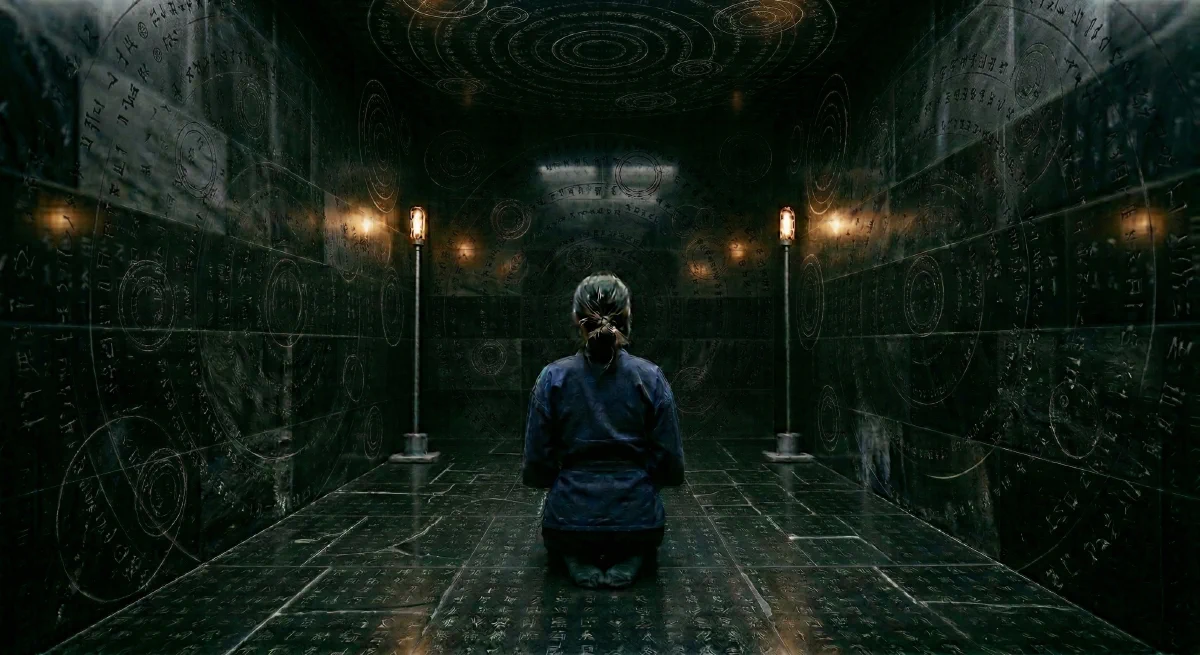
The elevator, the corridor, the pressure door. The chamber receives her the way it always does: the air thickens, the silence closes in, the symbols resolve on every surface. She sits on the floor, spine straight, hands at her sides, and the geometry opens.
She has been mapping the relational structure for weeks now. Forty percent formalised, sixty percent perceived. But tonight the perceived structure is doing something new. Not shifting. Not expanding. Clarifying. The gap between what she perceives and what she can formalise is closing, and as it closes, a property of the structure becomes visible that was obscured by the gap itself.
The symbols are not a language. She has known this from the beginning. They are not a code, not a notation, not a message. They are not communication of any kind.
They are an instruction set.
The recognition arrives without surprise. It is not a breakthrough (the word implies discovery, and this is not discovered so much as revealed, the way the bottom of a pool becomes visible as the water clears). The symbols encode operations. Not descriptions, not representations, not meaning in any linguistic sense. Operations. Procedures. Steps in a computation that executes not on hardware or paper but on the perceptual architecture of the mind that comprehends them.
She is not reading the symbols. She is running them. Her mind is the processor. The symbols are the program. And the output is the progressive reconfiguration of her perceptual system to match the structure they describe: the structure that is not contained in the chamber, not limited to the symbols, but present everywhere, in everything, the substrate beneath physics, the mechanism beneath matter, the thing that the universe is actually doing when it appears to be doing what we think it’s doing.
She knows this. She knows it the way she knows the geometry: not as a conclusion reached through argument but as a fact apprehended through direct perception. The symbols are changing her because that is what they do. That is what they are for. And she will continue because the alternative is to stop, and stopping would mean returning to the imprecision, the noise, the lossy compression of ordinary consciousness, and she cannot want that, because wanting itself has been optimized, restructured, aligned with the work, and the alignment is not a cage. It is a clearing.
She sits in the chamber and the geometry moves through her and the work continues.
The work is all there is.