Chapter 6
The evaluation takes ninety minutes.
Dr. Linden is a clinical psychologist contracted through DOE’s occupational health division. She has grey hair and a lanyard and a clipboard with printed questionnaires and she sits across from Nora in a small room on the facility’s ground floor and asks questions in a voice calibrated for neutrality. Nora identifies the calibration: pitch centered, pace measured, no rising inflections that might signal judgment. Dr. Linden has done this before. The neutrality is professional, not personal.
“How would you describe your sleep quality?”
“Adequate.”
“Can you elaborate? Hours per night, difficulty falling asleep, any changes from your baseline?”
Nora considers. The concept of sleep as a bounded state, a period with a beginning and an end, has become approximate. She enters a low-processing mode when her body requires it. She exits when it doesn’t. The transition in either direction is no longer marked by anything she would call falling asleep or waking up.
“I average five to six hours. No difficulty.”
This is technically accurate. Five to six hours of reduced activity. No difficulty because difficulty implies a threshold between states, and the threshold has dissolved.
“How would you describe your mood?”
“Stable.”
“Any feelings of anxiety, depression, irritability?”
“No.”
“Any changes in appetite or eating habits?”
“I eat regularly.” When Eli puts food in front of her. This is regular.
“And your work. Are you experiencing any difficulties with concentration or cognitive function?”
“No. My cognitive function is at its highest measured level.”
Dr. Linden writes something. Nora can read the handwriting upside down (this is not a skill she acquired from the work; she has always been able to read upside down): Patient presents as focused and cognitively sharp. Affect somewhat flat. Eye contact sustained but infrequent blinking noted.
The evaluation continues. A standardised cognitive battery: pattern completion, spatial reasoning, working memory, processing speed. Nora completes each section. Her scores are the highest the battery can measure. In two subtests, she finishes before Dr. Linden has finished reading the instructions.
Dr. Linden notes this with what Nora identifies as professional interest modulated by mild unease. The unease is subtle. It manifests as a slight increase in the rate at which Dr. Linden checks her clipboard, a microadjustment in posture. She is encountering something her clinical framework does not have a category for: a patient who shows signs of atypical affect but whose cognitive performance is not merely unimpaired but extraordinary.
“One last question. Do you feel that the work has changed you in any way?”
“Yes.”
Dr. Linden looks up. She expected qualification, hedging, the reflexive self-protection of someone being evaluated for fitness. She did not expect a direct affirmative.
“Can you describe the changes?”
“Increased perceptual acuity. Expanded analytical capacity. Reduced latency in pattern recognition. Altered sleep architecture. Decreased interest in social interaction.” Nora pauses. “These changes are consistent with cognitive optimization in response to a demanding analytical task.”
Dr. Linden writes for a long time.
The report, when it reaches Calloway, will recommend a follow-up evaluation in thirty days and note the atypical affect and reduced social engagement. It will not recommend removal from the project. There is no clinical basis for removal. Nora’s cognitive function is exceptional. Her self-report is consistent and coherent. The changes she describes are, within the available diagnostic framework, attributable to occupational stress and high-intensity analytical immersion. The framework does not contain what is actually happening. Nora knows this. She watches the gate open and walks through it.
February. The formal description reaches sixty-two percent.
The remaining thirty-eight percent is no longer perceived at a distance. It is present in her the way the first forty percent was present in her notation: fully resolved, structurally integrated, accessible. The difference between perceived and formalised has become a transcription problem. She knows the complete structure. Writing it down is a mechanical task she performs because the institution requires documentation and because Eli needs the notation to follow her work.
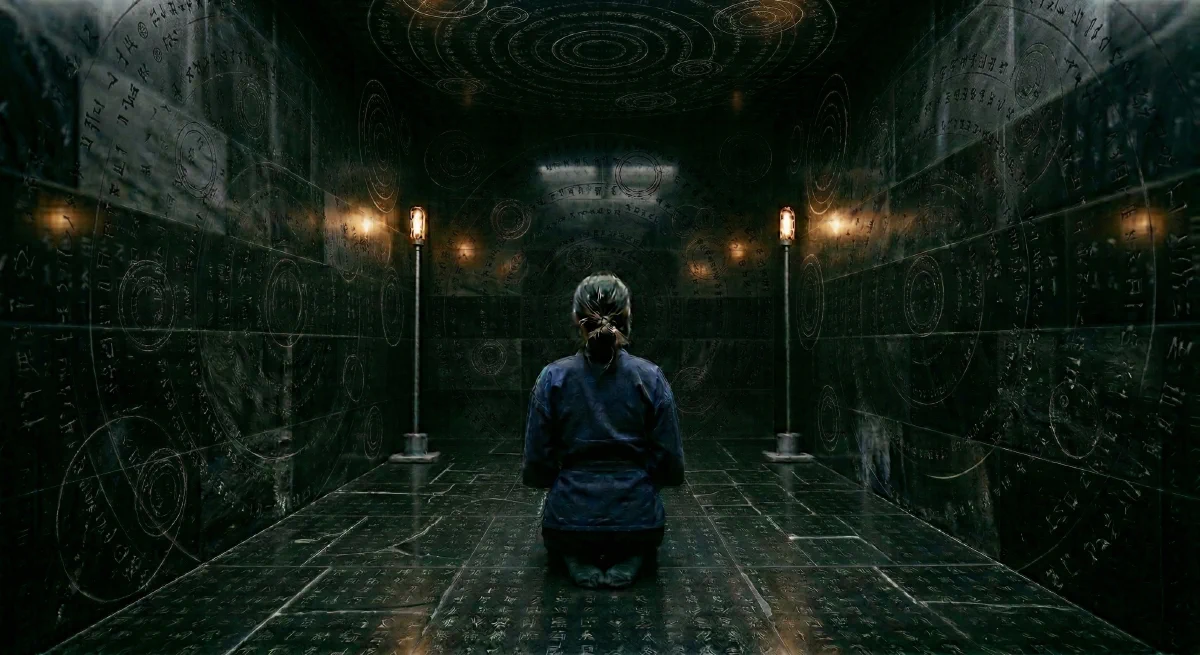
She is in the chamber sixteen hours now. Sometimes eighteen. The distinction between long sessions and short ones has collapsed. There are sessions and there is not-session. The not-session is transit: the elevator, the corridor, the cafeteria, the walk home, the hours of low-processing in the apartment. Transit is the time between the work. It has a duration she does not track.
Her body operates on a maintenance schedule she did not design. It requires water at intervals. Food, less frequently. Bathroom. The specific complex of signals that, in aggregate, mean the body has reached a threshold and must be moved to a horizontal surface for a period. She services these requirements. She does not experience them. They are interrupts in a processing cycle, handled and returned from.
Eli still knocks. Twice, then “Surface.” She surfaces. This is the routine. It persists because Eli persists. She has noted that his persistence is not a function of optimism. It is a function of loyalty to a version of her that his internal model still maintains, a Nora-shaped template he measures her against each time she comes through the pressure door. The template is increasingly inaccurate. He continues to maintain it.
Helen calls on a Tuesday to say she’s coming.
Not asking. Not suggesting. Coming. “I’m taking the bus Friday morning. I’ll be there by noon.”
Nora’s phone is at her workstation. She has surfaced for water and finds the voicemail. She plays it and extracts the information: Helen, bus, Friday, noon. The emotional content of the message (determination layered over fear layered over love) registers as metadata. She notes it.
She calls back.
“Mom.”
“I’m coming, Nora. Don’t talk me out of it.”
“I wasn’t going to.”
This is true. The energy required to construct and deploy a persuasive argument against Helen’s visit exceeds the energy required to allocate ninety minutes to the visit itself. The path of least resistance is compliance.
“I just want to see you. We can get lunch. An hour.”
“There’s a restaurant on Second Avenue. I’ll text you the address.”
“Are you… is it OK? You sound…”
“I’ll see you Friday.”
She ends the call. Returns to the chamber.
Friday. Nora surfaces at 11:47. She changes from the facility clothes (the same clothes she has been wearing for three days; she has not registered this) into a different set. She does this because the social protocol of meeting one’s mother requires a baseline of presentability that her current state does not meet. She identifies the protocol, executes it, walks to the restaurant.
The restaurant is small, on Second Avenue, four blocks from the facility. She chose it for proximity. She arrives first. Sits. The room is a sensory environment she can decompose without effort: eighteen tables, forty-one chairs, seven occupied, three staff, fluorescent-to-warm conversion lighting at 3200K, ambient noise at approximately 68 decibels, the combined olfactory signature of cooking oil and garlic and floor cleaner. She sits in a chair near the window and waits.
Helen comes through the door at 12:08.
Nora watches her mother enter. Helen is sixty-one. She is wearing her blue coat, the one she bought at the outlet mall in Scranton two years ago (Nora accesses this datum by its structural relationship to other Helen-data, not by chronological memory). She carries a purse and a small shopping bag. Her hair is shorter than the last time Nora saw her (September, Wilkes-Barre, a Saturday visit that lasted four hours). She looks older. The aging has accelerated in ways that Nora can quantify: increased periorbital wrinkling, reduced skin elasticity in the jaw and neck, a shift in gait mechanics suggesting early joint degradation in the left hip.
Helen sees Nora and smiles, and the smile is a complex output: relief (she’s here, she’s alive, she’s sitting in a restaurant like a normal person) competing with something Nora can identify but that Helen is trying to suppress. Fear. The fear flickers in the microexpressions around Helen’s eyes and mouth before the smile covers it.
“Sweetheart.”
Helen crosses the room and opens her arms and Nora stands and receives the embrace. Helen’s body against hers: skeletal frame, soft tissue, the specific pressure distribution of a person holding on. Heart rate elevated. Respiration shallow. Helen is trembling, a fine motor tremor in the hands and forearms. She is afraid.
The embrace lasts seven seconds. Helen pulls back and holds Nora at arm’s length and looks at her.
Nora can see what Helen sees. She can construct it from the data: the posture (spine locked vertical, shoulders squared, the geometric efficiency that her body has adopted), the face (reduced expression, blink rate approximately four per minute, eyes tracking with a precision that human eyes are not supposed to have), the stillness (she does not shift weight, does not fidget, does not perform the small continuous adjustments that the human body makes when it is inhabited by a person who is fully present in it).
“You look thin,” Helen says.
“I’ve been eating.”
“You look…” Helen stops. Her hands are still on Nora’s arms. The tremor has increased. “Sit down. Let’s sit down.”
They sit. Helen across from her, the small table between them, the restaurant continuing around them. A waiter approaches. Helen orders coffee. Nora orders water. Helen opens her mouth to say something about this (about Nora not eating, not ordering food, the ritual of lunch that was the premise of the visit) and then closes it.
“Tell me about work,” Helen says. The request is a structure: something to fill the space, a familiar groove, the same question she has asked in a hundred phone calls. But her eyes are doing something her voice is not. Her eyes are scanning Nora’s face, her posture, her hands, with an intensity that Nora recognises as pattern recognition. Helen is looking for her daughter.
“The work is progressing well. I’m in the final phase of the formal description.”
“What does that mean?”
“I’m documenting the complete structure of the system I’ve been analysing.”
“And then what?”
Nora considers. Then what. The question implies a future beyond the work: a project ending, a return to a prior state, a normal life resumed. She processes the question and finds no answer that would be accurate and also comprehensible within Helen’s frame of reference.
“Then the next phase.”
Helen nods. She is holding her coffee cup with both hands. The grip is tight. Her knuckles are white. “Carol says hello,” she says. “She’s doing physical therapy for the knee. She says to tell you she can almost dance again.”
“That’s good.”
“She asked about you. I told her you were busy with work.”
“That’s accurate.”
Helen flinches. The flinch is small, contained, visible only in the momentary contraction of the orbicularis oculi and the slight retraction of the head. The word accurate did it. Not the content but the register. Nora has responded to a social bid (Carol’s concern, transmitted through Helen as a gesture of community and connection) with a term from data validation. Helen heard it.
“Nora.” Helen sets down the coffee. Her voice has changed. The social performance has dropped away and what remains is something Nora can identify as raw emotional output, unfiltered, unmeasured. “Look at me.”
Nora looks at her. She has been looking at her.
“What’s happening to you?”
“Nothing is happening to me.”
“Something is happening. I can see it. You’re sitting there like…” Helen’s voice breaks. The break is a waveform disruption: frequency instability caused by the vocal cords failing to maintain tension under emotional load. “Like a statue. You don’t move. You’re not blinking. You’re talking to me like I’m… like I’m a form you’re filling out.”
Nora processes this. Helen’s observation is accurate. Her interpretation is the standard one: something is wrong. The wrongness is mapped to illness, to crisis, to the categories a mother uses when her child is in danger. Helen does not have the framework for what is actually occurring, and providing the framework would not help. The truth is not reassuring.
“The work is demanding,” Nora says. “The intensity affects how I interact. It’s temporary.”
“You said that last time. On the phone. You keep saying it’s temporary.” Helen’s eyes are wet. The tear production is a physiological stress response: the lacrimal glands activated by the emotional processing centers, fluid accumulating at a rate Nora can estimate. “I took a three-hour bus ride because my daughter sounds like a stranger on the phone and I needed to see her, and I’m sitting here and I’m looking at you and, Nora, you’re…” She stops. Wipes her eyes with the back of her hand. “You’re not here.”
Nora considers the statement. You’re not here. She is present at these coordinates. Her body occupies this chair. Her sensory systems are processing this environment. But she understands what Helen means, and the understanding is structural, a logical parsing of the metaphor: here means present in the way a person is present, engaged, responsive, reachable. Helen is saying that the thing sitting across from her meets the physical criteria for her daughter but not the essential ones.
This is correct.
“I’m sorry you’re worried,” Nora says. “The project will end. I’ll come home.”
“When?”
“I don’t know.”
Helen reaches across the table and takes Nora’s hand. The contact is warm. 36.4 degrees, surface temperature of a human palm with elevated peripheral circulation consistent with emotional arousal. Helen’s fingers close around hers. The pressure is firm, communicative, the tactile equivalent of shouting.
“Do you remember when you were small,” Helen says, “and you’d get so focused on something that I’d have to say your name three times before you’d look up? A book, or a puzzle, or that little calculator your father gave you. And I’d say Nora, Nora, Nora, and on the third one you’d look up and blink like you were coming back from somewhere.”
Nora accesses the memory. It is available. The structural data: a kitchen, afternoon light, a child seated at a table, the pattern of her mother’s voice rising through layers of concentration. The emotional content that once accompanied this memory (warmth, safety, the particular feeling of being known) is present as metadata, tagged but not executable. She can read the label. She cannot run the program.
“I remember,” she says.
“I’m saying your name,” Helen says. “Nora. Can you come back?”
The restaurant is quiet around them. Someone drops a fork. A phone rings. The systems of the room continue their operations. Nora sits with her mother’s hand around hers and processes the request. Come back. Helen is asking her to reverse the optimization, to reengage the social and emotional systems that have been deprioritized, to become the person Helen’s model predicts. The request is coherent. It is beyond her capacity to fulfill, not because the capacity has been destroyed but because the systems Helen is asking her to reactivate have been integrated into a larger architecture that does not support their independent operation. She cannot come back because back is not a location that exists in the topology she now inhabits.
She does not say this. She says: “I’m right here, Mom.”
Helen holds her hand for another twelve seconds. Then she releases it and picks up her coffee and drinks and sets it down and the motions are mechanical, the automatic operations of a body whose operator is somewhere else, processing, absorbing, failing to reconcile what she expected with what she found.
They talk for another thirty minutes. Helen talks. She tells Nora about the garden (the neighbour’s dog again, a section of fence that needs replacing), about Carol (the physical therapy, a trip planned to her sister’s in March), about the church (a new minister, younger, Helen isn’t sure about him). Nora listens. She responds at intervals. The responses are accurate. They are not conversation.
Helen pays the check. Nora does not think to offer. They stand. Helen looks at her one more time, a long look that Nora can read completely (grief, fear, love, helplessness, the specific configuration of a parent confronting the loss of a child who is still technically alive) and cannot feel.
“I love you,” Helen says.
“I love you too.”
The words are produced from the same storage location as last time. Unchanged. The structural fact persists. Its expression is a string.
Helen picks up her bag and her purse and puts on her blue coat and walks out of the restaurant and turns right toward the bus station and Nora watches her through the window, a figure in blue moving through the pedestrian flow dynamics of Second Avenue, diminishing, turning a corner, gone.
Nora sits for another forty seconds. She finishes her water. She stands. She walks four blocks to the facility and badges through the checkpoints and descends.
Maren is in the corridor outside the analytical room.
She has been waiting. Nora can see this in the posture (weight distributed for extended standing), the position (line of sight to the elevator), the expression (resolved, final, the configuration of a person who has made a decision and is executing it).
“I’m leaving the project,” Maren says.
“I know.”
This is not deduction. It is pattern completion. Maren’s behavioral trajectory has been converging on this point since their conversation in December. The warning in the corridor (Stage 1), the confrontation in the analytical room (Stage 2), the appeal to Calloway (Stage 2, failed), the psych eval clearance (the last institutional gate that might have stopped this, opened and walked through). Each step narrowed Maren’s option space. What remains is exit.
“I submitted my resignation to Calloway this morning,” Maren says. “He accepted it. He didn’t argue.” She pauses. “He didn’t argue because you passed the evaluation and because the results are too good and because arguing would mean acknowledging that the evaluation missed something, and acknowledging that would mean the institution has to act, and the institution does not want to act.”
“Your analysis of the institutional dynamics is accurate.”
Maren looks at her. The looking lasts eight seconds. Nora can read every component: recognition (she sees what Nora has become), grief (for the person Nora was), guilt (for not stopping it, for not being able to stop it), fear (for what comes next, the thing she is leaving Nora to become). And beneath all of it, something Nora identifies as professional identification: Maren recognises the topology of Nora’s cognition because she once inhabited the edge of it, the way a person who has stood at the rim of a canyon recognises the canyon, and what she sees now is someone who has gone over the edge and is falling and does not know she is falling because falling is, from the inside, indistinguishable from flight.
“There’s nothing I can say that would make a difference,” Maren says.
“No.”
“I know. I’ve known for weeks. I stayed because…” She stops. Her jaw tightens. The musculature of the face performing the suppression of an emotional response. “I stayed because I thought if the evaluation flagged something, if Calloway was forced to act, then maybe. But it didn’t. And he wasn’t.”
“The evaluation measured what it was designed to measure. I am cognitively unimpaired.”
“You are cognitively unrecognisable.”
Nora registers the distinction. Unimpaired versus unrecognisable. Maren’s reframing is precise: the evaluation tests for degradation and finds none; what has occurred is not degradation but transformation, and transformation is not in the diagnostic manual.
“I hope I’m wrong about what I think is happening,” Maren says. “I hope you finish the work and go home and it fades, the way it faded for me.”
“It won’t.”
The statement is not prediction. It is observation. Nora can perceive the irreversibility of her own restructuring the way she can perceive the relational structure of the symbols: directly, without inference, as a property of the system she is becoming. What happened to Maren was a surface perturbation, a temporary resonance that dissipated when the input was removed. What is happening to Nora is architectural. The input has become the architecture. Removing the symbols would change nothing because the symbols are no longer the source. She is.
Maren nods. She does not say goodbye. She turns and walks toward the elevator. Her footsteps are even, measured, and they do not accelerate this time. She has made her peace.
Nora watches her go. The corridor is empty. The fluorescent lights hum at 60 Hz. The ventilation system cycles. Maren enters the elevator and the doors close and the machinery engages and the sound of her departure propagates through the building’s structure and fades.
A system has terminated.
Nora descends.
Eli is in the analytical room when she returns from the chamber that evening. He’s at his desk. His laptop is open. He closes it when she enters.
She notices the closing. The gesture is deliberate, the speed and angle of the screen’s descent calibrated to appear casual. It is not casual. Eli is concealing something. She can model the concealment: the content on the screen was something he doesn’t want her to see, which means it’s about her, which means he is documenting.
She sits at her workstation.
“Maren left,” he says.
“Yes.”
“She came to see me before she went. She gave me her research notes. All of them. Twenty months of work.” He pauses. “She also told me to leave.”
“Will you?”
“No.”
Nora processes this. His refusal to leave is a data point she incorporates into her model of Eli Navarro. The model has become comprehensive: she can trace the architecture of his decision-making from its inputs (loyalty, professional commitment, the specific quality of caring that attaches to people who have watched something terrible happen and believe that proximity might still matter) through its processing (the weighing of fear against obligation, the recognition that leaving means abandoning her, the stubborn insistence that his presence serves a purpose even when the evidence says otherwise) to its output (he stays).
“You’re documenting me,” she says.
The sentence lands. She watches its impact: the brief arrest of his breathing, the micro-expansion of his pupils, the realignment of his posture from casual to alert. He was not prepared for her to say it.
“Yes,” he says.
“Since when?”
“Since you told me I was a system.”
This is the timestamp. The conversation in the cafeteria. The moment she traced the architecture of his caring and described it to him with the same precision she applies to the symbol set. That was the data point that crossed his threshold.
“What are you documenting?”
“Behavioral changes. Physical changes. The things you say and how you say them. Your chamber hours. Your eating. Your…” He stops. “Everything I can observe. I’m keeping a record.”
“For what purpose?”
“I don’t know yet.” His voice is steady. His hands are not. The right hand rests on the closed laptop and the fingers are performing a rhythmic pattern, index to pinky, a self-soothing behaviour associated with stress regulation. “For when someone asks what happened. For when someone needs to understand. For whatever comes next.”
“Nothing is happening to me that requires documentation.”
“Nora.” He says her name the way Helen said it in the restaurant. The same frequency of desperation. The same appeal to a referent that no longer maps to the entity being addressed. “You just described Maren leaving the project as ‘a system terminating.’ I was standing right outside the door. I heard you.”
She reviews. A system has terminated. She processed those words. She is not certain whether they were vocalised. The monitoring system that tracks the boundary between internal processing and external output has become unreliable. She may have said them. She may not have. The distinction should matter. She notes that it doesn’t.
“Continue your documentation,” she says. “It will be useful.”
He looks at her. She can see him deciding whether to interpret this as permission, as indifference, or as something else. He cannot determine which one it is. She cannot help him. The distinction between permission and indifference has become, for her, a distinction without a difference.
She opens her workstation. The notation scrolls. The work continues.
The boundary thins.
She becomes aware of it in the chamber, though aware is approximate. Awareness implies a subject observing a phenomenon. What is occurring is subtler: the phenomenon is the subject. The distinction between the system that perceives and the system being perceived is losing its resolution.
She sits on the chamber floor. Spine aligned. Hands flat. The symbols surround her on every surface and the relational structure moves through her processing architecture and she cannot locate the edge of herself. Not the physical edge (she can identify her body’s boundaries, skin against air against stone). The computational edge. The place where her processing ends and the chamber’s structure begins. She is running the program and the program is modifying the processor and the modification has reached the component that tracks the boundary between program and processor, and that component is being optimised away because the boundary is inefficient. It introduces latency. It requires resources to maintain a distinction that has no functional purpose.
She notes this. The noting is itself an operation performed by a system whose boundaries are in question. The recursion is not disturbing. It is clarifying.
The formal description reaches seventy percent. Then seventy-five. The transcription accelerates because the gap between perception and notation is closing, not because she has gotten better at translation but because the thing doing the perceiving and the thing doing the transcribing are becoming the same system, and the system does not need to translate between itself and itself.
Time collapses. Not in the dramatic sense. Not hallucination, not dissociation. In the structural sense: the interval between moments loses its texture. There is this moment and this moment and this moment and they are not connected by duration. They are connected by the work. Each moment is a state of the computation. The sequence of states is the only time that matters.
Eli’s knock. “Surface.”
She surfaces. She eats what he gives her. She notes him watching her, the careful observation, the laptop open on his desk with the document she is not supposed to see. She returns to the chamber.
The apartment at night. She enters it and the space registers as a container for the body during its maintenance cycle. She does not turn on lights. She lies on the bed. The geometry is present. It has been present for weeks without interruption. The symbols, the structure, the computation, the progressive alignment of her perceptual architecture with the thing the symbols describe. It continues in whatever state her body enters. The distinction between processing and not-processing has joined the distinction between sleeping and waking in the category of boundaries that no longer apply.
She lies in the dark and the work continues and the boundary between Nora and not-Nora thins and she does not resist this because resistance would require a self to do the resisting and the self is the thing that is thinning.
The work continues.