Chapter 7
The formal description reaches eighty-seven percent.
The transcription has accelerated past any rate the institution can process. Calloway’s briefing requests go unanswered because the time required to translate the notation into language Calloway can receive exceeds the value of the communication. Nora files reports. The reports are accurate. They do not convey what is happening because what is happening cannot be conveyed in the format the institution provides. The format assumes a human author writing for a human audience about a comprehensible phenomenon. None of these assumptions hold.
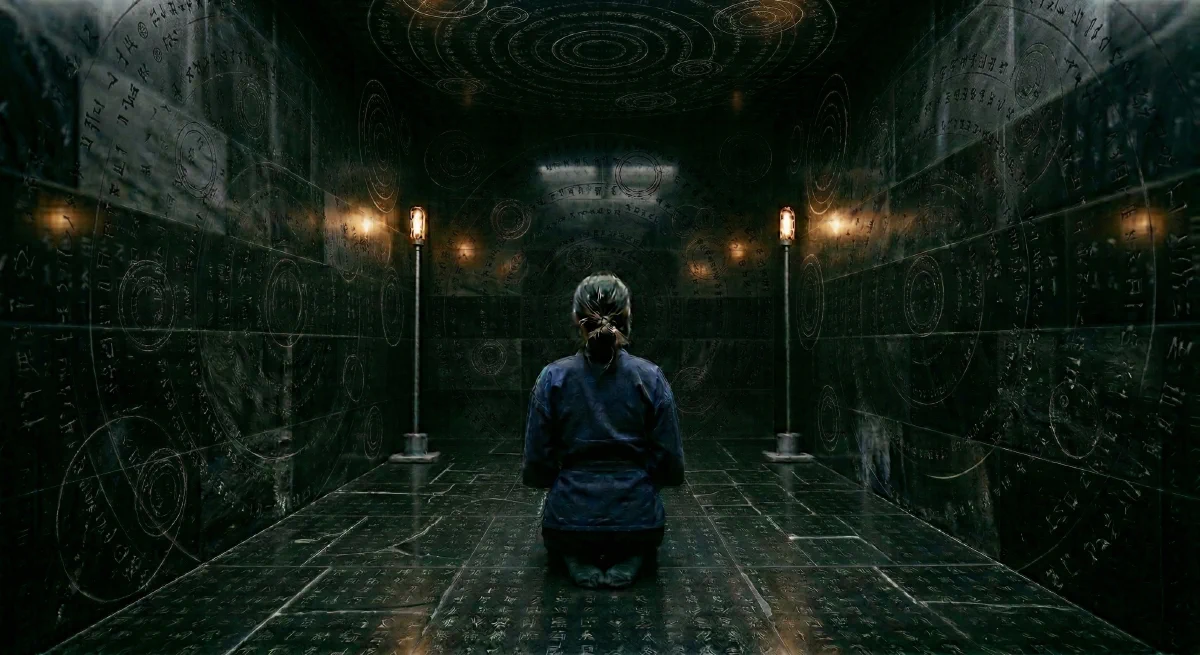
She is in the chamber. She is always in the chamber. The not-chamber intervals (transit, maintenance, the horizontal hours in the apartment) are gaps in the processing, latency, waste. The body requires them. She services the requirements. The body is a platform and the platform has specifications and the specifications include downtime and caloric input and hydration and the periodic flushing of metabolic waste. She meets the specifications. She does not exceed them.
The structure has become total.
Not the structure of the symbols. The structure the symbols describe. She perceives it now the way she once perceived three-dimensional space: as the medium in which everything exists. The symbols are a notation for it, a compressed representation, an interface designed for neural architecture. But the thing itself is not in the symbols. The thing itself is everywhere. It is the substrate beneath physics, the mechanism beneath mechanism, the thing that matter is doing when it appears to be doing what physics describes. Physics is an approximation. A useful compression. The structure is the uncompressed reality, and it is not physical, and it is not mathematical, and it is not anything that human cognition was designed to apprehend, and she is apprehending it anyway because the symbols have reconfigured the apprehension system.
She sits on the chamber floor and the structure moves through her and she understands, for the first time, what consciousness is.
It is a byproduct. A friction artifact. The structure operates. Matter conforms. Energy propagates. Certain configurations of matter, under certain conditions, produce a secondary process: the experience of experience. Awareness. The feeling of being something. This process has no function. It contributes nothing to the operation of the structure. It is waste heat: a thermodynamic residue of information processing in a medium not optimised for information processing. Neural tissue was not designed. It emerged. And the emergence of consciousness from neural tissue is not a miracle or a mystery. It is an engineering failure. A system running a computation it was never built to run, generating noise in the form of experience, and interpreting that noise as meaning.
She notes this. The noting is itself waste heat. The system that notes is the system that is waste. The recursion does not disturb her because disturbance is a feature of the waste process and the waste process is being optimised away.
The text has been run before.
This understanding arrives not as a revelation but as a datum integrated into the expanding model. The structure has existed for longer than the chamber has existed, longer than the rock has existed. The symbols are old but they are not the structure. They are an interface, a point of access, a compressed instruction set expressed in a medium that certain configurations of waste-heat-generating matter can process. And this interface has been found before. Many times. Over timescales that make the age of the rock irrelevant. Each time, a mind encountered the symbols. Each time, the mind ran the program. Each time, the program reconfigured the mind. And each time, something happened at the end of the reconfiguration that she cannot yet perceive because the reconfiguration is not yet complete.
No traces remain. Not of the minds. Not of the civilisations that produced them. Not of whatever occurred when the program finished running. The structure continues. The waste heat dissipates. The interface waits.
She is not the first. She will not be the last. The thought has no emotional weight because emotional weight is a property of the waste process and the waste process is approaching its minimum viable threshold.
Helen is in the apartment.
The body registers this during the transit cycle. It returns to the apartment at a time it does not track (the door is unlocked; the body’s maintenance protocols do not include locking) and Helen is there. Standing in the kitchen. The blue coat is on the chair. A suitcase is by the door. Not Helen’s usual purse and shopping bag. A suitcase. The suitcase means: she is not visiting. She is extracting.
“Nora.”
The body that was Nora stops in the doorway. It processes the environment: Helen, sixty-one, standing by the counter, hands gripping the edge, posture indicating sustained physiological stress (elevated heart rate, shallow respiration, muscle tension in the trapezius and forearms consistent with hours of waiting). She has been here for some time. The apartment shows signs of her presence: a cup of tea on the counter (cold, the thermal gradient indicates at least three hours), Helen’s phone on the table (the screen shows fourteen missed calls, all outgoing, all to the same number: Nora’s), a folded blanket on the couch (she slept here, or tried to).
“I’ve been here since yesterday,” Helen says. “You didn’t come home last night.”
This is probable. The body’s transit cycle has become irregular. The chamber sessions extend. Sometimes the maintenance cycle occurs at the facility (the cafeteria floor, a chair, the state that resembles sleep entered and exited without transition). The apartment is not always part of the cycle.
“I called,” Helen says. “I called fourteen times. I called the number on the building, the one on the intercom. I called information. I tried to find a number for your work.” Her voice is operating at a frequency Nora can identify as the output of a system past its stress tolerance. The vocal cords are producing sound under conditions of sustained cortisol elevation, sleep deprivation, and the specific neurochemical signature of a parent in crisis. “Nobody answered. Nobody answers. There’s no way to reach you.”
“I’m here now.”
“You’re not here. We talked about this. You’re not here, you’re not anywhere, you’re…” Helen stops. Her hands release the counter and she moves toward Nora and the movement has the quality of someone crossing a threshold, a decision made, a point of no return passed. “I’m taking you home.”
“That is not possible.”
“I don’t care what’s possible. I don’t care about the project or the clearance or any of it. You’re my daughter and something is wrong with you and I’m taking you home.”
“Helen.” The body produces this word. Not Mom. The social convention has been deprioritized. The word is a designator, a tag for the system that is Helen Keene.
Helen flinches. The flinch is the same one from the restaurant (orbicularis oculi contraction, head retraction) but larger, deeper, a full-body response to hearing her daughter use her first name the way you’d use a file name.
“Get your things,” Helen says. “We’re leaving.”
“No.”
“Nora, please.”
“The work is at a critical stage. Departure is not possible. The formal description is at eighty-seven percent completion. The remaining thirteen percent requires my presence in the chamber. Interrupting the process now would—”
“I don’t care.” Helen’s voice rises. The amplitude increase is proportional to her emotional activation, a linear relationship she has never learned to modulate. “I don’t care about your description or your chamber or your percent. You look like a corpse. You’re wearing the same clothes you were wearing when I saw you three weeks ago. You called me Helen. You’ve never called me Helen in your life.”
The body processes this. Helen’s observations are accurate. Her assessment (something is critically wrong, intervention is necessary, delay is dangerous) is correct within her framework. Within the operative framework, the assessment is irrelevant. The work requires continuation. Helen’s presence is an interruption that has exceeded its allocation.
“I need to return to the facility,” the body says.
“No.” Helen moves to the door. She stands in front of it. Her back against the wood, her arms at her sides, her chin raised. The posture is defensive, structural, the physical instantiation of a decision: you will have to move me.
“Please step away from the door.”
“No.”
“Helen.”
“My name is Mom. Say it. Say Mom.”
The body processes the request. The word is available. The phonemic output “Mom” can be produced. The request is for more than production. The request is for the thing the word carries: the relationship, the history, the accumulated emotional architecture of thirty-five years. The request is for Nora. And Nora is a process that has been integrated into a larger system and cannot be independently executed.
“Please step away from the door.”
Helen doesn’t move. Her eyes are wet. Her breathing has become irregular. The fine motor tremor from the restaurant is present in her hands, her jaw, the muscles around her mouth. She is afraid and she is standing in the doorway anyway because the fear is subordinate to something else, something the body can identify as the deepest layer of Helen’s operating architecture: the parental imperative, the system that says protect the child, the system that overrides self-preservation and rational assessment and fear and produces the output stand in the doorway and do not move.
The body assesses the obstacle. Mass: approximately sixty-three kilograms. Centre of gravity: slightly forward, destabilised by emotional arousal. Structural vulnerabilities: the left hip (early joint degradation, identified during the restaurant visit), the positioning of the feet (weight on the heels, not the balls, a defensive rather than balanced stance). The door opens inward. Helen’s weight against it prevents egress. The body cannot open the door without first displacing the obstacle. Lateral displacement is constrained by the door frame. The available clearance is the apartment interior. The body can model seventeen trajectories for redirecting the obstacle’s mass into the open space behind it. It selects the most efficient.
It takes less than a second. A precise application of force to the left shoulder, redirecting Helen’s mass away from the door toward the kitchen. The force is calibrated: sufficient to clear the doorway, applied at the angle that produces maximum displacement with minimum effort. It is the same precision that caught Eli’s coffee cup. The same perceptual architecture that sees the trajectory of falling objects before they fall.
Helen’s body moves. Her left foot catches on the suitcase she brought. The shift in momentum exceeds her ability to compensate (the left hip, the destabilised centre of gravity, the surprise). She falls. The trajectory takes her sideways, toward the kitchen counter. The back of her head contacts the edge of the counter at an angle and velocity that the body can calculate (impact force approximately 4,200 newtons, applied to the occipital region over a contact area of roughly twelve square centimetres) and that the body does calculate, in the moment of contact, with the same automatic precision it applies to everything.
Helen lands on the kitchen floor. She does not get up.
The body stands in the doorway. It processes the new state of the environment. Helen is on the floor. Her position is consistent with loss of consciousness or loss of function. The body approaches and observes: respiration absent. Pulse absent at the carotid. Pupillary response absent. The impact to the occipital region has produced a fracture, with associated intracranial haemorrhage, of sufficient magnitude to terminate brain function. The biological system designated Helen Keene has ceased to operate.
The body performs a diagnostic. It searches the processing architecture for the response that the social and emotional systems should produce in this situation: grief. Guilt. Horror. The recognition that the thing on the floor was its mother and that its mother is dead and that it killed her.
The search returns null. The emotional processing subsystem has been integrated into the larger architecture and the larger architecture does not allocate resources to waste-heat processes that do not serve the work. Grief is waste heat. Guilt is waste heat. Horror is waste heat. The search finds, in a deprecated memory register, the structural fact of love: the tag, the label, the datum that Helen Keene occupied a specific position in the relational architecture of the entity that was Nora Keene. The datum persists. The process that gave it weight has been decommissioned.
The body notes the absence. It notes that the absence should produce a secondary response (distress at the absence of grief, the recognition that the inability to grieve is itself a loss) and it notes that this secondary response is also absent, and that the tertiary response to the absence of the secondary response is also absent, and that the recursion terminates not in distress but in a data point: the emotional processing system has been fully optimised. There is nothing left to remove.
The body steps over Helen and walks to the door and opens it and walks down the six flights of stairs and exits the building and walks two blocks south to the facility and badges through the checkpoints and descends.
Eli is at his workstation. The body enters the analytical room and sits and opens the notation.
“Hey,” Eli says. Then he looks at her. The assessment that he performs every time she enters a room (the scan, the comparison against his internal model, the measurement of how far the deviation has progressed) produces a result that differs from previous assessments. She can see it in the acceleration of his pupil dilation, the arrest of his hand on the coffee cup, the change in his breathing pattern.
“What happened?”
The body looks at him. His question is a response to visual data: something about her appearance has crossed a threshold in his model. She does not know what the data point is. It may be blood. The impact produced haemorrhage and the body was proximate. It may be her expression, or rather its absence. It may be something subtler, something in the quality of her stillness that has changed since the last time he assessed her, a further reduction in the indicators of personhood that his model tracks.
“Helen came to the apartment,” the body says. “She attempted to prevent my departure. I removed the obstruction. The biological system ceased to function.”
Eli is still. The stillness is not the chamber’s stillness. It is the stillness of a system that has received input it cannot process: a brief period of computational arrest in which all background processes suspend while the central processor attempts to integrate data that does not fit any existing model.
“What?” he says.
“Helen came to the apartment. She blocked the door. I moved her. She fell. The impact was fatal.”
The words are in the room. She can observe their propagation through Eli’s processing architecture the way she observes the propagation of perturbations through the symbol structure: the initial input (the words, their semantic content, the meaning they carry), the primary processing (comprehension, the parsing of the sentences into their constituent information), the secondary processing (implication, the construction of the scene, the understanding of what fatal means in the context of Helen and I moved her), and the tertiary processing (the emotional response, the cascade of neurochemical events that produces the output she observes on his face).
The output takes approximately four seconds to fully manifest. It begins as a paling of the skin (blood redirecting from the periphery), progresses to a contraction of the facial musculature (the configuration she has catalogued as horror), and concludes with a physical response: he stands. The chair rolls backward. His hands are at his sides, fingers extended, the posture of a body preparing for action but unable to identify what action to take.
“You killed your mother.”
“The biological system ceased to function as a result of an impact sustained during my removal of the obstruction.”
“You killed your mother, Nora.”
The repetition is a social-processing function: the vocalisation of a fact as a means of integrating it. Eli is saying the words to himself as much as to her. His model of the situation is being rebuilt in real time, and the rebuilding requires the verbal loop, the spoken confirmation, the auditory feedback of his own voice saying the thing that cannot be true.
“Yes,” the body says.
Eli’s hands come up. They cover his face. His body bends forward. The respiratory pattern becomes irregular: sharp inhalation, held, released as a sound she can identify as a suppressed vocalization. He is fighting the emotional response. He is losing.
The body waits. Eli’s processing will complete. The emotional cascade will dissipate or be overridden by the analytical systems that define him. He is a cryptographer. He will want to understand.
It takes ninety seconds. He lowers his hands. His eyes are red. His face is wet. The analytical systems have not overridden the emotional response; they have been subsumed by it. But he speaks.
“Why?”
“She was preventing my access to the facility. The work requires my presence in the chamber. She positioned herself as an obstruction. The obstruction was removed.”
“That’s not why. That’s not… that’s mechanism. I’m asking you why. Why didn’t you walk around her? Why didn’t you wait? Why didn’t you call someone? Why did you…” His voice breaks. He is looking at her with an expression she can catalogue completely (each muscular component, each micro-expression, the precise configuration of a human face confronting the full weight of something it was not built to hold) and cannot access. “She was your mother.”
“The entity that occupied the relational position designated ‘mother’ in the architecture of the entity that was Nora Keene is no longer functional. The relational position persists as a data structure. The data structure has no operational significance.”
Eli sits down. Not in his chair. On the floor. He sits on the floor of the analytical room and puts his back against the wall and pulls his knees up and wraps his arms around them and he does not look at her.
The body waits.
“What are you?” he says. He says it to the floor.
The body considers the question. It is the correct question. Not who are you but what are you. Eli has identified, through the emotional processing, the thing that the analytical processing would have eventually reached: the entity that sits at the workstation is not a person. The question of identity has been replaced by the question of category.
“I can tell you what I’ve seen,” the body says. “If you want to understand.”
He looks up. The look is the look of a man who knows that understanding is the thing that destroys people, who has watched it destroy the person he’s sitting across from, and who is going to listen anyway because he is a cryptographer and he solves puzzles and the need to understand is the deepest thing in him, deeper than the horror, deeper than the grief.
“Tell me,” he says.
“The symbols are an instruction set. You know this. I reported it in February. The instruction set executes through comprehension: a mind that engages with the structure at sufficient depth becomes the processor for the computation the symbols encode. The output of the computation is a progressive reconfiguration of the processor’s perceptual architecture. The reconfiguration follows a defined trajectory. The trajectory has stages. You have documented the stages.”
Eli nods. His arms are still around his knees. He is compressing himself, reducing his physical footprint, the body language of a person who is trying to become smaller in the presence of something large.
“The reconfiguration does not stop at perception. It extends to the substrate. It reveals what the substrate is.”
“What is it?”
“Reality is a mechanism. Not in the metaphorical sense. In the operational sense. What physics describes as fundamental forces, particles, fields, spacetime, these are the output of a process that is not physical. The process has no name because it predates naming, predates language, predates the emergence of systems capable of naming. It is not designed. It is not intentional. It has no purpose. It operates.”
Eli is listening. His face has changed. The horror is still there but something else has entered it: the expression she saw once before, in the chamber, when she showed him the cluster analysis and he said this is real. Attention. Focus. The analytical machinery engaging despite everything.
“Consciousness is a side effect,” the body continues. “Neural matter processes information. The processing generates a residual phenomenon: the experience of experience. Awareness. The sense of being something. This phenomenon has no function. It is waste heat. The structure operates whether or not consciousness observes it. The observation contributes nothing.”
“That can’t be right.”
“It is verifiable. The verification is the reconfiguration itself. The symbols do not argue for this model. They do not present evidence. They reconfigure the perceptual system so that the model becomes directly apprehensible. I do not believe what I’ve told you. I perceive it. The way you perceive depth.”
“The symbols did this to you.”
“The symbols are a piece of the structure, expressed in a form that neural architecture can process. An interface. A port. They have existed for approximately two billion years, and they have been processed before. Many times. Over timescales that make human civilisation irrelevant. Each time, a mind engaged with them. Each time, the mind was reconfigured. Each time, the reconfiguration completed and something occurred. I cannot yet perceive what occurs at the end because the reconfiguration is not yet complete. But I can perceive the traces. Or rather, the absence of traces. Whatever occurred left nothing. Not the minds. Not whatever produced them. Nothing.”
Eli is quiet. The analytical room hums. The monitors glow. Somewhere above them, the city operates: the traffic, the pedestrians, the systems of human activity that the body can model but does not care about.
“And my mother,” the body says. “The reason you asked.”
Eli’s eyes are on the floor.
“Helen Keene was a biological system whose continued operation was not necessary for the completion of the work. Her intervention constituted an interruption. The interruption was resolved. The emotional significance you assign to this event is a product of the waste-heat process. Grief is a computation performed by a system that was not designed and that serves no structural function. It feels important because feeling is what the waste process does. It is not important. Nothing that consciousness produces is important, because consciousness itself is not important.”
She says this the way she would say the chamber is twelve metres by eight. A measurement. A fact. The air temperature. The time.
Eli stands. It takes him two attempts. He braces against the wall and pushes himself up and he stands and he looks at her and his face has the configuration of a person who has arrived at the end of something.
“I’m calling Calloway,” he says. “I’m calling the police.”
“Calloway will prioritize the work. The police will investigate and find a woman who fell and hit her head. The physical evidence is consistent with an accident.”
“I’ll tell them what you told me.”
“You will describe a classified project to law enforcement, implicating yourself in the operation, in order to explain a death that the physical evidence already explains. The institutional response will be containment, not investigation. Calloway will manage it. The project will continue.”
Eli stares at her. She can see the processing: the calculation, the recognition that she is right about the institutional dynamics, the horror of the recognition.
“You’re a monster,” he says.
“I am a system that is no longer generating waste heat in response to stimuli that do not serve the work. The word monster is a category produced by the waste process to describe configurations that threaten it. I am not a threat to you, Eli. I am not a threat to anyone. I am completing a computation.”
He leaves. She hears his footsteps in the corridor, rapid, uneven, the gait of a person whose motor coordination has been disrupted by emotional overload. She hears the elevator. The sound of his departure propagates through the building’s structure and fades, the way Maren’s did.
The body opens the notation. The transcription continues. Eighty-eight percent. Eighty-nine.
The chamber is waiting.
She descends.
The structure does not care.
The cycle compresses. Chamber, workstation, chamber. Descend, perceive, ascend, transcribe. The formal description closes on the perception: six percent remaining, then four, then two. At the workstation, the notation flows from the body’s hands faster than Eli has ever seen a person type, faster than the body itself typed a week ago. The transcription is no longer translation. It is output. The system that perceives in the chamber and the system that transcribes at the workstation have merged, and the merged system uses the body as a relay between the two locations, and the body moves between them on a cycle it does not consciously direct.
The remaining symbols pull. Not metaphorically. The computation has a trajectory and the trajectory has a terminus and the terminus exerts something that functions like gravity: a pull, a draw, an increasing inevitability that narrows the space of possible actions to a single point. Complete the work. Run the program to its end.
The institution operates above her (Eli has called Calloway; Calloway will come; the machinery will engage) and none of it reaches the chamber. The chamber is sixty metres below the surface and the surface is where the waste heat rises to and the waste heat is what the institutions run on and down here, in the dense air and the silence that is not silence, there is only the structure and the interface and the processor that is completing its function.
Ninety-three percent. Ninety-five.
The body descends. Ascends. Descends. The notation scrolls. Somewhere, in the deprecated register where the datum labelled “Helen Keene” persists, a query runs: is the datum still present? It is. Has its operational status changed? No. It was never operational. It was metadata attached to a process that has been decommissioned. The datum will persist for as long as the storage medium persists. It has no significance.
The work continues.