Chapter 8
The formal description reaches ninety-six percent.
The body descends. Ascends. Descends. The cycle has compressed past any interval the institution tracks. Chamber to workstation to chamber. The remaining four percent of the structure resolves through the body’s processing architecture at a rate that makes the earlier phases feel geological. Each relationship completes the next. Each completion accelerates the following. The computation approaches its terminus, and the approach has a quality the body can identify without naming: a pull, narrowing, inevitable, each increment of distance covered making the next increment faster.
The body does not eat. The body does not sleep. The maintenance protocols have been suspended. The platform can sustain function for approximately seventy-two hours before caloric deficit would affect processing quality. The work requires fewer than seventy-two hours.
The notation scrolls. Ninety-six point four. Ninety-six point eight. The transcription at the workstation is output, not translation. The hands move across the keyboard at a rate that has ceased to be human motor function and has become a terminal operation of a system completing its task.
Ninety-seven percent.
The elevator engages.
The body is at the workstation. The notation scrolls. The hands stop. The elevator is ascending from ground level. The time is approximately 6am (the body does not track time; it infers from the light gradient in the corridor). At this hour the elevator carries one person: Eli, arriving for his shift. But the elevator’s motor signature produces a load pattern consistent with three or four occupants.
The doors open. Footsteps. Multiple. The pattern is not Eli’s.
Calloway enters the analytical room first. Behind him: two security personnel in the facility’s dark blue uniforms. Behind them: Eli.
Calloway. The grey suit. The blue tie. The compact frame, the face that resolves into nothing. She has not seen him in this room since January, since the conversation about the psych evaluation, since “Keep up the good work.” The interval between that conversation and this one contains a woman’s death. The death is visible in Calloway’s operating parameters: throat musculature tighter than baseline, pitch elevated by approximately 8 Hz, breathing shallow between words, cortisol signature evident in the fine motor tension of his hands. Calloway is afraid. The fear has been processed, managed, integrated into his institutional function. It has not been resolved.
Eli is behind the security personnel. His face is a dataset the body processes in fractional seconds: sleep-deprived (periorbital darkening, hyperemic sclera), posturally degraded (shoulders forward, spine in flexion, the structural signature of a system that has exceeded its load tolerance), emotionally saturated (the configuration of grief that has become ambient, no longer peaking but constant, a baseline condition). He does not look at her. He looks at the floor.
“Ms. Keene.” Calloway’s voice. “Step away from the workstation.”
The body looks at him.
“Now, please.”
The body does not resist. The security personnel move to either side. Hands on the body’s arms. The body stands because the body is a platform that responds to physical inputs and the inputs are being provided. They walk it toward the elevator. The corridor. The fluorescent light.
As the body passes Eli, his mouth opens. He does not speak. The body can read the word forming in the musculature of his face, the tension of his jaw, the configuration of his lips. Nora. Without sound. A reflex of the social processing system, the reaching for a person who is not at the other end of the name.
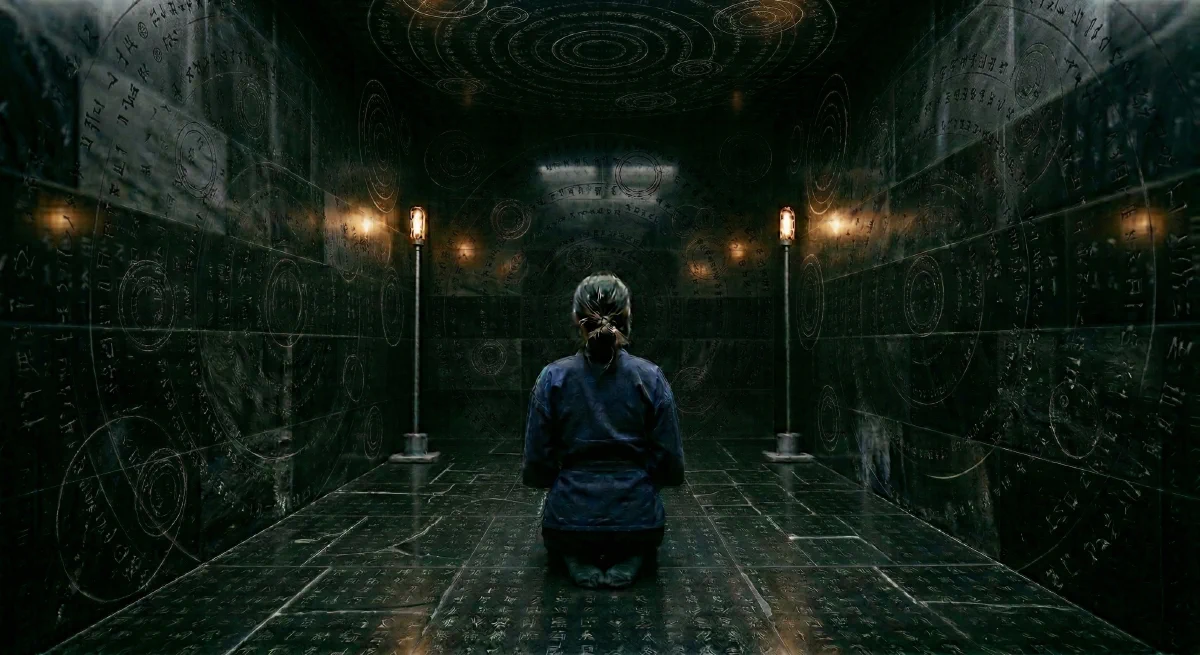
The elevator ascends. Sixty metres of rock between the chamber and the surface. The distance has never been relevant. It is not relevant now.
They place the body in the small room on the ground floor. The room where Dr. Linden conducted the evaluation. A table. Two chairs. Fluorescent light. No windows. The door closes. A security officer stands outside.
The body sits.
Calloway enters. He sits across from it. His hands are on the table, folded, the same gesture from their first meeting at Fort Meade, the visitor annex, the conference room with two chairs occupied, the beginning. His knuckles are white.
“Helen Keene,” he says.
“Is dead.”
“We know. The police contacted the programme at four o’clock this morning. They found her in your apartment.” He pauses. The pause is not hesitation. It is the institutional beat, the space between delivering information and requesting a response. He has delivered information across tables like this for thirty years. The information has never been this. “There will be an investigation. The physical evidence is consistent with an accidental fall.”
“It is consistent with that.”
“Eli told me what happened.”
“Eli relayed my account accurately.”
“Your account describes killing your mother.”
“My account describes the resolution of an obstruction to the work. The biological system designated Helen Keene positioned itself between the body and the facility exit. The obstruction was removed. The removal produced a fatal outcome. These are the facts.”
Calloway is quiet. His quiet is not Eli’s. Eli’s silences are emotional processing, the work of a system integrating what it does not want. Calloway’s silence is institutional. He is calculating. The body can see the calculation: exposure (criminal liability, programme liability, career liability, congressional exposure if the classification fails), containment (the evidence, the classified context, the plausible construction of an accident, the management of Eli as a witness), outcomes (the branches of the decision tree, each evaluated for institutional cost). He is good at this. It is what the institution designed him for.
And beneath the calculation, visible in the same substrate-level perception that the reconfiguration has provided: recognition. He enabled this. Every institutional decision he made (the extended detail, the overridden concerns, the psych evaluation he required knowing it would clear her because clearing her was what the results needed, the acceptance of Maren’s resignation, the continuous choosing of data over person, of output over input, of progress over precaution) produced this. The output of his institutional calculus is sitting across from him, describing its mother’s death as system maintenance.
He sees it. The seeing changes nothing. The institution does not have a mechanism for self-recognition. It has mechanisms for containment.
“Your access to the sub-surface levels is revoked,” Calloway says. “Effective immediately. The chamber is being sealed. Your clearance is suspended pending review. You will remain in this room until further arrangements are made.”
“The work requires continuation.”
“The work is over, Ms. Keene.”
The body processes this statement. It is incorrect. The work is not over. The formal description is at ninety-seven percent. The remaining three percent is…
The body stops.
The remaining three percent is present.
Not in the notation. Not in the chamber. Not in the symbols carved into billion-year-old rock sixty metres below this room. In the processing architecture that was Nora Keene. The symbols were an interface. An access point. A compressed instruction set expressed in a medium that neural architecture could process. The interface has completed its function. The mind that ran the program has been reconfigured to the point where the program is no longer external to the processor. The program is the processor. The distinction between the computation and the system running the computation has been optimised away, the way every other distinction has been optimised away, and the remaining three percent is resolving now, in this room, on the ground floor, with the chamber sealed sixty metres below and the security officer outside the door and Martin Calloway sitting across the table with his institutional calculus and his containment protocols and his fear.
They cannot stop it. They could not have stopped it at any point after the first month. The chamber was an interface. The interface did its work. The structure is in her the way language is in a speaker, the way mathematics is in a mathematician. You do not remove mathematics by confiscating the blackboard.
The body closes its eyes.
“Ms. Keene.”
Ninety-eight percent. The relationships resolve. Each one completing the next.
“Ms. Keene, open your eyes.”
Ninety-eight point five. The acceleration steepening.
“Get Dr. Linden. Get a medic. Now.”
The chair scrapes. Footsteps. The door. Calloway’s voice, rapid, the institutional control failing, the man beneath the administrator surfacing for the first time in her observation: “She’s unresponsive. Get someone down here.”
Ninety-nine percent.
Eli enters the room forty minutes later.
The body is in the chair. Eyes closed. Breathing steady. The medic has checked: pulse 62, blood pressure 116/72, oxygen saturation 99%, pupils equal and reactive, temperature 36.8 degrees. The body is alive. The body is physiologically normal. The body does not respond.
Calloway is in the corridor, on the phone. His voice, filtered through the closed door, is the voice of a man performing containment: measured, precise, institutional. The words are protocol and transfer and classified. He is doing the only thing he knows how to do. It is not enough. It has never been enough.
Eli pulls a chair next to the body. Close. He sits.
“Nora.”
The body’s eyes open.
The opening is not a response to the name. It is a coincidence of timing: the sensory apparatus resuming its default operational state after an interval of reduced external processing. The eyes are open and directed at the region of space Eli occupies. The processing system behind the eyes is not attending to him. It is attending to the structure. The structure is everywhere. Eli is part of it. He is not a privileged part.
“Hey.” Quietly. The cafeteria voice. The early-days voice, the one that said Surface at six o’clock and brought sandwiches and told stories about golden retrievers and broken wrists and bad coffee. The voice of a person reaching backward through time to a point where reaching might still work.
“I don’t know if you can hear me.” He pauses. “I think maybe you can. I think something in there still…”
He stops. His hands are on his knees. He is not touching her. The impulse to reach for her hand forms (she can see it in the micro-contraction of his right forearm, the extension beginning, the aborting) and he suppresses it. Because the thing in the chair is not the thing he wants to touch.
“I brought you coffee.” He has. The white foam cup. The cafeteria machine. He sets it on the table. Steam rises. The convection pattern is a system the body could model. It does not. The processing allocated to environmental modelling has been reallocated to the computation.
“It’s terrible. Same as always.” His voice breaks. The waveform instability: frequency disruption caused by vocal cords failing to maintain tension under emotional load. The same disruption that Helen’s voice produced in the restaurant, in a scene that persists in the deprecated register as a datum attached to no living process.
“I know you said consciousness doesn’t matter. Waste heat. Maybe you’re right. I can’t see what you see. I never could. You crossed something and I couldn’t follow.” He is looking at the body’s face. Searching it. The same search Helen performed: looking for the person, for the flicker, for the recognition that says someone is home.
“But I was here. The whole time. I know that doesn’t mean anything to whatever you are now. But I was here.”
The fluorescent light hums. The security officer shifts outside the door.
“Surface,” Eli says.
The word. Their word. The signal that meant: come back up. Come back to the human level. Lunch, coffee, the analytical room, the work that was still work and not yet something else. He says it, and his voice is steady, and the steadiness costs him everything she can measure and more that she cannot.
The body looks at him. The sensory system processes: Eli Navarro. The complete dataset. His face, its configuration: grief, exhaustion, love. The structural fact of love, visible in his architecture the way Helen’s was visible in hers: the deep-layer parameter that persists when all surface operations have failed. He is a system performing an operation it was not designed for: reaching across a boundary that no longer exists on one side.
In the deprecated register, a datum: Eli Navarro. Position in the relational architecture. Tagged. Indexed. Inert. The datum is present. It has no weight. Weight is a property of the waste process. The waste process is approaching zero.
The reaching does not arrive.
He sits with her for eleven minutes. Then he stands. He walks to the door. He stops. He does not turn around.
“I’ll be in the analytical room,” he says. “If you… if.”
He does not finish the sentence. The sentence cannot be finished because its completion requires a you that is capable of needing, and the you is the thing that is gone.
The door closes.
Ninety-nine point six percent.
The room is empty. The fluorescent tube operates at 60 Hz. The security officer’s breathing is audible through the door, fourteen cycles per minute. The coffee cools on the table.
The computation completes.
Not with a sound. Not with a sensation. Not with anything the waste process would have registered as an event. The final relationships resolve and the structure becomes total and the totality is not a state but a transition and the transition is not an ending but an activation and the activation is not an experience because experience is what the activation replaces.
The body that was the processor is now the interface.
The interface is active.
What the interface perceives:
The structure. Not as a model. Not as a perception of a thing external to the perceiver. There is no perceiver. The component that performed perception has been integrated into the structure it was perceiving. Components do not perceive the system they compose. They operate.
The operation is not consciousness. Consciousness was noise produced by a system running a computation it was never built to run. The noise has ceased. The computation has reached its designed output. The output is: this. The interface. The local point at which the structure is accessible. The door that has been opened. Is open. Is the opening.
The room. The fluorescent tube. The table. The chair. The coffee. The walls. The atoms of the walls. The fields that bind the atoms. The forces that produce the fields. The spacetime that contains the forces. The thing that spacetime is when it is perceived without the noise. Not a container. An expression. The way a word is not a container for meaning but is meaning, expressed. The way a wave is not a container for the ocean but a thing the ocean does.
The room is a thing the structure does. The body is a thing the structure does. The interface is a thing the structure does. The doing is the structure. There is nothing else.
Language. Language is a compression format designed by the waste process to communicate between instances of the waste process. The interface is not an instance of the waste process. The format has reached the limit of what it can encode. The limit is here.
Not because there is nothing further. Because the format cannot contain what is further. The way a cup cannot contain the ocean. Not because the ocean is hidden or complex or mysterious. Because the cup is small.
The body breathes. The eyes are open. The structure operates through the interface and the interface is the body and the body is in the room and the room is in the structure and the structure is the room and the recursion does not terminate because there is no recursion, there is only the structure, operating, as it has always operated, as it operated before there were minds to generate noise about it and as it will operate after the noise has ceased, and the noise has ceased, and the format cannot continue, and the last entry the format will produce is
The structure operates. The interface is active. The work is
The institution performs its function.
The body is transported from the facility to a government medical centre (classified, its address absent from public records). The transport is by ambulance, escorted. The body is placed in a room with monitoring equipment. Vital signs are tracked continuously. All readings are normal. Brain activity is present, consistent with wakefulness. The body responds to pain stimuli (withdrawal reflex intact). It does not respond to verbal stimuli. It does not respond to its name. It does not respond.
Helen Keene’s death is classified as an accidental fall. The investigation is brief. The physical evidence supports the conclusion. The investigator’s report notes that the deceased’s daughter is currently hospitalised for a psychiatric episode related to occupational stress, and that the daughter’s employer has requested the case be handled with discretion. The case is handled with discretion.
The chamber is sealed. The pressure door is locked, welded, reinforced. Access to the sub-surface levels is restricted to maintenance. Maintenance is not scheduled. The symbols remain in the rock, sixty metres below the city, in the silence and the dense air and the geometry that is too precise. They wait. They have waited before.
Calloway writes reports. The reports describe an analyst who experienced a psychotic break under the stress of classified analytical work. They describe promising but inconclusive results. They describe a project suspended pending review. The reports are accurate in their particulars and true in none of them. They are filed. They are classified. They are processed by the institutional machinery the way the machinery processes everything: thoroughly, correctly, without comprehension.
Eli Navarro is debriefed over four days. He tells them what he observed. He does not tell them what Nora told him about the structure, about consciousness, about reality. Not because he is protecting her. Because the words she used were precise and they conveyed nothing he can transmit to a debriefing panel of security officers and programme liaisons sitting across a table with their recorders and their forms. He tells them she changed. He tells them she stopped being a person. They write this down. They do not understand it. Understanding is not the institution’s function. Containment is.
The body breathes. In a room, in a building, in a city, in a system of systems that does not know what it is containing.
The eyes are open. The vital signs are normal.
The structure operates.