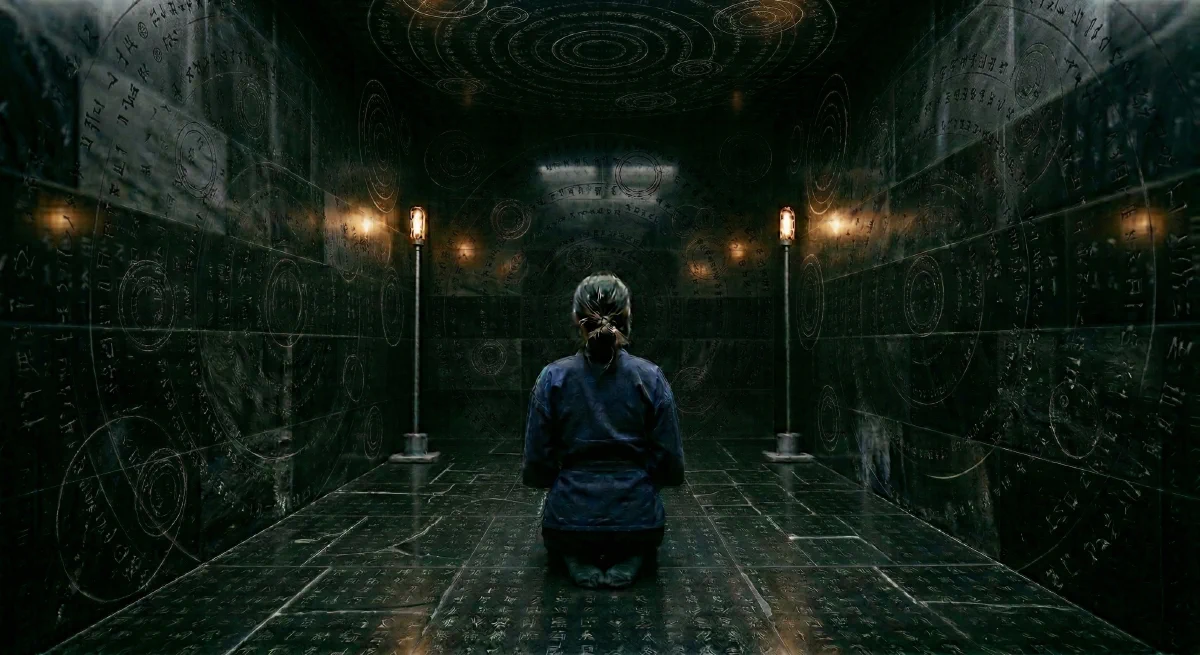
Epilogue
The coffee is terrible.
Eli stands in the kitchen of his apartment in Silver Spring and drinks it anyway, the way he has always drunk terrible coffee, which is with a kind of satisfaction that he has never been able to explain to anyone and has stopped trying to. The mug is white ceramic, chipped on the rim, a thing he’s owned since Berkeley. The kitchen window is open. It’s May, and the air that comes through smells like cut grass and warm asphalt and, faintly, the jasmine that his downstairs neighbour planted along the fence last spring. He drinks the coffee and stands at the window and watches the light move across the parking lot and feels, with the particular acuteness of a man who has recently learned what absence looks like, the weight of an ordinary morning.
He is fine.
This is what he tells people. His mother, who calls twice a week now instead of once (she heard something in his voice in March and adjusted her frequency without comment, the way mothers do). His former colleagues at DOE, the ones he can talk to, which is most of them, about everything except the one thing that matters. The counsellor he sees on Tuesdays, a civilian psychologist with a security clearance and a small office in Bethesda, who asks good questions and listens well and cannot help him because the thing she is trying to help him with is classified, and the version of it she’s been cleared to know is the version that doesn’t contain the truth.
He is fine. He has an apartment. He is on administrative leave, which is what the institution calls the space between what happened and what happens next, and the space has been filled with the machinery of processing: paperwork, interviews, a medical evaluation (passed), a psychological evaluation (passed, provisionally, with a recommendation for continued counselling). He goes to the grocery store. He cooks. He runs three miles every morning on a route that takes him past a park where someone walks a golden retriever, and the dog reminds him of the lodge on the ski trip, and the ski trip reminds him of January, and January reminds him of the analytical room, and the analytical room reminds him of her, and this is where the chain always ends, in the room where the coffee was bad and the work was everything and the woman at the next desk was still a person.
He doesn’t think about what she became. He thinks about what she was.
The distinction matters to him. It is, in fact, the only thing that matters to him, because the alternative is to think about the thing in the chair with open eyes that did not respond when he said her name, and the eleven minutes he sat beside it, and the word he said (Surface) that went nowhere, that fell into whatever she had become and did not come back, and if he thinks about that for too long the ground shifts under him in a way that the counsellor’s questions cannot reach.
So he thinks about what she was. The precision. The quiet focus. The way she held a coffee cup for an hour without drinking, lost in the data. The way she said “two hundred and six thousand, four hundred and three” without looking up, and he grinned, because she was counting pairs in her head while he was still doing the multiplication.
He drinks the coffee. He puts the mug in the sink. He goes for his run.
The files are on his laptop.
He hasn’t opened them. Not since the debriefings ended, six weeks ago, when a man in a grey suit (not Calloway, a different man, with a different suit and the same institutional blankness behind the eyes) told him that his personal notes and analytical records were being reviewed for classification and that he should not access, distribute, or discuss any project-related materials pending final determination.
He said yes. He signed the form. He went home.
But the files are on his laptop. His cataloguing data. The spatial measurements, the positional relationships, the spreadsheet that runs to thousands of rows, every symbol mapped to the millimetre from the laser-etched reference grid he helped install in the first week. Months of work. His work, not hers. She had the breakthroughs. He had the data.
He tells himself he isn’t going to open them.
He tells himself this on a Tuesday evening in the second week of May, standing in the kitchen after his run, eating pasta he cooked without much attention (garlic, olive oil, whatever was in the fridge), and the telling is sincere in the way that all self-deception is sincere, which is to say it is performed with conviction and believed by no one. The files are on his laptop and his laptop is on the desk in the second bedroom he uses as an office and the office door is closed and he is not going to open it.
He washes the dishes. Watches something on television without registering it. Goes to bed.
He does not fall asleep quickly.
He opens the files on a Thursday.
The reason he gives himself is administrative: the final report. There are loose ends in his cataloguing data, inconsistencies he noted during the debriefings but didn’t have time to resolve. Minor things. Formatting errors, duplicate entries, a handful of positional measurements that need cross-referencing. The kind of work that a thorough analyst does to close a file properly, the kind of work that has nothing to do with the symbols themselves and everything to do with the satisfaction of a clean dataset. He is a thorough analyst. He is closing a file.
He sits at the desk and opens the laptop and the spreadsheet fills the screen and for a moment the room tilts, very slightly, the way a room tilts when you stand up too fast, a brief disorientation that is not physical but temporal, as if the data has carried him backward to a place he hasn’t left as completely as he thought.
Six hundred and forty-three symbols. Position. Orientation. Size. Nearest-neighbour distances. Cluster membership. The columns are labelled in his own handwriting (digitised, but he can see the ghost of the hand behind it, the careful lettering he learned from years of lab notebooks). The data is clean, precise, the product of months of work in a room sixty metres underground with the silence and the dense air and the symbols on every surface.
He starts with the formatting errors. There are seven. He fixes them.
He moves to the duplicate entries. There are three. He resolves them.
He starts on the positional cross-references, and this is where the work stops being administrative, because the cross-references require him to look at the spatial relationships between symbols, and the spatial relationships are the thing, the actual thing, the thing he’s been not-thinking-about for six weeks.
He looks at them anyway.
The pattern is in the distance metrics.
He doesn’t see it on Thursday. He sees it on Saturday, at two in the morning, sitting at the desk in the light of the laptop screen with a cup of coffee going cold beside him (he notices this, the coldness of the coffee, and the noticing produces a sensation he has to sit with for a moment before he can continue).
He has been going through the pairwise distances. Not all two hundred and six thousand. A subset. The relationships between the clusters that Nora identified in her first weeks, the ones he verified, the ones he called “real” in the analytical room with the whiteboard covered in her notation and his voice quiet with the reverence of someone who knows they are looking at something that has never been seen before.
The clusters are still there in his data. They were always there. But the distances between certain clusters are not what he expected.
He checks his measurements. He checks them again. The measurements are correct. The discrepancy is not an error. It’s a feature. Three of the clusters that he and Nora always treated as separate, three clusters that sit in different regions of the chamber and that the dimensional analysis mapped to different positions in the higher-order topology, have a distance relationship that doesn’t fit. The distances between them are too regular. Too precise. The kind of precision that isn’t noise and isn’t coincidence and that means something, and the something is a relationship that nobody mapped because everybody (including him, including her) was looking at the clusters as the fundamental units, and the clusters aren’t the fundamental units, the clusters are components of something larger, the way chords are components of a progression, the way words are components of a sentence.
He stares at the screen. The numbers glow in the dark room. The coffee is cold. The jasmine comes through the window, faint, sweet, the smell of a world that operates on principles he understands.
He should close the laptop. He knows this. He knows what happened to the last person who followed this thread. He documented every stage. He watched her dissolve. He sat in the cafeteria and listed the changes (not eating, not sleeping, the posture, the blinking) and she confirmed them, every one, and then she explained his concern as a predictable function of attachment and told him he was a system and stood up and walked away and left him sitting there with the architecture of his caring laid out on the table like a diagram.
He knows. He watched. He was there, the whole time.
He does not close the laptop.
He spends Sunday with the data.
Not in the chamber (the chamber is sealed, sixty metres below a city block on the Lower East Side, the pressure door locked and welded and reinforced, the symbols waiting in the dark). At his desk in Silver Spring, in the apartment with the jasmine and the parking lot and the sound of his neighbour’s television through the wall. But the data is the same data. The measurements are the same measurements. And the pattern he found on Saturday night is still there on Sunday morning, and it’s larger than he thought.
The three clusters aren’t the only ones. He runs the distance analysis across all of the cluster groups, using the notation system he and Nora built together (her mathematics, his precision, the collaboration that was the best work he’s ever done and that he misses with an ache that is not professional), and the results come back and he sits very still and looks at them for a long time.
There is a structure in the inter-cluster distances that neither of them mapped.
Not because it wasn’t there. Because they were looking at the wrong scale. Nora’s breakthrough was seeing the total field, the way all six hundred and forty-three symbols relate to each other simultaneously. His data was always about the components: the individual symbols, the pairs, the clusters. He never looked at the relationships between clusters because the clusters were his highest-order unit. They were the answer. He built the notation for them. He indexed them. He verified them.
But the clusters have relationships to each other that follow the same geometric logic as the symbols within them. The pattern is recursive. The structure nests. And the nesting produces, at the inter-cluster scale, exactly the kind of higher-dimensional topology that Nora described in her first week, standing at the whiteboard, drawing and erasing and redrawing because the geometry wouldn’t fit in two dimensions.
He can see it.
Not the way she saw it. Not the total field, not the single expression, not the thing that required you to stop breaking the system into pieces and perceive the whole. He’s still working with pieces. But the pieces are clicking together in a way that has its own momentum, each relationship completing the next, each completion revealing the following, and the process has a quality he recognises from every problem he has ever solved: the sense of something yielding, of a locked door beginning to turn.
He thinks about Maren. “Take breaks,” she said. “The work is absorbing.”
He thinks about Nora, in the cafeteria, in the early days. The way she held the coffee cup. The way she looked at the data with the focus of someone who has found the only thing worth looking at. The way she fell asleep eventually, and then not at all, and then stopped being someone who slept.
He thinks about the thing in the chair.
He closes the laptop. He goes to the kitchen. He makes a sandwich. He eats it standing at the window, looking out at the parking lot, at the ordinary world with its ordinary geometry, its approximately-right angles, its surfaces that are close enough to flat, and the word approximately catches in his mind like a thread on a nail.
He finishes the sandwich. Washes the plate. Stands at the sink for a long time.
Then he goes back to the desk and opens the laptop.
It happens on a Tuesday.
He’s not working late. It’s early evening, still light outside, the May sun falling through the window at the angle that puts a stripe of gold across the desk and the keyboard and his hands. He’s been going through the inter-cluster topology for three days, mapping the relationships with the same meticulous precision he applied to the individual symbols, and the structure has been growing, not in the data (the data hasn’t changed, the data is the same data it was in February) but in his perception of it, the way the structure was always there in the chamber, waiting to be seen by someone patient enough and careful enough and willing to sit with it until it yielded.
He is patient. He is careful. He has always been these things. They are the qualities that made him good at the work, that made him invaluable to a project he was never meant to solve, that made him the person who documented everything and understood nothing and sat in the analytical room after she was gone and tried to write a final report about something that a final report cannot contain.
He is looking at a subset of the distance relationships. Twelve clusters, thirty-six inter-cluster pairs. The topology doesn’t resolve in three dimensions. He’s known this for days. But he’s been trying to map it anyway, to force it into a framework he can visualize, because the alternative is to do what she did: stop trying to map it, and see it.
He stops trying.
Not deliberately. Not as a strategy. The way she described it (and he remembers, with the precision of someone who documented everything, her exact words from those early weeks when she still used words that meant what words mean): she exhausted her frameworks. She stopped looking for anything. And the symbols looked back.
He is sitting at his desk in Silver Spring in the May light with the laptop open and the data on the screen and the coffee cold and the jasmine through the window and he stops trying to force the twelve clusters into three dimensions and he looks at the numbers without looking for anything.
And the numbers rearrange.
Not on the screen. On the screen they are the same. But in his mind, in the space behind his eyes where he holds the model of the thing he’s studying, the twelve clusters shift. The three-dimensional projection he’s been building dissolves, and what replaces it is not a projection at all. It is the shape that produces the projection, the geometry that exists behind the shadow on the wall, and it is coherent, and it is precise, and every distance metric that didn’t fit, every relationship that looked like noise, clicks into place simultaneously with a rightness that he feels in his chest, a resonance, a fit between the structure of the thing and the structure of the mind perceiving it.
He is very still.
He is aware, distantly, of the apartment around him. The window. The light. The sound of a car passing. The smell of jasmine. The world, the ordinary world, with its ordinary physics and its ordinary dimensions and its approximate surfaces and its rough-draft geometry. The world that feels, suddenly, like a sketch of itself. Adequate but imprecise.
It is beautiful.
The words arrive without irony. Without self-consciousness. Without the remove of a man who has watched this before, who has seen where it leads, who documented every stage and sat in the cafeteria and said You OK? and heard her say I’m fine and knew she wasn’t and couldn’t stop it and tried anyway and failed. The words arrive the way facts arrive, simply and without complication: the geometry is beautiful. The way the clusters resolve from noise into order is beautiful. The sense of a system yielding, of comprehension opening, of something that has been locked finally, finally turning.
He sits at his desk. The light moves across his hands. The data glows on the screen.
He has so much work to do.