Tideline
She saw Lily in the way Maisie crouched at the waterline.
It was the posture. The curve of the small back, the deliberate placement of fingers in the wet sand, the head tilted just so, as if listening for something buried beneath the surface. The gesture was so precisely Lily’s that Erin’s breath caught and the decade she had spent rebuilding herself split open like a seam.
The moment passed. Maisie looked up, grinning, holding a razor clam shell in both hands, and she was Maisie again. Four years old and sun-brown and very much alive. Jon was spreading a blanket further up the beach, anchoring the corners with their shoes. The tide was pulling back, exposing a vast brown-grey flat that stretched to the horizon, glistening and still. Wading birds picked along the channels. The air smelled of salt and warm stone.
A good day. A deliberate day. The first time they had taken Maisie to the coast, because Maisie had just turned four, the age Lily had been, and Erin needed to prove that the number was not a curse. That a child could be four years old and crouching at the water’s edge and it did not have to mean anything.
But she had seen it. The posture. The tilt of the head.
She turned away from Jon and the blanket, toward the open flat. The tide had retreated far, exposing a quarter mile of silt cut by shallow channels and fringed with bladderwrack. Near the waterline, the flat looked solid, packed, safe. Further out, it darkened, taking on a wet sheen that suggested depth. A sign at the top of the beach path read DANGER: TIDAL MUD. DO NOT WALK ON THE FLATS. She was already looking past it, out to where the light collected on the far edge of the water.
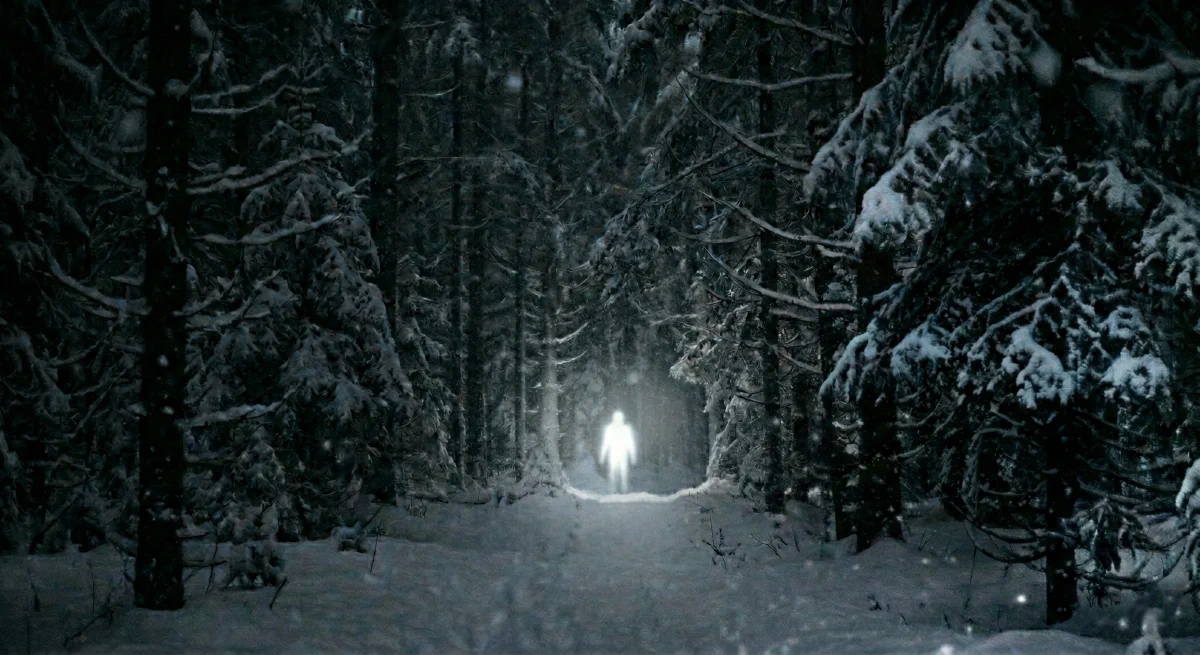
There was a figure on the flat.
It was small and distant, no more than a brightness against the shimmer of wet sand. At that distance it could have been a trick of the light, a post, a shadow thrown by cloud. But Erin’s eyes had already done the work. The brightness resolved into the shape of a child. A little girl, crouching at the tideline, fingers in the silt. Searching for shells.
Lily.
The name arrived whole and certain. Not a question. Not a hope. A recognition, deep and involuntary, the way one recognizes a face in a crowd before conscious thought has time to intervene. She knew the way the child held her shoulders. She knew the angle of the wrist. She had memorized those geometries in hospital beds, in the slow hours of holding a body that was becoming less and less her daughter and more and more a collection of symptoms.
Erin stepped off the packed sand and onto the flat.
The surface held. For the first twenty yards, the silt was firm beneath her sandals, and the only sound was the faint squelch of moisture displaced by her weight. The sun was warm on her arms. Ahead, the child looked up and seemed to laugh, and the sound reached Erin like something carried on the wind, though the wind was blowing the wrong way. A high, bright, lilting sound. Lily’s laugh. She would have known it in a room of a thousand children.
The mud changed character without warning. One step landed on solid ground, the next sank to the ankle. Erin stumbled, caught herself, pulled her foot free with a sucking sound and kept walking. The silt here was darker, wetter, threaded with the greenish film of algae. It smelled of the deep earth, of hydrogen sulfide, of something lightless and ancient. The flat looked the same in every direction, featureless and wide, the beach behind her already a distant line.
She could hear Lily laughing. The sound filled the air the way birdsong fills a wood, directionless and encompassing, and beneath it ran a low hum, a frequency she felt in her sternum more than heard. It was warm. Not the warmth of the sun but something closer, something that pressed against her skin like an embrace. Like being held.
I’m coming, sweetheart.
The thought was so natural it did not register as strange. The years of therapy, the careful language of acceptance and moving forward, the nights spent whispering to Jon that she was okay, that the grief had a shape now and she could hold it without being cut, all of it peeled away like wallpaper from a damp wall. Underneath was the old room. The original room. The one where Lily was still alive and waiting and everything that had happened since was a terrible, correctable mistake.
She did not hear Jon calling her name.
He was standing at the edge of the packed sand with Maisie on his hip, one hand cupped around his mouth, shouting. His voice carried across the flat, clear enough for the couple walking their dog near the dunes to stop and stare. But Erin was two hundred yards out and she heard nothing except the hum and the laughter and the gentle lapping of water in the channels around her feet.
The mud was at her calves now. Each step required a deliberate, wrenching effort, a pulling against a vacuum that formed beneath her foot the instant she tried to lift it. She did not panic. Panic belonged to a different version of this moment, the version where she was lost, where the flat was empty, where the child ahead was not her daughter. In this version, the one the warmth had built for her, the mud was an inconvenience. Lily was close. Lily was right there, just a little further, crouching at the edge of the water with her fingers in the silt, looking up with that expression she used to wear when she found something beautiful and needed someone to see it too.
Wait for me. I’m right here.
The mud took her left sandal. She felt it pull free from her foot and vanish into the silt with a soft, final sound. She kept walking. Her bare foot sank deeper than the shod one, the cold mud closing around her shin like a fist, and when she tried to pull free the vacuum held. She shifted her weight. The other foot sank. The silt locked around both legs with the patience of something geological, something that had been swallowing things for ten thousand years and had no concept of urgency.
She was stuck.
The realization arrived distantly, like news from another country. She pulled. The mud gripped tighter. She twisted, and the motion drove her deeper, past the knee on her left side, the fine angular grains of glacial silt compacting around her legs with a force that was grotesque, mechanical, indifferent. The smell of sulfur rose around her. Somewhere behind her, people were shouting. She heard none of it. She heard Lily.
The child was so close. Twenty feet, perhaps less. The glow around her was subtle in the daylight, barely distinguishable from the glare of sun on wet sand, but it was there, a warmth that had nothing to do with temperature. It pressed against Erin’s chest and her throat and the backs of her eyes, and it felt like forgiveness. Not the forgiveness she had been offered in therapists’ offices, the rational, earned kind, the kind that came with caveats and stages and the understanding that some wounds simply scar. This was absolute. This was the warmth of a small hand in hers, a weight on her lap, a voice she had not heard in ten years saying nothing at all, only being there, only being close.
Erin stopped struggling. Her body made the decision before her mind did, a quiet cessation at the level of the nervous system, a laying down of arms. The mud held her at the waist, her body canted forward, arms outstretched. The water was coming. She could see it threading through the channels, silver and patient, filling the low places first, then spreading across the flat in a slow, irreversible sheet. It reached her hands. It was cold, a shock against skin that had been so warm, but the cold lasted only a moment before the warmth folded over it and the water became part of the embrace.
There you are. There you are.
The water rose. It covered her wrists, her forearms. It crept across the flat with the patience of something that had done this twice a day for millennia. It did not rush. It did not need to. She was not going anywhere.
From shore, Jon had handed Maisie to a stranger and waded out three steps before the mud grabbed his ankles and he understood. He was screaming. The sound did not reach her.
Erin looked up at the figure of her daughter. Lily was standing now, small and radiant, reaching out one hand the way she used to reach for Erin’s hand in the hospital, in the last days, when she was too weak to speak but not too weak to hold on. The light was warm and close and it asked for nothing. It understood nothing. It simply was.
The water was at her chest. Then her chin. Then her mouth.
She did not close her eyes. She was looking at Lily. She was reaching for Lily’s hand. The water filled her nose and her throat and the hum grew louder, a frequency beyond sound, and the warmth was everything, and Lily was smiling, and Erin thought, with the last coherent flicker of her drowning brain, I found you.
The light moved on.
It drifted along the tideline with the same unhurried gait. It did not look back at the place where a woman’s hand still reached above the surface of the shallow water, fingers curled around nothing. It had felt the shudder of surrender, the precise physiological moment when the nervous system stopped fighting, and it had taken what it came for. Now there was something else. Further along the shore. A vibration. A grief.
On the beach, a four-year-old girl watched the place where her mother had been and did not understand what she was seeing. She would not understand for years. But she would remember the flat, and the light on the water, and the way her mother had walked toward something only she could see. She would remember it every time she closed her eyes.