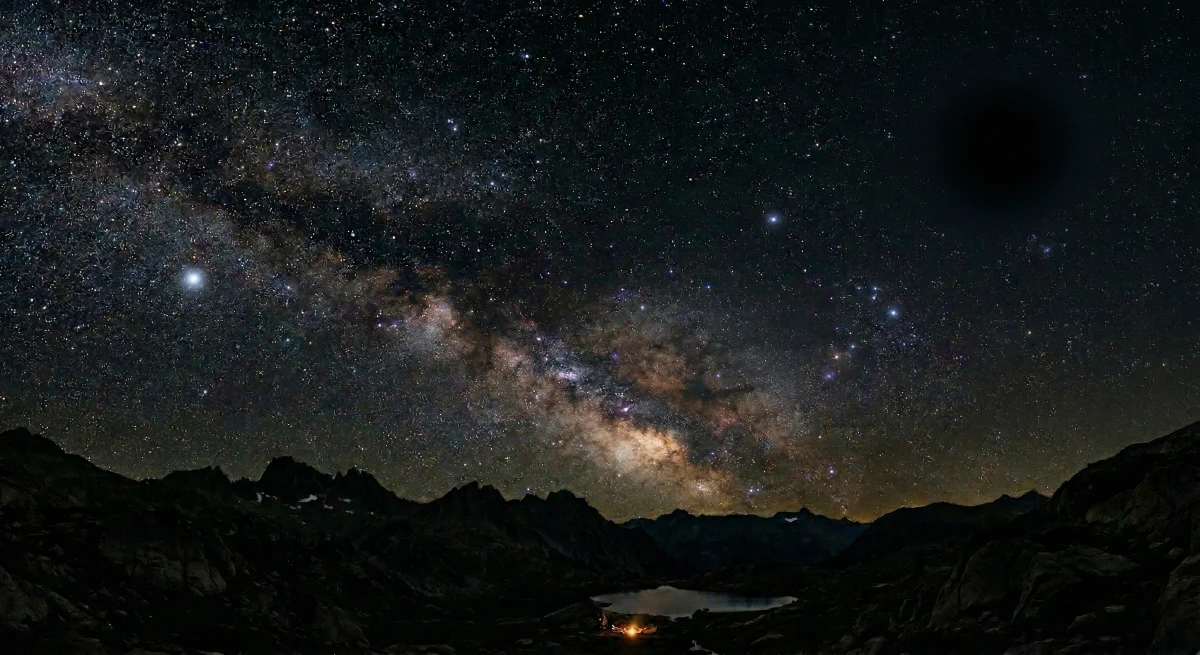
Universe 510
Universe 510 arrived on a Tuesday, six weeks into the expanded search.
By then, the new parameters had given them another four hundred observations, and every one had come back the same: particle fog, thermal flatline, nothing. The wider brane offset hadn’t changed the results. It had only made the pattern bigger. Lena had stopped attending every observation session. There was no point. She spent most of her time in her office now, working through the analysis Coale had asked for, looking for structure in the emptiness. She hadn’t found any. The fog was the same in every universe they’d observed. The same particle density. The same thermal signature. The same nothing, repeated five hundred and nine times.
Marcus still attended every session. Of course he did.
He was the one who called her. She was at her desk, halfway through a spectral comparison that was going nowhere, when her phone buzzed.
“Lena.” His voice was different. Tight, controlled, the way people sound when they’re trying very hard not to shout. “You need to come to the observation lab. Right now.”
She was out of her chair before he finished the sentence.
The lab was crowded when she arrived, which was unusual. Word had travelled fast. Yuen was at the primary terminal, both hands flat on the desk as if steadying himself, and Marcus was standing behind him, staring at the main display with an expression Lena had never seen on him before. He looked like he might cry.
On the screen, the spectrographic portrait was alive with colour. Emission peaks. Absorption lines. Hydrogen, helium, carbon, oxygen, iron. The unmistakable chemical fingerprint of a universe that had structure, that had matter, that had stars.
“Five-ten,” Yuen said quietly. He didn’t look away from the screen. “Brane offset nine-seven-two. The observation window just closed, but…” He shook his head. “It’s all there.”
Lena stood in the doorway and stared. After five hundred and nine empty rooms, they’d found one with the lights on.
Marcus turned to her. His eyes were wet. “Lena,” he said. “There’s someone home.”
They ran the observation again the next day, and the day after that, burning through the array’s power budget at a rate that would give Coale’s accountants heart failure. Each ninety-second window brought more data, and each dataset confirmed what the first had shown. Universe 510 was not empty. It was rich, complex, structured. They mapped a star system, then a cluster. They identified a rocky planet in a habitable orbit with atmospheric signatures that made Yuen swear under his breath when he saw the readout: oxygen-nitrogen mix, trace carbon dioxide, water vapour. A living atmosphere.
On the fourth observation, they found the civilisation.
It was Marcus who spotted it. He’d been running the raw emission data through a filter designed to isolate artificial electromagnetic sources, a long shot that he’d built mostly as a thought experiment back when they’d assumed they’d never find anything to use it on. Now the filter lit up. Organised radio-frequency emissions, concentrated and patterned. Not natural. Not random. The signature of a technological civilisation broadcasting into its own sky.
“They’re about where we might be in thirty, maybe forty years,” Marcus said, after two days of analysis. His voice had the measured calm of someone delivering news he still couldn’t quite believe. “Industrial atmospheric modification, orbital infrastructure, planet-wide communications network. One world, as far as we can tell. No evidence of interplanetary expansion yet.”
“Can we resolve visual data?” Coale asked. She’d been in the observation lab every day since 510, which told Lena more about Washington’s reaction than any memo could have.
“Not directly,” Yuen said. “The observation window gives us particle states and emissions, not images. But we can infer a lot from the electromagnetic profile. City-scale light emissions on the night side. Orbital objects, probably satellites. Dense, coordinated broadcast activity across multiple frequency bands.”
Coale nodded slowly. “This is what we’ve been looking for.”
It was. And for a few days, the Blackwell Institute felt the way it must have felt at the very beginning, before Lena had arrived, when the array was still theoretical and the whole project hummed with the possibility of discovery. People smiled in the corridors. Marcus laughed at meals. Even Lena, who could not shake the low-frequency discomfort that had lived in her chest since the hundredth empty universe, allowed herself to feel something like relief. They had found life. Intelligent, complex, broadcasting life. The emptiness was not universal.
Then the broadcasts started to thin.
It happened gradually enough that no one flagged it at first. The observation windows were brief, ninety seconds each, and the data was dense. It was Yuen who noticed, on the eleventh day, running a comparison across their accumulated datasets.
“We’re losing signal density,” he said. He’d pulled Lena aside after the morning session, speaking quietly, as if the observation might undo itself if he said it too loudly. “Look.” He showed her the trend line on his tablet. Radio-frequency emissions from Universe 510, plotted over their eleven observation windows. The line went down. Not dramatically. Not all at once. But consistently, unmistakably, down.
“Equipment drift?” Lena asked, already knowing the answer.
“I’ve calibrated three times. The array is fine. They’re broadcasting less.”
Lena took the tablet from him and studied the graph. Eleven data points, each representing a ninety-second snapshot. The decline was smooth, almost linear. Whatever was happening, it was steady and sustained.
“Could be anything,” she said. “Seasonal variation. A shift in broadcast technology. Maybe they’re moving to a different part of the spectrum that we’re not sampling.”
“Maybe,” Yuen said. He didn’t sound convinced.
Over the next two weeks, it became harder to explain away. The radio-frequency emissions continued to drop. But that wasn’t the only thing. The orbital objects they’d catalogued, the satellites or stations orbiting the planet, were fewer each time they looked. The numbers didn’t hold steady or fluctuate. They decreased. Steadily, methodically, as if the objects were being de-orbited on a schedule.
Marcus ran his artificial-source filter on the latest dataset and sat with the results for a long time before he said anything.
“The night-side light emissions are down thirty percent from our first observation,” he told the team during the morning briefing. He said it carefully, like a doctor delivering a diagnosis. “That’s not a power grid failure. The reduction is geographically structured. It’s moving across the surface in a wave, east to west. Regions are going dark in sequence.”
The room was quiet. A different kind of quiet than the silence after Lena’s threshold presentation months ago. That had been scepticism, impatience. This was the quiet of people who didn’t want to say what they were thinking.
“Could be a coordinated conservation effort,” Marcus offered. “A cultural movement. We’ve seen proposals for things like that on Earth, voluntary de-industrialisation, back-to-nature movements. Maybe they’re further along that path than we are.”
“A conservation effort that de-orbits satellites?” Lena said.
“If you’re serious about reducing your footprint, you’d address orbital debris too.”
“In a coordinated east-to-west wave? Across an entire planet?”
Marcus didn’t have an answer for that. No one did.
Lena started staying late in the observation lab, reviewing each new dataset as it came in. She told herself it was diligence. The analysis Coale wanted. In truth, she was watching, the way you watch a candle in a draft, waiting to see which way the flame leans before it goes out.
Universe 510 was going quiet.
“They’re not collapsing,” Lena said to Marcus one evening. They were alone in the lab, the fluorescent lights giving everything their usual sickly cast. “A civilisation that collapses looks different. You’d see uneven failure. Infrastructure breaking down in some regions while others hold. Refugees, resource wars, the electromagnetic signature of conflict. This is…” She gestured at the data on her screen. “This is orderly. This is planned.”
“You think they’re choosing this.”
“I think they’re executing a project. Something planet-wide, coordinated, and deliberate. And whatever it is, it involves shutting down every detectable signal they produce.”
Marcus was quiet for a moment. “It’s a beautiful pattern,” he said, and she could hear him fighting with himself, the part of him that loved the elegance of a clean dataset warring with the part that didn’t want it to mean anything. “But we’re watching through a ninety-second keyhole. We don’t know anything about their culture, their politics, their biology. We could be watching a harvest festival for all we know.”
“Maybe,” she said. “But look.” She pulled up the composite trend on her monitor, all their indicators overlaid on a single graph. Radio emissions, orbital objects, night-side light, atmospheric chemistry. Every line pointed the same direction: down. “Every measurable sign of their existence is declining. All of them, all at once, on the same curve. What kind of project has that as its output?”
He looked at the graph for a long time.
“It looks like someone turning off all the lights in their house,” he said. “And locking the door. And hoping that whatever’s outside keeps walking.”
They sat with that for a while.
“We don’t know that,” Marcus said, eventually. But his voice had lost something. The wonder was still there, Lena thought, but it had changed shape. It was the wonder of a man staring into a dark room, knowing something was in it, not yet sure whether he wanted to see what.
She turned back to her screen. The latest dataset was loading, the most recent ninety-second window into Universe 510. When the spectrographic portrait resolved, she had to check it twice against the previous observation.
Another continent had gone dark. The night side of the planet now showed light in only one region, a shrinking cluster on the western hemisphere, no larger than what a single city might produce.
Lena stared at it. She thought about all those empty universes, the five hundred and nine rooms with the lights off. And now, for the first time, she was watching through the keyhole as someone reached for the switch.