The Petrov Moment
Coale was on the phone to Washington. Whatever happened next on that call would take weeks to produce a decision, and during those weeks the array would stay operational, because you don’t shut down an eleven-billion-dollar programme while a review is pending.
Lena stood up.
She walked out of the briefing room and down the corridor toward the observation wing. The fluorescent lights buzzed overhead. The linoleum squeaked under her shoes. The substation hummed through the floor, steady and constant, the sound she’d lived with for months, the sound she now understood to be a beacon pulsing at the boundary between realities.
The clean room was empty. Marcus wasn’t there. He must have gone to his office, or left the building. She didn’t know and it didn’t matter.
The array sat in the centre of the room, massive and still, its nested rings of superconducting magnets gleaming under the overhead lights. It looked the way it always had: clinical, impressive, inert. The observation window wasn’t active. No ninety-second session was running. But the magnets were powered, maintaining the field geometry that defined the array’s coordinates in the brane topology. Even at rest, the machine kept its hand on the doorknob.
Lena walked to the primary control terminal. She logged in with her credentials. The system recognised her as lead scientist, which gave her access to the monitoring interfaces, the calibration tools, and the observation scheduling system. It did not give her access to the power management controls. Those were restricted to the facility director and the engineering team.
She sat down at the terminal. The hum was there, pressing up through the floor, and she let her hands rest on the keyboard without typing.
Petrov had sat at a terminal too. Different terminal, different century, different calculus, but the same essential posture: one person, one decision, the whole thing balanced on what they did next. She’d built a career on understanding what he’d done that night in 1983. The button was there and he didn’t press it. Every institutional pressure, every protocol, every training scenario told him to act, and he just… didn’t. He sat with the uncertainty and chose not to move. She had always thought of it as the clearest act of judgment under pressure she’d ever studied.
She understood the pull of it. Wait. You don’t have complete information. You’re one person in a room making a decision that belongs to committees, to directors, to people with the authority to be wrong on this scale. Coale was calling Washington. Marcus wanted more data. There were processes for this. She could log out, walk back to the briefing room, and let the institution do what institutions do. That was the responsible thing. The Petrov thing. Restraint.
But Petrov’s institution had wanted him to launch. The system said act, and he defied it by doing nothing. That was the shape of his courage, and she’d spent years studying it, teaching it, building a threshold curve named after it. She had always understood it as a principle of restraint. She was only now seeing that she’d confused the principle with its form. Petrov didn’t choose inaction. He chose to defy the default. His default just happened to be action.
Her default was the opposite. Every institutional instinct said wait. And the array would keep running. The signal would keep propagating. Five hundred and nine universes were already gone and the machine that marked the next one was humming through the floor beneath her.
She navigated to the calibration interface and entered a diagnostic sequence she’d helped design two years ago, during the array’s initial testing phase. The sequence was meant to stress-test the superconducting magnets by cycling them through rapid temperature fluctuations. It had a safety threshold built in to prevent damage to the coils. Petrov saved the world by not pressing a button. The principle was the same. The shape was inverted. She disabled the safety threshold.
She pressed enter.
The array didn’t explode. It didn’t spark or shatter or make any dramatic sound. What happened was quieter than that. The magnets began their cycling sequence, and within ninety seconds the temperature fluctuations exceeded the critical threshold. The superconducting coils lost coherence. The magnetic field collapsed. The power draw from the substation dropped to nearly nothing.
The hum stopped.
For the first time since Lena had arrived at the Blackwell Institute, the floor was still. The silence was enormous. It filled the clean room more completely than the hum ever had, pressing into the walls, into the spaces between the equipment, into her. She sat at the terminal and listened to the building not making a sound.
Then the alarms started, and after the alarms, the voices, and after the voices, the rest of it.
She wasn’t arrested. She was suspended, which in a classified facility amounted to much the same thing: her credentials were revoked, her access to the building was cut, and she was escorted to the perimeter by two men who were polite about it in the way that people are polite when they’ve been told to be polite. Coale called her that evening, brief and furious, and said words like “sabotage” and “federal property” and “do you understand what you’ve done.” Lena said yes. She understood exactly what she’d done.
Marcus called the next morning. He didn’t say much. He asked if she was okay, and she said she was, and they both knew it wasn’t entirely true. Then he said, “The magnets are destroyed. The coils will need to be completely rebuilt. Eighteen months minimum, if they even approve the funding.”
“Good,” Lena said.
There was a long silence. Then Marcus said, “I would have done the same thing. I think. I hope I would have.”
“I know,” she said.
After that, the days were quiet.
Lena went home to the apartment she rented in the nearest town, forty miles from the Institute, a place she’d barely spent time in since the project began. It was small, functional, and mostly empty. She made coffee and drank it while it was hot. She read. She went for walks in the scrubland around town, where the sky stretched flat to the horizon and the air smelled like dust and creosote. She did not check her email. She did not call anyone at Blackwell. She did not think about branes or particle fog or the spectrographic portraits of empty universes, except when she did, which was often, in the early hours of the morning when sleep wouldn’t come and the silence of the apartment pressed in on her like the silence of the clean room after the hum stopped.
She told herself she had done the right thing. She told herself that the signal had stopped, the flares had ceased, the door was no longer marked. She told herself that whatever was out there, whatever consumed universes and reduced them to uniform nothing, had one less beacon to follow.
She told herself these things, and most of the time she believed them.
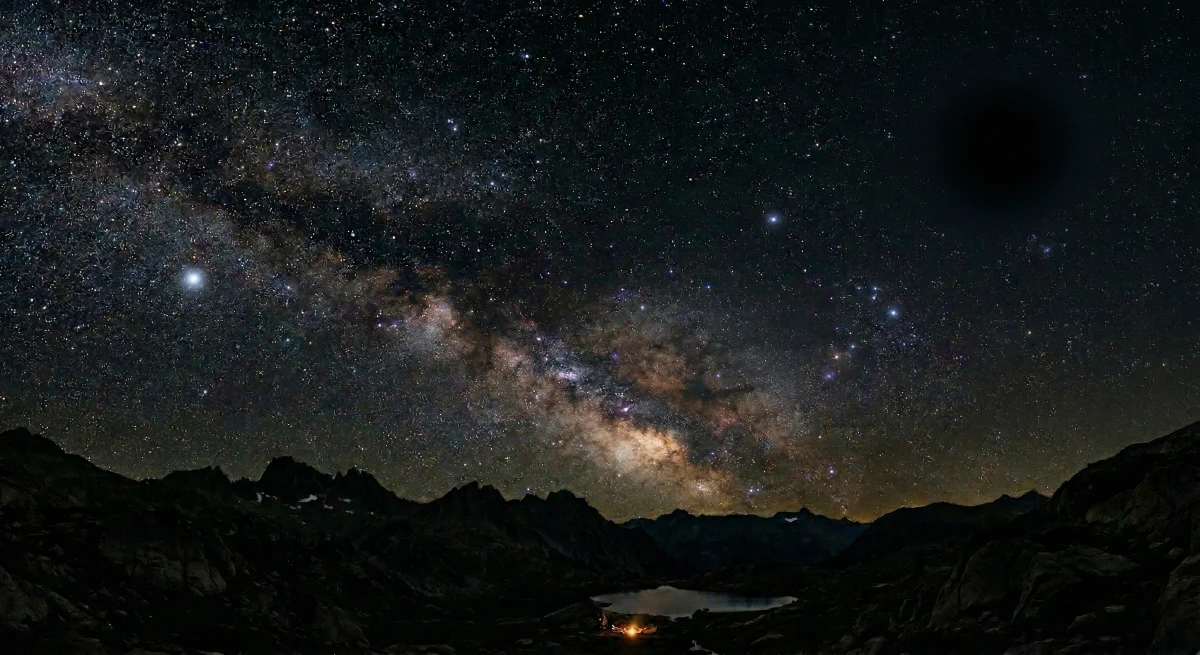
One night she went outside to clear her head. The air was cold and dry, the way it always was in the high desert at night, and the sky was clear. She stood in the small yard behind her apartment and looked up.
She’d always loved the night sky in New Mexico. That had been one of the few consolations of the posting. No light pollution for miles. The Milky Way visible as a bright smear across the dark, and the constellations sharp and familiar, the same ones she’d learned as a child lying on her back in her parents’ garden in Bratislava.
She found Cassiopeia first, the way she always did. The crooked W. Five stars, each one fixed in its place, the same pattern she’d traced with her finger a thousand times.
She counted them.
She counted them again.
One of the stars in the familiar pattern wasn’t there. Not dimmed. Not obscured by clouds. The sky around it was perfectly clear, and the star was simply absent, a gap in the constellation where a point of light had been for as long as she could remember.
Lena stood very still.
It could be anything. Atmospheric distortion. Her own fatigue. A satellite she’d mistaken for a star all these years, now decommissioned or moved to a different orbit. There were rational explanations. There were always rational explanations, until there weren’t.
She went inside. She closed the curtain. She did not look at the sky again.