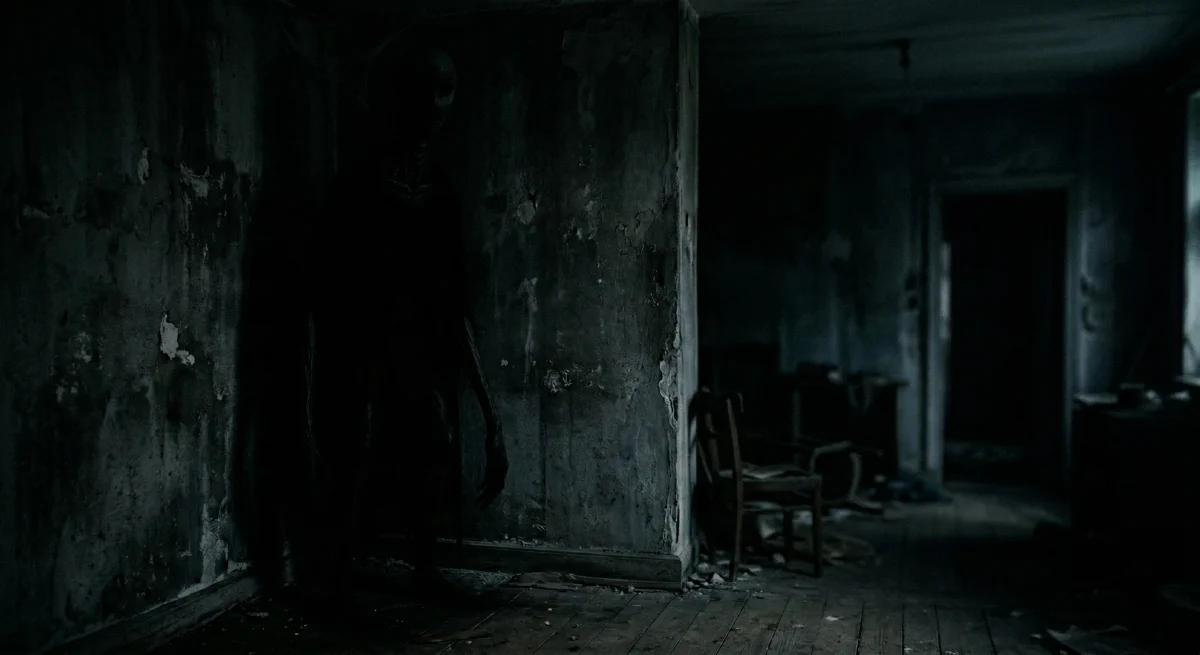
Chapter 1: Night Shift
The fluorescent tube above the nurses’ station had been dying for three weeks. It buzzed and flickered in a rhythm Ellie had come to know like a second pulse, a slow stutter of light that made the paperwork swim if she stared too long. She’d put in two maintenance requests. The first had disappeared into whatever void swallowed maintenance requests at Thornwood Psychiatric Hospital. The second had come back with a note: Ordered. 4-6 weeks.
Four to six weeks. For a light bulb.
She finished her charting on Mrs. Okafor (vitals stable, sleep intermittent, refused evening Haldol, accepted compromise of Benadryl at 2200) and capped her pen. The clock above the medication window read 1:47 a.m. Five hours and thirteen minutes until shift change. Not that she was counting.
The ward was quiet, which was the word nurses used when they meant something different from silent. Thornwood was never silent. The building breathed, old pipes ticking in the walls, the ventilation system pushing stale air through ducts that hadn’t been cleaned since the Reagan administration. Somewhere down B corridor a patient was talking in his sleep, a low, formless murmur that rose and fell like a radio drifting between stations. From the dayroom came the creak of someone shifting in a chair, probably Gerald, who slept better upright than in bed and had long since stopped being asked to go back to his room.
Ellie stood, and her knees protested. Thirty-one years old and her body was already filing complaints. Night shifts did that. Six years of them, rotating between the 11-to-7 and the occasional double when somebody called in, which was often, because Thornwood paid twelve dollars an hour and most of the good nurses had already left for Riverside General or the clinics in Columbus. The ones who stayed were either dedicated or stuck. Ellie tried not to think too hard about which category she fell into.
She picked up her clipboard and started rounds.
The psych ward at Thornwood occupied the east wing of what had once been a Victorian estate for nervous women, then a tuberculosis sanatorium, then a state hospital, and finally, through a series of budget cuts and administrative surrenders, the underfunded, understaffed facility it was now. The hallways were too wide and too high, built for an era that believed in the curative properties of open space and good ventilation, though the ventilation had long since failed and the open space just meant more floor to mop. The ceilings disappeared into shadow above the reach of the fluorescent strips, and the linoleum, once some shade of institutional green, had been worn to a colorless grey that showed every scuff.
Ellie moved through it the way she moved through most things: steadily, without fuss, paying attention.
Room 14, Mr. Aguilar. Sleeping on his side, facing the wall. His breathing was even, the tremor in his hands (Haldol, unavoidable) stilled for now. She checked the observation window and moved on.
Room 16, Mrs. Prescott. Awake, sitting up in bed, staring at the wall with the fixed concentration of someone watching television, except there was no television. Ellie opened the door softly.
“Can’t sleep, June?”
Mrs. Prescott didn’t look at her. “The wallpaper’s moving again.”
“It does that sometimes. Old building.” Ellie checked her chart. Last dose of Thorazine at 2100, due again at 0600. “Can I get you anything? Warm milk? We might still have some of those graham crackers.”
“Graham crackers,” Mrs. Prescott repeated, as though the words were in a foreign language. Then she blinked and looked at Ellie with sudden clarity. “You’re the nice one. The night one.”
“That’s me.”
“The night one knows things the day ones don’t.” Mrs. Prescott smiled, vague and sweet, and then turned back to the wall. “The wallpaper knows too.”
Ellie brought her the crackers and a small carton of milk and left her to her wallpaper. There was no point arguing with a patient’s reality at two in the morning. The best you could do was make sure they were safe and comfortable and not hurting themselves, and let the day shift psychiatrists earn their salaries sorting out the rest.
She was halfway down C corridor when her pager buzzed. She unclipped it from her waistband and read the number: the station. Brenda.
The nearest phone was at the junction of C and D corridors, a beige wall unit with a cord that had been stretched to twice its intended length by years of nurses pacing while they talked. Ellie dialed the station.
“It’s me.”
“Daniel’s up again.” Brenda’s voice was flat with the particular exhaustion of someone four hours into a shift she hadn’t wanted. “He’s agitated. Won’t talk to me. Asking for you.”
“I’ll come down.”
“He’s been asking since midnight. I told him you were busy.”
“I’ll come down now.”
Ellie hung up and stood for a moment in the corridor, one hand on the phone. Daniel Morrison. Room 22. He’d been at Thornwood for, what, eight months now? Nine? Long enough that his file had thickened from a slim intake folder into something that required both hands to lift. Paranoid schizophrenia, treatment-resistant, referred from County after they ran out of beds and patience in roughly that order. He was thirty-four, a former high school English teacher who’d stopped showing up to work one November morning and been found three days later in his apartment, all the mirrors covered with newspaper and every window nailed shut.
He was also, in his lucid moments, one of the most articulate patients Ellie had ever worked with. That was the thing people on the outside didn’t understand about schizophrenia, the thing the movies got wrong. It wasn’t a constant state of raving incoherence. It came in waves. Daniel could go hours, sometimes days, perfectly clear, perfectly reasonable, discussing books he’d once taught (Faulkner, Flannery O’Connor, the kind of Southern Gothic that made Ellie think he’d chosen his illness’s imagery on purpose, if that were possible). And then something would shift, some internal weather, and the clarity would drain out of him like water from a cracked glass, and he’d be back in the other place, the one only he could see.
Lately the waves were coming faster.
Ellie walked back through C corridor, past the dayroom where Gerald was indeed asleep in his chair, past the darkened activity room with its folding tables and its smell of dried tempera paint, through the locked fire door (key on the ring, third from the left, she could do it blind) and into B corridor where the long-term patients slept. Or didn’t.
Room 22. The observation window showed Daniel sitting on the edge of his bed, feet flat on the floor, hands gripping the mattress on either side. He was dressed in the standard issue pajamas, pale blue, and his hair, which had been dark and neatly combed when he was admitted, had gone grey at the temples and stuck up in unwashed tufts. He wasn’t moving. He was staring at the corner of the room.
Ellie knocked twice and opened the door. “Daniel. It’s Ellie.”
He didn’t look at her. “Close the door.”
She stepped inside and pulled it shut behind her. The room was small, eight by ten, with a bolted-down bed, a small desk, and a chair. The window was reinforced glass, and through it the January dark pressed in, the kind of darkness that felt solid, that had weight. The overhead light was off. The only illumination came from the corridor, filtering through the observation window and laying a pale rectangle across the floor.
“Brenda said you wanted to talk to me.”
“Not to her. To you.” His eyes were still fixed on the corner. “You listen. She just writes things down.”
“That’s not fair to Brenda.”
“No. Probably not.” He swallowed. His throat worked like he was trying to get something down that didn’t want to go. “They’re closer tonight.”
Ellie pulled the chair from the desk and sat down, keeping her body language open, unhurried. “Tell me what you’re seeing.”
“You don’t believe me. I know that. But I need you to listen anyway.”
“I’m listening.”
Daniel finally turned to look at her. His eyes were bloodshot and wide, the pupils dilated so far that his irises had nearly disappeared. He hadn’t been sleeping. That much was obvious. He probably hadn’t slept in days.
“There are tall ones,” he said. His voice was steady, which was worse somehow than if he’d been frantic. He was reporting, not raving. Cataloguing. “They stand in the corners. Not all the time. They come and go, like… like something on the other side of frosted glass. You can see the shape but not the detail. Except lately I can see more. The glass is clearing.”
“What do they look like, Daniel?”
“Wrong.” He said it simply. “Everything about them is wrong. The proportions. The way they’re put together. They have arms, legs, something like a head. But the arms are too long. The joints bend in directions that don’t make sense. And the faces…” He trailed off, his gaze drifting back to the corner. “Do you know what a face looks like when someone removes the features but leaves the skin? Smoothed over. Except not smooth. Folded. Like a wound that’s been sewn shut badly.”
Ellie kept her expression neutral. She’d heard a hundred patients describe a hundred visions, and Daniel’s were, she had to admit, more coherent than most. Most schizophrenic hallucinations were fragmentary, inconsistent, colored by the patient’s particular preoccupations. Daniel’s were the same every time. The tall figures. The wrong proportions. The folded faces. He’d been describing them for months with the consistency of someone describing a real room they’d visited over and over.
“How many tonight?”
“Two. There were two. One left. One is still here.” He nodded toward the corner. The empty corner, so far as Ellie could see, with its scuffed baseboard and its faint water stain on the ceiling above. “It’s watching me. It’s been watching me for three hours.”
“Daniel, I want to talk about your medication. Dr. Rennick adjusted your Haldol last week, and I think…”
“It’s not about medication.” He said it without anger, without desperation. Just a flat statement. “Medication blurs them. Makes them harder to see. But they’re still there. It’s like… turning down the brightness on a television. The picture gets darker but it doesn’t go away.”
“That’s actually a good description of how antipsychotics work,” Ellie said carefully. “They reduce the intensity of…”
“Of hallucinations. I know. I’ve read the pamphlets.” A ghost of something that might have been humor crossed his face. “I used to teach, remember. I know what a metaphor is. This isn’t one.”
They sat in silence for a moment. Down the corridor, someone coughed. The pipes ticked. The building settled around them the way old buildings do, with small complaints and adjustments, the architecture remembering shapes it used to hold.
“They’re changing,” Daniel said. “Getting more solid. More… present. A month ago they were shadows. Shapes. Now I can see… textures. The way light hits them, except it doesn’t hit them right. It bends around them. Like they’re not quite in the same room as the light.”
Ellie wrote in her chart: Pt reports increased vividness of visual hallucinations. Consistent imagery. Alert, oriented x3. Recommend discuss med adjustment w/ Dr. Rennick a.m.
“I want you to try to sleep tonight,” she said. “I can get you something to help, if you want.”
“Sleep is when they come closest.” He looked at her again. “Ellie. I need to tell you something, and I need you to hear it, even if you don’t believe it.”
“I’m here.”
“They’ve been watching this place for a long time. The hospital. I don’t think it’s just me they’re interested in. Hoffman sees them too, and Singh, and that new woman in 31. We don’t talk about it, but I can see it in their faces. They know. We all know.” He paused. “But lately they’ve been watching you.”
Something cold moved through Ellie’s chest. Not belief, nothing so dramatic. Just the particular discomfort of hearing a patient speak with absolute conviction about something impossible. The same discomfort she felt when Mrs. Prescott described her moving wallpaper, or when Gerald explained that the CIA had implanted a receiver in his fillings. Except Daniel didn’t sound like Mrs. Prescott or Gerald. He sounded like a man standing at a window, describing what he saw outside.
“Me?”
“When you come into the room, they turn. They orient toward you. Like…” He searched for the word. “Like plants toward light. You do something to them. Or you are something to them. I don’t know which.”
“Daniel…”
He grabbed her arm. His grip was sudden and strong, the grip of a man who hadn’t moved in hours and had all that stillness coiled up inside him. His fingers dug into her forearm through the fabric of her scrubs. His face was close to hers. His eyes were that terrible, sourceless dark.
“They’re coming through,” he said. “The glass is clearing, Ellie. Whatever was between us and them, it’s getting thin. And they know you can see.”
“I can’t see anything, Daniel.” She kept her voice steady, her hand resting over his, not pulling away. “I can’t see what you see.”
“Not yet.” He loosened his grip. His hand fell back to the mattress. “Not yet.”
Ellie stayed with him another twenty minutes. She got him to take a low dose of Ativan, enough to blunt the anxiety without knocking him out entirely, because he was right that the heavier sedatives gave him nightmares and she’d learned to pick her battles. She talked to him about nothing, about the weather, about a book she’d been reading (she hadn’t been reading anything, but she invented a mystery novel and let him critique her fictional plot), and slowly the tension went out of his shoulders and his breathing evened and his eyes stopped fixing on the corner of the room.
When she left, she pulled the door shut quietly and stood in the corridor for a moment. The fluorescent light above her head hummed its dying hum. B corridor stretched away in both directions, long and empty and institutional, the doors to patients’ rooms spaced evenly like teeth. At the far end, where the corridor turned toward the stairwell, there was a shadow.
It was just a shadow. The light down there was out (maintenance request number seven hundred and something, she’d stopped keeping track) and the darkness pooled in the corner where the corridors met, and it was just the absence of light, the way shadows work, the way they had always worked in this drafty, neglected building with its Victorian bones and its twentieth-century failures.
Ellie looked at it.
It was tall. Narrow. It filled the corner from floor to somewhere above where the light could reach, and it was perfectly still in a way that empty space is not, in a way that suggested something was choosing to be motionless rather than simply having nothing to move.
She blinked. She looked down at her clipboard, then back up.
The corridor was empty. The shadow was just a shadow, the corner just a corner. The light was out and the darkness gathered there because that is what darkness does.
Ellie went back to the nurses’ station.
Brenda was reading a romance novel with a shirtless man on the cover, her feet up on the desk in violation of about six different policies that nobody enforced after midnight. She looked up when Ellie sat down.
“He calm?”
“For now. I gave him point-five of Ativan. He’ll probably sleep.”
“He gives me the creeps.” Brenda said it without malice, the way you might describe a persistent draft. “The way he talks about those things. So detailed. Most of them just say ‘I see monsters’ and that’s it. Daniel gives you the whole… I don’t know. Blueprint.”
“He was a teacher. He’s used to being precise.”
“Yeah, well. I’d rather he was imprecise.” She turned a page. “You look tired.”
“I’m fine.”
“You always say that.”
“Because it’s always true enough.”
Brenda gave her a look that said she disagreed but didn’t care enough to argue, and went back to her book. Ellie sat at the station and tried to focus on her paperwork. Medication logs, incident reports (nothing tonight, which was a blessing), the intake form for the new patient coming in the morning. Routine. The machinery of institutional care, grinding forward on its paper gears.
But her mind kept drifting back to Daniel’s room. To his hand on her arm. To the way he’d said they know you can see, as though he were warning a neighbor about a loose dog, something mundane and real.
And to the shadow at the end of B corridor that had been nothing, that had been the absence of light, that had been tall and narrow and perfectly still and had not moved, had not moved, because there was nothing there to move.
She finished her shift.
Dawn came to Thornwood the way it came to most institutional buildings: grudgingly, the grey light seeping through reinforced windows and revealing the wear that the fluorescents were kind enough to blur. The night sounds faded and the day sounds replaced them, the rattle of the breakfast cart, the PA system crackling to life with Dr. Rennick’s morning announcements, the shift change chatter of nurses who had slept in their own beds and eaten real food and looked at Ellie with the distant pity reserved for night-shift lifers.
She gave report to Kim, the day charge nurse. Vitals, incidents, medication changes, Daniel’s episode. Kim wrote it all down in her brisk, competent hand and said, “I’ll flag it for Rennick,” and that was that. Daniel Morrison and his tall figures with their folded faces, filed and flagged and folded into the system.
The parking lot was nearly empty at 7:15 a.m. Ellie’s car, a ‘91 Civic with rust creeping up the wheel wells and a heater that worked when it felt like it, sat under a skin of frost. She scraped the windshield with a credit card she kept in the glove box for this purpose and sat with the engine running, waiting for warmth that came slowly. Her breath clouded in front of her. Through the smeared glass, Thornwood loomed, red brick and gabled roofs and narrow windows like watching eyes, the kind of building that looked like it had been designed to contain something.
Millbrook spread out beyond the hospital grounds, flat and grey and still. The steel mill had closed in ‘86, and the town had been holding its breath ever since, waiting for something to replace the five thousand jobs that had evaporated overnight. Nothing had come. The storefronts on Main Street were half boarded up, the movie theater showed second-run films to empty seats, and the high school still had a football team but the bleachers were starting to rot. It was the kind of town people described as “a good place to raise kids” when they meant there was nothing else to recommend it.
Ellie drove through it without seeing it. She’d lived here her whole life, and familiarity had a way of making things invisible. The houses she passed, small ranches and split-levels with American flags and satellite dishes and yards that would be green in summer and were now just frozen mud, were as unremarkable to her as her own heartbeat. This was just the place. The place where she was.
Her apartment was the second floor of a converted house on Birch Street, a quiet block that was mostly elderly couples and one family with three kids who left their bikes on the sidewalk year-round. She let herself in, climbed the stairs, unlocked her door. The apartment was exactly as she’d left it twelve hours ago: small, clean, sparsely furnished. A couch she’d bought at Goodwill. A kitchen table with one chair. The bedroom visible through the open door, bed made with military corners because some habits were just how she was built.
There were no photographs on the walls. A calendar from the Millbrook Hardware hung by the phone, January 1994, but she hadn’t written anything on it. No appointments, no birthdays circled, no reminders. The apartment of someone who lived here but didn’t quite inhabit it.
She showered, standing under the water until it started to cool, letting the hospital smell wash off her. Bleach and antiseptic and the particular staleness of recirculated air. She towel-dried her hair and put on sweatpants and a t-shirt that had once been her brother’s, a faded Cleveland Indians shirt that was too big for her and too old to wear in public and that she kept anyway, for reasons she chose not to examine.
The answering machine on the kitchen counter blinked red. One message.
She knew who it was before she pressed play. The same voice that called every two or three weeks, left the same tentative, halting message, and was met with the same silence.
“Ellie, it’s… it’s Mom. I just wanted to check in. See how you’re doing. I know you’re busy with work and everything, I just…” A pause. The sound of breathing. “Anyway. Call me when you get a chance. If you want. Okay. Love you.”
Ellie stood with her hand on the machine. The message ended with a click and a beep and the red light went steady, waiting.
She pressed delete.
It wasn’t that she hated her mother. It was something more complicated than that, something that lived in the space between grief and blame and the particular failure of two people who needed each other but couldn’t figure out how. Tommy had been dead for thirteen years, and the distance between Ellie and Rachel Vance had grown so gradually and so steadily that it felt less like estrangement and more like geography, like they lived on opposite sides of a canyon that nobody had meant to dig.
But that was a thought for daylight hours, for people who had slept, and Ellie pulled the curtains shut and got into bed and lay in the dark with her eyes open. The ceiling was blank and white and cracked in one corner where the house was settling. Outside, a car passed. A dog barked. The ordinary sounds of an ordinary morning in an ordinary town.
She closed her eyes.
They know you can see.
She opened them again. The ceiling was still there, blank and white and cracked. Nothing in the corners. Nothing in the shadows. Nothing watching her from the spaces where the light didn’t reach.
She rolled onto her side, pulled the covers up, and eventually, without quite noticing the transition, she slept. If she dreamed, she didn’t remember.
But something in the quality of the dark felt different, felt heavier, felt occupied, and when her alarm went off eleven hours later and she woke to the grey winter afternoon with its early dusk already gathering at the windows, the first thing she did, before she was fully conscious, before thought had caught up with instinct, was look at the corners of her room.
They were empty.
Of course they were empty.
She got up, made coffee, and went back to work.