Chapter 3: Peripheral
The sky was the color of old dishwater when Ellie pulled out of the Thornwood lot, and the heater took three blocks to remember it had a job. She drove with her hands at ten and two, the way she always drove, the way her father had taught her before he stopped teaching her things, and the Civic shuddered over the railroad tracks on Route 4 and she watched the town slide past in the grey morning light, and everything was ordinary, and everything was fine.
She was two blocks from Birch Street when she saw the figure.
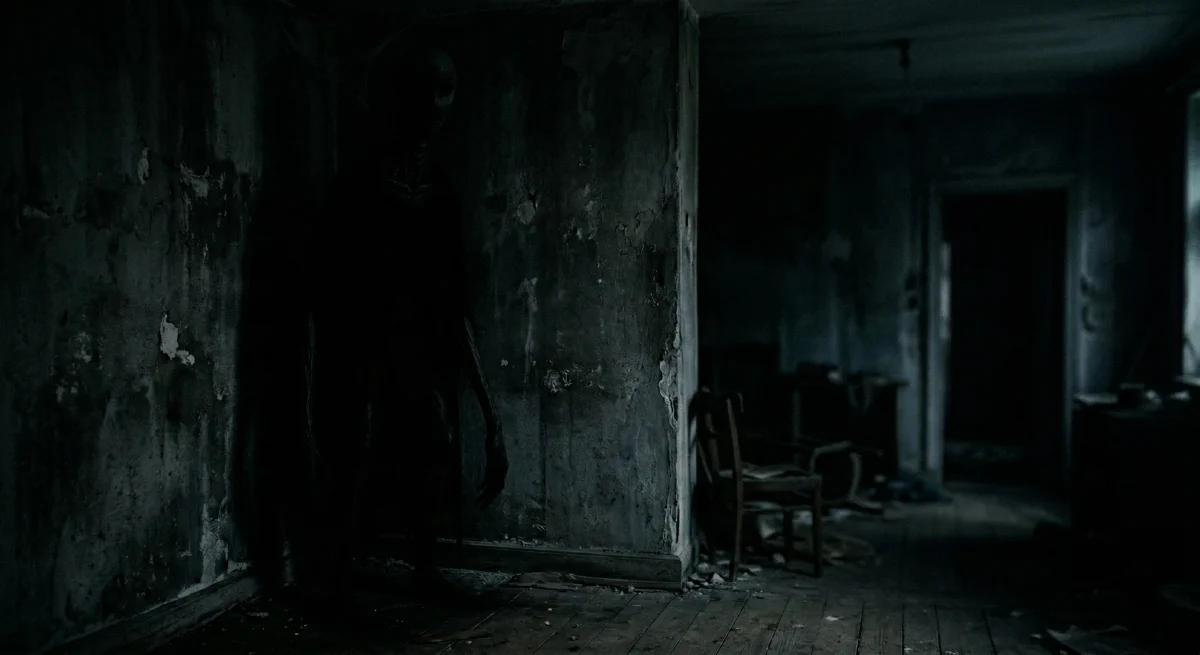
It was standing between the Caldwell house and the vacant lot next to it, in the narrow channel of shadow where the two properties didn’t quite meet. Tall. Still. The posture wrong in a way she couldn’t have explained if someone had asked, wrong the way a coat hanging on a door is wrong at three in the morning, when for one bad second your brain makes it into a person.
She looked.
A fence post. Leaning slightly, wrapped in dead ivy, the kind that went brown and skeletal in January and wouldn’t green again until April. Just a fence post in the gap between two houses. She’d driven past it a thousand times.
She parked in front of the house on Birch Street and sat for a moment with the engine running. The frost on the windshield was already reforming at the edges, thin crystals spreading inward like something growing. The street was quiet. The neighbor’s bikes were where they always were, three of them in a tangle of handlebars and spokes. A dog barked somewhere, muffled.
She went inside and locked the door behind her. She stood in the small entryway and listened to the apartment the way you listen to a house when you come home and want to know you’re alone.
She showered until the water cooled. She put on sweatpants and Tommy’s Cleveland Indians shirt and pulled the blackout curtains shut. The room went dark, not fully, because blackout curtains were only as good as their edges, and the January light crept in along the sides and through the gap where the two panels met in the middle, a thin vertical line of grey that fell across the carpet like a seam.
She lay down. The bed was firm, the sheets cool, the pillow shaped to her. She closed her eyes.
The silence had a texture.
That was the only way she could describe it, and she didn’t try. But lying in the dark with her eyes closed and her body doing its slow unwinding, the silence felt different. Not louder. Not emptier. Just… attended to. Like the difference between an empty room and a room where someone is standing very quietly with their back to the wall. Nothing had changed. But the quality of the nothing had shifted, the way a note changes when you press the sustain pedal, the same sound, held differently.
She opened her eyes.
The ceiling was there. White, cracked in the corner. The gap in the curtains let in its thin line of light. The bedroom doorway was a dark rectangle, the hall beyond it darker, and she could see the edge of the wall and the shadow where the hall turned toward the kitchen and nothing else, because there was nothing else.
She stared at the doorway for a long time.
Then she rolled over and pressed her face into the pillow and told herself the feeling was exhaustion, which it was. Two nights in a row. Patients who sat up in their beds describing atmospheric shifts and frequency changes and movement in the dark. Of course it got into your head. That was the nature of sustained proximity to disordered thinking. Four patients across three corridors all awake on the same night, all describing the same thing in different words, and Ellie was not going to think about that because it didn’t mean what it seemed to mean. It meant the ward had a bad night. Wards had bad nights. Sometimes everyone was just off.
She slept.
It was not good sleep. It was the shallow, interrupted kind where you surface every hour or so and lie still with your eyes closed, willing yourself back under, and the dreams (if they were dreams) were nothing she could hold onto afterward, just impressions: corridors, long and wide and lit badly, and a sound like breathing that wasn’t hers, and the sense of something very large standing very still in a room she couldn’t see.
She woke at three-fifteen. Not gently but sharply, the way you wake when something has changed, some animal alarm that fires before the conscious mind has a chance to name what triggered it.
The room was grey. Afternoon light pressing through the curtain gap. The crack in the ceiling was there, in the corner above the closet, running from the wall seam toward the light fixture in a line that was, she now noticed, slightly longer than she remembered. Or she hadn’t looked at it carefully before. Ceilings cracked. Houses settled.
She sat up.
She checked the corners of the room.
This was the second time she’d done this. The first had been yesterday, waking from her post-shift sleep, and she’d done it then without thinking, before thought had caught up with instinct. Now she did it deliberately, and the deliberateness disturbed her more than the instinct had. The corners were empty. The closet door was closed. The bedroom window behind the curtains showed nothing but the flat grey of a January afternoon. She was alone.
She noticed her hands were gripping the edge of the mattress, both sides, the way Mrs. Singh had been gripping hers. She let go.
Coffee. Maxwell House, a spoonful, hot water from the kettle. She drank it standing at the counter, looking out the kitchen window at Birch Street. A car she didn’t recognize was parked across the street, a blue sedan, and she looked at it, and it was a car, and she looked at the space beneath it, where the shadow pooled between the tires and the curb, and it was a shadow, and she looked at the end of the block where the street met Elm, and there was a shape at the corner, and it was the mailbox, the same green postal box that had been there for longer than she’d been alive, and she knew it was the mailbox, and she was still looking at it.
She put her mug down.
She was doing this. She could feel herself doing it, the way a patient sometimes could, the ones who were aware enough to recognize the onset of an episode, who could stand outside their own unraveling and name it and still not stop it. She was scanning. Looking for tall shapes in shadows, wrong proportions, stillness where there should be movement. She was looking for Daniel’s monsters.
This was textbook. Prolonged exposure to consistent delusional material could produce sympathetic ideation in caregivers, especially those who were sleep-deprived and socially isolated. There was a chapter in the DSM-III about it, or adjacent to it, and she could almost hear her nursing instructor’s voice: If you notice yourself adopting the patient’s framework, step back. Talk to a colleague. Get sleep.
She was stepping back. She would get sleep.
She rinsed her mug and put it upside down on the rack. She stood at the sink and looked at the window and stopped.
The kitchen window faced east. At this time of day, with the afternoon light behind her and the kitchen darker than the street outside, the glass was half-transparent, half-reflective. She could see Birch Street through it, the parked cars and the bare trees and the grey sky. And she could see, layered over it, the dim reflection of the kitchen behind her. The counter. The refrigerator. The doorway to the hall.
There was something in the doorway.
It was tall. It filled the frame from the threshold to the header, and it was narrow, narrower than a person, and it was dark in a way that wasn’t shadow, in a way that had depth and texture, and it stood in the doorway to the hall the way something stands when it has been standing there for a very long time, with a patience that had nothing to do with waiting because waiting implies an end and this was just presence, motionless and absolute.
Ellie spun around.
The doorway was empty. The hall beyond it was empty. The apartment was quiet and still and there was nothing in the doorway, nothing, and she stood with her back against the counter and her heart going fast and her hands gripping the laminate edge and breathed.
She turned back to the window. Her reflection, pale and hollow-eyed, looked back at her with an expression she recognized because she’d seen it on patients a hundred times. The look of someone who has seen something impossible and is deciding, in real time, how much of their own perception to trust.
She pulled the curtain across the kitchen window. It was a thin curtain, not the blackout kind, and the reflection vanished, and Ellie stood with her hand on the fabric and breathed until her heart settled.
Hadley had covered every reflective surface in her apartment.
Ellie did not think about that.
She spent the rest of the afternoon on the Goodwill couch, not moving. She did not turn on the television (she didn’t own one) and did not read (she had nothing to read) and did not call anyone (there was no one to call). She watched the light change as the afternoon moved toward evening, the thin grey brightening briefly and then fading, the shapes of furniture losing their edges. She did not turn on a lamp. She sat in the slow accumulation of dark and thought about nothing, which took more effort than it should have.
At six she heated a Lean Cuisine (Salisbury steak, which was neither Salisbury nor steak but was two hundred and sixty calories and took four minutes and required nothing from her) and ate it standing at the counter with the curtain still drawn across the kitchen window. At seven she changed into clean scrubs. At eight she scraped the Civic’s windshield (the credit card was getting thin, worn to a translucent wafer from months of frost) and drove to work with the heater blowing cold air for the first three blocks and then warm air that smelled like dust and old rubber.
Thornwood at night. The parking lot half-empty, the building dark against the darker sky. She sat in the car for a moment after she turned off the engine, looking at the east wing windows, all dark except for the nurses’ station glowing with its dying fluorescent.
Kim had stayed late, which was unusual. She was at the station with a chart open and a look on her face that wasn’t quite concern but was in the neighborhood.
“Quiet day,” Kim said. “Aguilar’s been sleeping a lot, Rennick’s monitoring. Singh had a good afternoon. Webb’s wife called at nine-fifteen, I let it go to voicemail.”
“And Morrison?”
Kim paused. It was a small pause, the kind that most people wouldn’t notice, the kind that Ellie noticed because noticing pauses was what she did for a living.
“Morrison’s been… quiet.”
“Quiet how?”
“Quiet as in he hasn’t said a word since about seven this morning.” Kim pulled Daniel’s chart and opened it. “Day shift flagged it. He ate breakfast, went to the dayroom, sat in his usual chair. Didn’t talk to Rennick during rounds, didn’t respond to prompts, didn’t interact with anyone. Just sat. When they brought him lunch he ate it, went back to his room, lay down. Hasn’t spoken since.” She looked up. “Rennick thinks it’s the Haldol. New dose is higher, sometimes patients go flat for a few days while they adjust.”
Ellie took the chart. She read through the day notes: Pt non-verbal since early AM. Ate meals without prompting. No signs of distress. Responsive to simple commands (sit, stand, follow). Does not initiate interaction. Oriented x3 per assessment. Recommend observation, follow up 48 hrs re: medication adjustment.
“That’s not flat,” Ellie said.
Kim looked at her.
“Flat is affect. Flat is monotone, reduced expression, diminished response. This is withdrawal. He’s choosing not to talk.”
“Maybe. Rennick didn’t seem worried.”
“Rennick sees him for ten minutes a day.”
Kim didn’t argue. She wasn’t the arguing type, and anyway, it wasn’t her shift anymore. She handed over the rest of the charts, gave a summary of the evening (movie again, this time something with Tom Hanks, the dayroom still smelled like popcorn), and left.
Ellie sat at the station. The fluorescent buzzed above her, its three-week death still in progress, the light wavering in its rhythm of flicker and recovery. She read Daniel’s chart again. Then she read it a third time.
Daniel Morrison, who had described his hallucinations with the precision of a man giving sworn testimony, who had catalogued the tall figures and their wrong proportions and their folded faces with the consistency of someone describing a room he visited every day, who had looked at Ellie two nights ago with bloodshot eyes and said they’re coming through and then last night had looked at her with clear eyes and said you were always kind to me, had stopped talking. The most articulate patient on the ward. The one who used metaphor like a scalpel. The one who said the glass was clearing and the things behind it were becoming solid and the light was bending wrong and that Ellie should pay attention because something was watching her. That man had gone silent.
Not drugged silent. Not flat-affect silent. The day staff’s own notes said he was responsive, oriented, eating. He could talk. He was choosing not to.
Daniel had said everything he was going to say. Whatever he’d been trying to tell her, he’d finished telling it. The word from last night came back to her, the one she’d filed away: finished. He hadn’t been calm because the medication was working. He’d been calm because he was done.
Ellie closed the chart and put it with the others and picked up her clipboard and started rounds.
The ward was quiet. Not last night’s held-breath quiet, not the charged expectancy of four patients sitting up in their beds describing atmospheric changes. Quieter than that. The kind of quiet that settles over a place when the people in it are all listening to the same thing and none of them are willing to say what it is. Gerald was in his chair. Mrs. Prescott was asleep. Webb was snoring lightly. Mrs. Okafor accepted her Benadryl. Hoffman was in bed with his eyes closed, though Ellie wasn’t sure he was sleeping. Singh was asleep, or pretending to be, curled on her side with the blanket pulled to her chin. Hadley was sitting cross-legged on her bed, facing the corner, and when Ellie looked through the observation window she did not open the door, and Hadley did not turn, and they stayed like that for a moment, the glass between them, and then Ellie moved on.
She checked Daniel through the observation window. He was lying on his back, hands folded on his chest, eyes open, looking at the ceiling. The exact position from last night. She stood at the window and watched him. He did not move, did not look at her, did not speak. After a minute she made a note in his chart and moved on.
Patel was at the station when Ellie came back. She’d been quiet tonight, working through her charts with the focused diligence of someone still new enough to double-check everything. She looked up when Ellie sat down.
“How’s everyone?”
“Sleeping. Mostly.” Ellie pulled the stack of charts toward her. “Morrison’s the same. Non-verbal.”
Patel nodded. She looked like she wanted to say something else, but she turned back to her charting and the moment passed, and the station settled into its familiar nighttime quiet, the two of them working side by side under the dying light, pens scratching, the building breathing around them.
At 2:40 a.m. Ellie went to check the supply closet at the end of B corridor, because they were low on Benadryl cups and the overnight delivery wouldn’t come until five. The closet was past the stairwell junction, past the spot where the light was out. She walked down the corridor with her clipboard in one hand and her keys in the other. Her footsteps were the only sound. The corridor was long, the light thinning as she walked, the fluorescent strips spaced farther apart on this stretch because the building had been rewired in sections and this section had been done on the cheap. Ahead of her the corner where B corridor met the stairwell was dark the way it was always dark, the pooling shadow, the dead bulb, the absence of light that she had noted and reported and been told would be fixed in four to six weeks. She did not look at the dark. She looked at the supply closet door, three rooms past the stairwell on the left, and she walked.
And in her peripheral vision, close, closer than the wall, closer than the distance between her body and the edge of the corridor, there was something tall, and it was keeping pace with her.
She did not turn her head. She walked. Her hand on the clipboard was steady and her hand on the keys was steady. The corridor was five feet wide and she was alone in it.
Three steps. Four. Five. Six.
It was tall. The sense of it, the impression at the edge of sight, was of something that reached nearly to the ceiling, and narrow, and its movement was not movement exactly but a kind of drifting, a displacement of air. It matched her pace and it was beside her and it did not make a sound.
The fire door. The key, third from the left. She could do it blind. She put the key in and turned it and stepped through and pulled it shut behind her and stood on the other side with her back against the cold metal and her heart going so hard she could feel it in her teeth.
C corridor. Brighter. Lights all working. Patel at the station fifty yards ahead. Ellie stood with her back against the door and her hands shaking and she pressed the clipboard against her chest and breathed.
It was nothing. Exhaustion and suggestion. Her tired brain playing back imagery she’d absorbed from patients, the way you can’t stop hearing a song you’ve listened to too many times. It meant nothing. There was nothing there.
She went back to the station. She did her charting. She did not go back down B corridor for the rest of her shift. When Patel offered to check the supply closet at four, Ellie said yes, and did not explain why, and Patel didn’t ask.
Dawn came. She gave report to Kim and walked to the parking lot and scraped her windshield and drove home.
The apartment was exactly as she’d left it. The kitchen curtain was still drawn across the window. She stood in the doorway and looked at the empty hall and the empty rooms, the spaces where the light fell and the spaces where it didn’t. Everything was ordinary. She was alone. She locked the door behind her and did not check the corners and did not check the corners and did not check the corners and then checked the corners, quickly, before she could stop herself. They were empty. Of course they were empty. She went to bed with the blackout curtains drawn and her eyes closed and her hands folded on her chest (like Daniel, she thought, and then she stopped thinking). She did not sleep well. She did not dream well. When she woke the room was dark and the feeling was back, the attended silence, the held-breath quality of air that was being watched by something patient and still. She got up and made coffee and went to work.