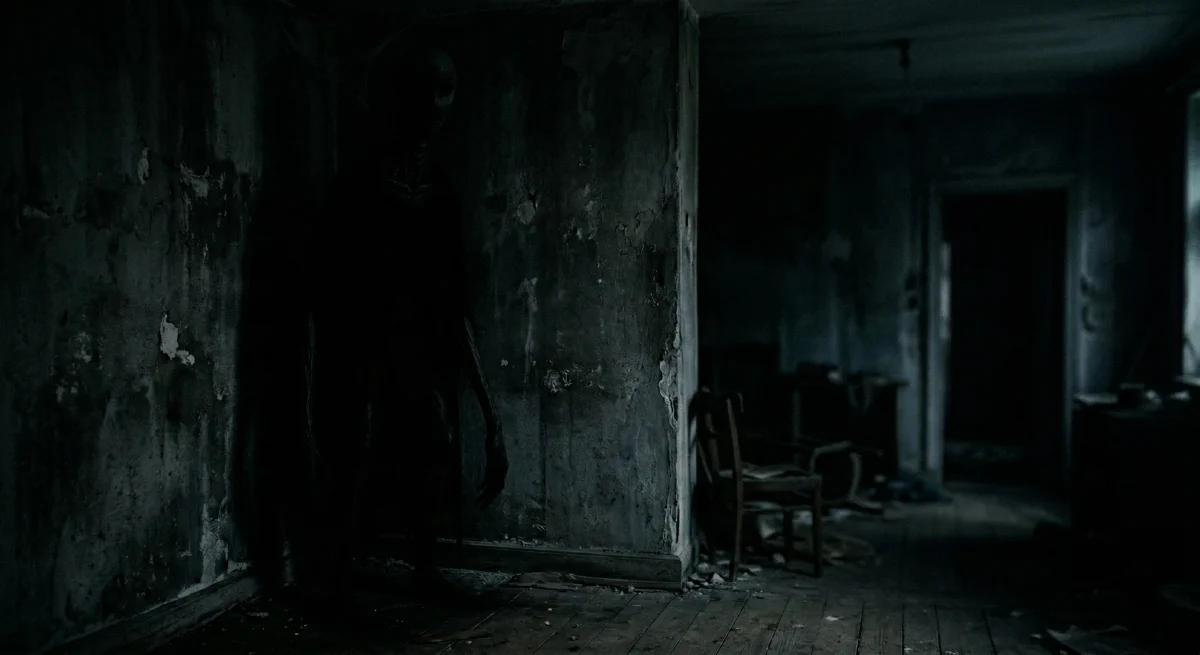
Chapter 4: The Corner
The parking lot was dark when she pulled in. Six cars, maybe seven, scattered across the asphalt in the way of people who parked where habit told them to and didn’t think about it. Ellie’s spot was by the dumpsters, where it always was. The Civic shuddered once when she turned off the engine and then went still, ticking softly in the cold. She sat for a moment with her hands on the wheel and looked at the building.
Thornwood looked the same. Red brick and gabled roofs and the east wing windows dark except for the nurses’ station, its dying fluorescent still visible through the glass, still flickering, still waiting for the replacement bulb that was somewhere between a warehouse and a purchase order and would arrive in four to six weeks or never. Everything about the building was the same. The narrow windows. The roofline against the sky. The way the brick absorbed the parking lot light and gave nothing back.
She went inside.
Linda was half out the door, coat buttoned, keys already in her hand. She gave report the way she always gave report, efficient and clipped, the verbal equivalent of someone handing off a baton while already running in the other direction.
“Quiet day. Aguilar slept most of it, Rennick wants vitals every four hours. Singh’s doing better, ate all her meals. Webb’s wife called twice, both times after nine, I let it ring. Hadley refused her afternoon meds but wasn’t combative about it, just said no. Hoffman joined a puzzle in the dayroom, first time in a week.” She paused. “Morrison’s the same.”
“Still not talking.”
“Not a word. Rennick’s giving it another twenty-four hours before he reassesses the Haldol.”
Ellie took the charts. Linda left. The station settled into its nighttime quiet, the fluorescent above her buzzing its slow death, the corridors exhaling into the particular stillness that came when the day shift cleared out and the building remembered it was old.
Patel was already on the floor. Ellie could see her at the far end of C corridor, checking a room, her silhouette small and precise against the light. They’d be the only two tonight. Two nurses for forty-three patients, which was short even by Thornwood standards, but the budget was what the budget was, and the patients were who they were, and you managed.
She picked up her clipboard and started rounds.
The ward was quiet. Not the held-breath quiet of two nights ago, when four patients had been sitting up in their rooms describing atmospheric changes and frequency shifts. Not the listening quiet of last night, when the silence itself had seemed to have weight. This was something flatter. Emptier. The quiet of a room after an argument, when everyone has said what they were going to say and the air is still ringing with it but the voices have stopped.
Aguilar, sleeping. Prescott, sleeping. Singh, sleeping, genuinely sleeping this time, the mattress-gripping and the wide eyes gone. She marked charts and moved on. Hoffman was in bed, on his side, facing the wall. Not at the window tonight. His breathing was slow and regular, but there was something about the set of his shoulders, the way the blanket was pulled tight around him, that made Ellie think of someone bracing. She watched him through the observation window for a long moment. He didn’t move. She moved on.
The corridor stretched ahead of her, long and wide and lit badly. She was approaching B corridor, where the fire door separated the sections, where the long-term patients were, where Daniel’s room was, and where the light was out at the stairwell junction, the dead bulb, the pooling dark in the corner that she had reported and re-reported and that would be fixed in four to six weeks or never. B corridor, where two nights ago something tall and narrow had kept pace with her in her peripheral vision, drifting beside her without sound, matching her step for step.
She put the key in the fire door. Third from the left. She turned it.
B corridor was darker than it had been. She noticed it immediately, the way you notice a room that’s lost a lamp, not dramatic but measurable, and she looked up and saw that another fluorescent had gone, the one midway between the fire door and the stairwell junction. The section of corridor it had covered was now a long stripe of dimness between two pools of light, and at the far end the dead bulb’s territory had expanded, the dark spreading from the stairwell corner like water finding its level.
She walked.
Her footsteps were even. Her clipboard was in her left hand, her keys in her right, and she walked down B corridor the way she walked down every corridor, steadily, without fuss, paying attention. She did not look at the shadows. She did not look at the stairwell corner. She looked at the doors, the numbers, the observation windows, because that was what she was here for, and what she was here for was the only thing that held.
Room 31. Hadley.
Ellie stopped at the observation window. The room was dim, lit only by the corridor light filtering through the glass. Hadley was on her bed, cross-legged, facing the far corner. The same position she’d held every time Ellie had seen her. Patient as stone. Watching whatever she watched in the dark space where the walls met.
Ellie did not open the door. She had not opened Hadley’s door since the night before last, since Hadley had looked at her with those clear, fearless eyes and said you should rest too, while it’s still quiet. She stood at the window and watched Hadley watching the corner, and the glass was between them, and Hadley did not turn.
Then Hadley tilted her head, slightly, the way a person does when they hear footsteps they’ve been expecting. Still facing the corner. Still cross-legged and still. But angled now, just barely, toward the door.
“It’s getting louder, isn’t it.”
Not a question. Almost gentle. The voice of a person who had been where Ellie was and had come out the other side of it, though what the other side looked like, Ellie couldn’t tell, because Hadley was sitting cross-legged on a bed in a locked psychiatric ward at two in the morning, and whatever the other side was, it had not set her free.
Ellie did not answer. After a moment she moved on. Hadley did not call after her. The corridor was quiet, and her footsteps were the only sound.
Room 22. Daniel.
She stood at the observation window. The pale rectangle of corridor light fell across the floor of his room, touching the foot of the bed, and beyond it Daniel lay on his back with his hands folded on his chest and his eyes on the ceiling. The same position. The exact same position he’d held for two days. His chest rose and fell. His face was still. The angles of his jaw and the hollows under his eyes made him look carved rather than alive, a figure on a tomb. His grey-flecked hair caught the faint light. His hands were still and his mouth was closed.
She opened the door.
She hadn’t opened it since the silence began. She’d been checking through the glass, marking her chart, moving on. But tonight she opened the door and stepped inside and stood near the foot of his bed and waited, the way she’d waited with him a hundred times before, because Daniel was the kind of patient you waited with, the kind whose silence held more than most people’s speech.
The room was cold. Not dramatically, not in a way that meant anything other than old radiators and January air, but the cold sat against her skin and the dark pressed at the window behind her and the only light was the corridor glow through the observation window. Daniel lay on his back and did not look at her.
She stood there for a long time. A minute. Two. The building settled around them, pipes ticking in the walls, the radiator clicking its slow, irregular cadence. She could hear her own breathing and his. Nothing else.
She was about to leave. She had her hand on the door, her fingers curled around the metal edge, and she was about to pull it open and step out and mark his chart (the same note, pt non-verbal, resting, no change) when he spoke.
“It followed you.”
Three words. His voice was quiet, uninflected, the voice of a man stating something so obvious it barely needed saying. He did not look at her. He did not move. He said it to the ceiling the way he said everything, with that steady, reporting precision, and then he closed his eyes and his hands were still on his chest and his breathing was even and he was done.
Ellie stood with her hand on the door.
The corridor. Two nights ago. The thing keeping pace beside her, tall and narrow, drifting without sound. She had not told anyone. She had not told Patel, had not written it in any chart, had not spoken it aloud, because speaking of it would make it something she’d said instead of something she could file under exhaustion and suggestion and the particular cost of proximity to disordered minds. And Daniel had been silent for two days. And he had chosen this, this one sentence, these three words, to break the silence with.
She pulled the door shut. She stood in the corridor and breathed. The fluorescent at the far end of B corridor was still dead, the new one was still dead, and the dark pooled in two places now instead of one, and the corridor was long and badly lit and she was standing in it alone.
She went back to the station.
Patel was there, working through her charts with the focused diligence that was starting to look less like newness and more like personality. She looked up when Ellie sat down, and there was something in her expression, a hovering attention, the look of someone who wanted to ask a question and was deciding whether to.
“You okay?”
“Fine.”
“You look tired.”
“Night shift.”
Patel held the look a moment longer, then let it go. She went back to her charting. The pens scratched. The fluorescent buzzed. The building breathed. Ellie wrote her notes. Her handwriting was steady. She made sure of that.
She did not write what Daniel had said. She wrote: Pt spoke briefly during check (0215). Single statement, unprompted. Content nonspecific. Eyes closed after. Returned to resting state. Monitor.
Content nonspecific. That was what she wrote. She capped her pen and put the chart with the others and sat at the station and looked at nothing and thought about nothing and the shift continued.
The rest of the night moved the way nights moved at Thornwood, in long stretches of nothing broken by small tasks. She rechecked Aguilar’s vitals at 0400. She gave Mrs. Okafor her Benadryl. She walked the corridors (not B corridor, she let Patel take B corridor, and Patel didn’t ask why) and checked the rooms and marked her charts. The hours passed the way they always passed, one after another, in order, because that was how time worked and there was nothing wrong with time.
Dawn came. Kim arrived, brisk and competent, coat still buttoned, coffee in hand. Ellie gave report. She heard her own voice, steady and professional, running through the night’s events with the clinical precision of someone who had been doing this for six years and could do it in her sleep. Nothing to flag. Quiet night. Morrison spoke once, single statement, nonspecific. Hadley refused morning meds. Everyone else stable.
Kim took the charts. Ellie walked to the parking lot.
The sky was grey. The frost was light today, barely a film on the windshield, and the credit card went through it in two strokes. The heater blew cold for three blocks and then warm air that smelled like dust, and she drove home the way she always drove home, ten and two, Route 4, the railroad tracks that made the Civic shudder, and everything was ordinary.
The apartment was as she’d left it. Kitchen curtain drawn. No light on the answering machine. She locked the door behind her and stood in the entryway and listened, the way she listened every time now, for the quality of the silence, for the difference between empty and occupied.
She showered. She put on sweatpants and Tommy’s shirt, the Cleveland Indians logo cracked and fading, the fabric so soft from years of washing that it barely felt like wearing anything at all. She pulled the blackout curtains shut. The room went dark. She lay down.
The bed was firm. The sheets were cool. The pillow shaped to her. She closed her eyes.
The silence was there. The attended silence, the one that had followed her home for three days now, the one that sat in the room like a person who wouldn’t speak. It was heavier tonight. Denser. The air against her face had a closeness to it, the particular pressure of a room that is smaller than it should be, as if the walls had shifted inward by some increment too small to measure but large enough to feel.
She kept her eyes closed. She breathed. She counted her breaths because counting was structure and structure was the thing that held, and she counted to sixty, and then to sixty again, and her body was tired, her body was so tired, three nights of broken sleep and the shifts between them and the weight of everything she was not thinking about pressing down on her like a hand on her chest.
She could not sleep.
Something was wrong with the room. Not the vague wrongness of the night before, not the attended silence, not the sense of being watched. Something geometric. Something spatial. There was a density in the air that had a location, a pressure that occupied a specific part of the room, the way heat occupies the space above a stove. It was coming from the corner. The corner above the closet, where the ceiling crack ran from the wall seam toward the light fixture, the crack she’d noticed was longer than she remembered, or maybe she hadn’t looked at it carefully before, because ceilings crack, and houses settle, and there is nothing wrong with the corner of a room.
She opened her eyes.
It was standing in the corner of her bedroom.
Not in her peripheral vision. Not in the reflection of a window. Not at the edge of sight where the mind fills in shapes from shadow and suggestion. It was there. In the corner. Where the ceiling met the walls, where the crack ran, filling the space from the floor to somewhere above where the thin line of light from the curtain gap could reach. It was tall. It was narrow. The proportions were wrong in the way Daniel had described, the way she had listened to and noted and filed and never believed: arms too long, reaching past where arms should stop, the joints bent at angles that her mind could see but not accept, folded the wrong way, articulated like something designed by a hand that had heard of human bodies but never seen one. And the face. If it was a face. Smooth and featureless, skin stretched over an absence, over the place where a face should be, not blank but sealed, closed, like a wound that had been stitched shut and had healed that way.
It did not move. It did not breathe. It stood in the corner with the patience of something that had been standing there for a very long time, that had perhaps been standing there for all the nights she had slept in this room, and she had not known because she had not looked, or because it had not been ready to be seen.
She could not move.
She lay in bed and looked at it and it looked at her. There were no eyes. There was nothing in the smooth, sealed surface of its face that corresponded to sight. But it was looking. She could feel it, the attention, fixed and total, like heat, like the pressure of a hand held close to skin without touching. It was oriented toward her the way Daniel had said. Like a plant toward light.
The room was silent. The blackout curtains blocked the world. The only light was the thin line where the panels didn’t quite meet, falling across the carpet in a pale seam, and it did not reach the corner. The thing in the corner was darker than the dark around it. It occupied the shadow the way a stone occupies water, displacing it, changing its shape.
She didn’t know how long she lay there. Her body had gone still in a way that was not calm, that was not choice. Do not move. Do not make a sound. The rabbit in the grass. The mouse under the owl’s shadow. Her body was very still.
Her eyes were open. Her hands were at her sides. She could feel her heartbeat in her throat, in her wrists, in the thin skin behind her ears. She breathed in shallow pulls that barely moved her chest. The thing in the corner did not move. It stood and it watched and the silence was absolute, not attended now but filled, saturated, the silence of two things that see each other and neither one looks away.
She closed her eyes.
She didn’t decide to. The lids came down the way they come down when the body has reached its limit, when there is nothing left to hold them open, and the dark behind her eyelids was a different dark than the dark of the room, warmer, closer, hers, and she lay in it and breathed and did not move.
When she opened her eyes the light had changed. The thin line between the curtain panels was brighter, the pale grey of late morning, and it fell across the carpet at a different angle, and the corner was empty.
The ceiling crack was there. The wall seam was there. The closet door was closed. The room was a room. There was nothing in the corner and there was no pressure in the air and the silence was ordinary silence, the kind that means no one is home, and she was alone.
She sat up.
She looked at the corner. She looked at it for a long time. The baseboard. The scuffed paint. The crack running across the ceiling, hairline thin, the kind of crack that appears in old houses as the foundation shifts, as the weight settles, as the building adjusts to the slow work of time.
She knew what she had seen.
She sat on the edge of the bed with her feet on the cold floor and Tommy’s shirt hanging loose around her shoulders and her hands in her lap, and she did not tell herself it was exhaustion, and she did not tell herself it was suggestion, and she did not reach for the DSM-III or the nursing textbook or the clinical framework that had held her together for six years in a building full of people who saw things that weren’t there.
She knew.
She got up. She went to the kitchen. She made coffee, Maxwell House, a spoonful, hot water from the kettle. She drank it standing at the counter with the curtain still drawn across the window. She did not pull the curtain back. She did not check the reflection. She stood in the dim kitchen and held the mug in both hands and the coffee was hot and the apartment was quiet and outside, beyond the drawn curtains, Birch Street went about its ordinary morning.
She rinsed the mug and put it upside down on the rack. She went back to the bedroom and pulled the blackout curtains open, and the grey winter light came in, and the corner was just a corner, and she looked at it, and she got back into bed, and she did not sleep.