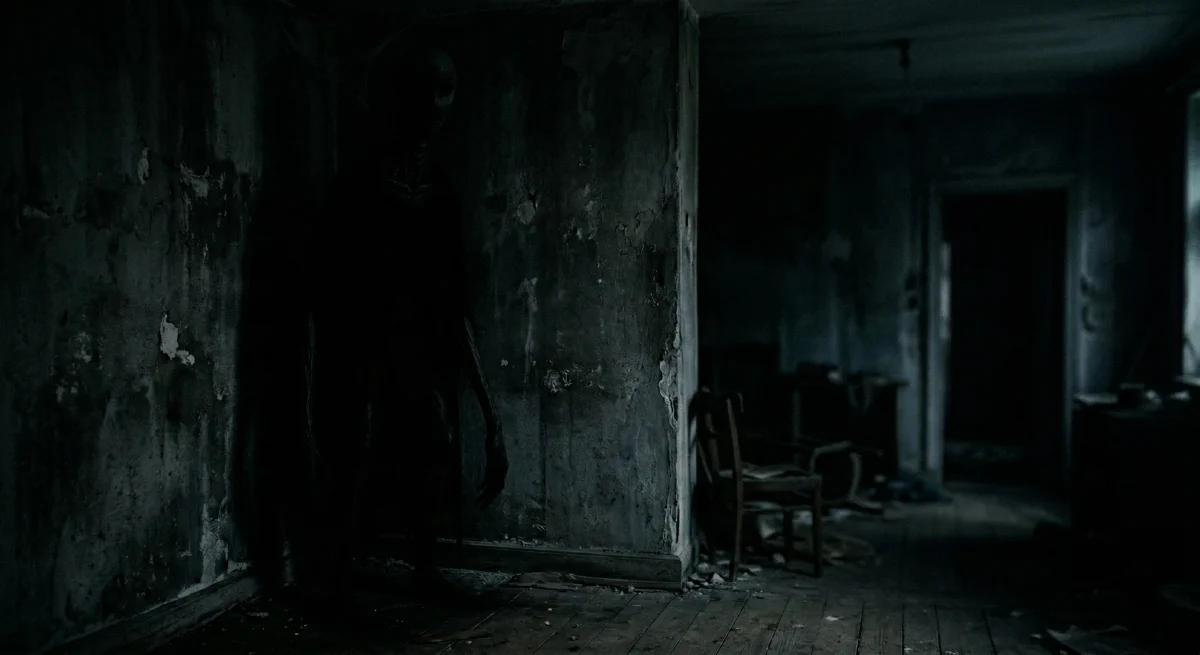
Chapter 5: Am I Like Them?
She lay in bed with the curtains open, watching the corner. It was empty. The light was grey. The clock on the nightstand said 11:47 and she had not slept.
The ceiling crack was there. Hairline thin, running from the wall seam toward the light fixture, the same crack that had been there when she moved in, the same crack that had been there last night when the thing stood beneath it. She traced it with her eyes and tried to feel nothing and felt everything.
She got up.
The apartment was cold. The heat in the building came from a single furnace in the basement and it worked the way everything in her life worked, inconsistently, with long gaps between effort, and in January the gaps were longer. She put on socks and padded to the kitchen and filled the kettle and stood at the counter with her hands flat on it and waited for the water to boil.
Maxwell House. A spoonful. Hot water. She held the mug in both hands and drank standing up, the way she always drank. The routine was there, the sequence of small actions she’d built her life around. It meant… nothing. The structure was intact but the thing it was supposed to hold together had come apart. The coffee was just hot water with powder in it. The kitchen was just a room. The curtain was still drawn across the window because there was something on the other side of reflections now, and she was not ready to see it again.
Am I losing my mind?
Not the clinical version. Not the one from two days ago, when she’d stood at this same counter and applied the DSM-III like a bandage and told herself it was sympathetic ideation, prolonged exposure, the predictable cost of proximity to disordered thinking. That version had a framework. That version had a name and a treatment plan and a chapter in a textbook. This version had nothing. This was just the question, bare and simple, asked by a woman standing in her kitchen at noon on a Thursday in January with no sleep and no answers and a memory of something tall and faceless standing in the corner of her bedroom watching her with a patience that did not belong to anything alive.
She put the mug down. She went to the phone.
The yellow pages were in the drawer beneath the phone, a fat book with a cracked spine and a cover that said MILLBROOK & SURROUNDING COMMUNITIES 1993-1994. She opened it on the counter and turned to the back. Mental Health Services. The section was thin. Three listings for Millbrook proper: Thornwood Psychiatric (she almost laughed), the Licking County Crisis Line, and a boxed ad for a practice on Chestnut Street. MILLBROOK COUNSELING ASSOCIATES. Individual, couples, and family therapy. Sliding scale available. Two names she didn’t recognize.
She picked up the phone and dialed.
A woman answered on the third ring, pleasant and professional, the voice of someone whose job was to make the first call easier. Ellie said she’d like to make an appointment. The woman asked what kind of appointment. Ellie said individual. The woman asked if this was her first time. Ellie said yes. There was a pause, the sound of pages turning, a paper appointment book, and the woman said they’d had a cancellation this afternoon, two-thirty, if that worked.
“That works.”
She hung up and stood with her hand on the phone and looked at the kitchen curtain, which hung flat and still across the window, blocking nothing, hiding nothing, just a piece of fabric over a pane of glass, and she did not pull it back.
She dressed. Not scrubs, not sweatpants. Jeans and a sweater and her winter coat, the clothes of a person going out into the world on purpose. She brushed her teeth and looked at herself in the bathroom mirror, and the face that looked back was a face she recognized but barely: dark circles hollowed under the eyes, cheekbones sharper than they should have been, the particular grey complexion of someone running on caffeine and adrenaline and nothing else. She looked like her patients. She looked like Daniel on a bad night, hollow and watchful and running out of time.
She looked away from the mirror.
The Civic started on the second try. The frost was thin today, almost nothing, and the credit card scraped through it in one pass, its edge worn almost translucent now, a wafer of plastic that wouldn’t last another month. The heater blew cold for the usual three blocks and then warm air with its smell of dust and old rubber, and she drove.
Millbrook in the daytime. The same grey storefronts, the same boarded windows, the same sky the color of dishwater pressing down on everything. She drove past the Kroger, past the laundromat, past the movie theater on Market Street (still showing Tombstone, the poster sun-faded now behind the glass). She drove past all of it and saw none of it, and then saw, in the side window of the Civic, in the curved glass that reflected the buildings behind her as she passed them, something that was not a building and was not behind her. Tall and narrow. There for one second and gone the next. She gripped the wheel at ten and two and did not look again.
The library was on Main Street, between the post office and a store that had been a shoe repair and was now nothing. A brick building, low and solid, with a flagpole out front and a sign in the window that said MILLBROOK PUBLIC LIBRARY in letters that predated Ellie’s birth. She’d been here as a kid. Tommy had loved it here, the children’s section with its beanbag chairs and its shelf of Hardy Boys books that he tore through one after another, carrying them home in stacks that reached his chin. She hadn’t been back in years.
Inside it smelled the way libraries smell: paper and dust and the particular warmth of a building that is heated better than it needs to be because the people who come here are mostly elderly and the cold matters to them. The main room was large and quiet, fluorescent lights humming above rows of dark wooden shelves. A woman at the front desk looked up and smiled. Two older men sat at a table by the window, reading newspapers. A mother with a small child was in the children’s section, the child pulling books from a low shelf with the focused destruction of a toddler.
Ellie went to the reference section.
It was in the back, past the fiction shelves and the periodicals, a small alcove with a sign that said REFERENCE, NON-CIRCULATING. Metal shelves holding encyclopedias, atlases, telephone directories from surrounding counties, and one shelf of medical and health books. She scanned the spines. A home medical encyclopedia from 1987. A nursing reference that she recognized from school. Two books on nutrition. A book called The Broken Brain that she pulled from the shelf and opened and put back.
And there, on the bottom shelf, a thick paperback with a cracked spine and a title she knew: Surviving Schizophrenia: A Family Manual, by E. Fuller Torrey. She’d seen it in the Thornwood staff room. One of the nurses had kept a copy in her locker, the dog-eared kind of book that people carry when they need to understand something that has happened to someone they love.
She took it to a table by the wall, away from the windows, and sat down and opened it.
She knew the basics. Six years on the ward had given her the working knowledge of a nurse who dealt with schizophrenia every shift: the medications, the symptom clusters, the management strategies, the language of care plans and progress notes. But that knowledge was practical, procedural. It was the knowledge of someone who stands on one side of the observation window.
Now she was reading it differently.
Chapter three. Symptoms. She ran her finger down the page, and the words were the same words she’d read a hundred times in charts and textbooks, and they were different now because they were about her.
Visual hallucinations. Seeing things. Figures, shapes, presences that other people cannot see. She thought of the corner of her bedroom. She thought of B corridor.
Paranoid ideation. The belief that one is being watched, followed, monitored. She thought of the attended silence. The sense of something in the room. The way her eyes went to corners now, every room, automatic.
The list went on. Sleep disturbance. Social withdrawal. She didn’t need to read the descriptions. She knew them the way she knew medication dosages, from the other side of the clipboard, except now the clipboard was pointed at her and every line was a mirror.
Hereditary factors. Ten percent if a first-degree relative was affected. Higher with multiple relatives. She didn’t know Rachel’s medical history, not really. Rachel had always been anxious, always worried, but anxious wasn’t schizophrenic. Was it?
She sat at the table with the book open in her lap, the fluorescent light humming above her (always fluorescents, always humming, every institution in her life lit by the same dying buzz). She could write her own intake form. She could fill in every field. She could sit on the other side of the desk and watch someone nod and write it down and offer medication and a bed in a ward with reinforced windows and observation checks every thirty minutes, and the person writing would be kind, and the person writing would listen, and the person writing would not believe her, because that was the job. She knew. She’d been that person.
The terrible thing was this: Daniel’s descriptions matched. Not approximately. Not the way two patients on the same ward develop overlapping imagery because proximity breeds shared delusion. Exactly. The tall figures with wrong proportions. The arms too long, the joints bending at angles the mind could see but not accept. The sealed faces, the skin stretched over absence. The way light bent around them. She had heard Daniel describe these things for months. She had written consistent imagery and recommend discuss med adjustment. She had been kind. She had not believed him. Then she had seen the same thing standing in her bedroom, and it had not been a copy of Daniel’s vision, it had not been borrowed or absorbed or sympathetically generated. It had been its own thing. Present. Real. The same way a table is real or a wall is real, occupying space, casting a kind of anti-shadow, there in a way that hallucinations are not supposed to be there.
But that was exactly what every patient said. Every one. It’s real, I know it’s real, it’s not like the others, this one is different. She’d heard it from Daniel. From Singh. From Hoffman. From Gerald and Prescott and Webb and every patient who had ever sat on the edge of a bed and said I know what I saw. She had been kind. She had listened. She had written it down. She had not believed them, because not believing them was the same thing as helping them, because belief was the territory of the illness, and the job was to hold the line between the world that was real and the world that wasn’t.
And now she was sitting in a library reading a book about her own symptoms and she could not tell which side of the line she was on.
She closed the book. She put it back on the shelf. She left the library and sat in the Civic in the parking lot, hands on the wheel, engine off, the cold coming in through the gaps in the doors. She breathed. The breathing was something she had to think about, because if she didn’t think about it her chest would tighten and the air would stop and she would sit here forever in a frozen car in a dying town understanding nothing.
She drove to the appointment.
Millbrook Counseling Associates was on the second floor of a building on Chestnut Street, above a State Farm insurance office. The stairwell smelled like carpet cleaner. The waiting room was small: four chairs, a table with magazines (People, Time, a National Geographic from October), a watercolor painting of a covered bridge that was trying very hard to be calming. A white noise machine hummed from somewhere behind the reception desk.
A woman came out at two-thirty exactly. Mid-forties, brown hair pinned back, cardigan, reading glasses on a chain around her neck. She smiled the way therapists smile, warm and careful, the smile of someone who has been trained to make the first minute easy.
“Eleanor? I’m Jan. Come on in.”
The office was small. A desk pushed against one wall, two chairs facing each other, a plant on the windowsill (plastic, Ellie noticed), and a box of tissues on the side table, placed where a patient could reach them without asking. The window looked out onto Chestnut Street, where a man was walking a dog and the parking meters stood in a row like small sentries.
“So,” Jan said, settling into her chair with a legal pad in her lap. “What brings you in today?”
Ellie had rehearsed this in the car. She’d rehearsed it the way she rehearsed patient interactions, choosing the words that conveyed enough without revealing too much, the controlled disclosure of someone who understood how information worked in clinical settings.
“I haven’t been sleeping well. A few nights now. I work night shifts at Thornwood, the psychiatric hospital, and I think the schedule is catching up with me.” She paused. “And I’ve been… noticing things. At the edges of my vision. Shapes, movement. Things that aren’t there when I look directly.”
Jan wrote something on the pad. “How long have you been working nights?”
“Six years.”
“And the sleep trouble, when did that start?”
“This week. Maybe last week. It’s hard to say with night shifts. Sleep is always off.”
“And the visual disturbances?”
“A few days.”
Jan nodded. She asked about caffeine intake, about medication, about alcohol. She asked if Ellie had experienced anything stressful recently, any changes at work or at home. She asked about relationships, support systems, family. Ellie answered the way she’d planned to answer: carefully, truthfully enough, steering the conversation along the edges of what was actually happening without ever touching the center of it.
She did not say: There is something standing in the corner of my bedroom. It has no face. It watched me for hours and I could not move.
She did not say: My patient described it exactly, months before I saw it, and he has not spoken in three days and I wrote “content nonspecific” in his chart because I cannot write the truth.
She did not say: I went to the library today and read a book about schizophrenia and every page was about me.
She sat in the chair and said the words she could say. The space between what she said and what she needed to say was enormous. Jan listened and nodded and wrote. She was competent. She was kind. She heard “burnout” and “sleep deprivation” and “the stress of psychiatric nursing” because those were the words Ellie gave her, and they made a coherent story, but the coherent story was not the true one.
“It sounds like you’re dealing with a lot of accumulated stress,” Jan said. “Night shift work is particularly hard on the body, and six years is a long time. The visual disturbances you’re describing are very consistent with severe sleep deprivation. The brain starts to misfire when it’s not getting enough REM sleep. You might also be experiencing some vicarious trauma from your patients. That’s very common in psychiatric care.”
“I know,” Ellie said.
“What I’d suggest is, first, talk to your doctor about the sleep issues. There are short-term options that can help reset your cycle. Second, try to build in some downtime that isn’t just recovery from the shift. Even twenty minutes a day of something that isn’t work or sleep. A walk. Reading. Something for you.” She paused. “And I’d like to see you again. Next week, if you can.”
“Okay.”
“Is there anything else you want to talk about today?”
The question sat in the room between them. The white noise hummed from the waiting room. The plastic plant on the windowsill caught the flat afternoon light and held it, motionless, in its fake leaves.
“No,” Ellie said. “That’s everything.”
She paid thirty-five dollars at the reception desk and walked down the stairs and stood on the sidewalk on Chestnut Street. The cold hit her face. The sky was the same dishwater grey it had been all day. She stood there and knew she had wasted her time and thirty-five dollars, because the problem was not sleep. The solution was not a walk. The woman upstairs was kind and competent and completely, utterly useless, because you cannot help someone who cannot tell you what is wrong.
She drove home.
The afternoon was failing. January light draining from the sky in the slow way it drained, not sunset but surrender, the daylight giving up by four o’clock and letting the grey deepen into something that wasn’t quite dark but wasn’t light either. She drove through Millbrook and the storefronts were lit now, the ones that were still open, their windows throwing yellow rectangles onto the wet sidewalk, and in one of those windows, the plate glass of the old hardware store on Main Street, she saw her reflection pass and beside her reflection something else passed, something taller, something that moved with her and stopped when she stopped at the light and was gone when she looked.
She gripped the wheel.
The light changed. She drove.
Back on Birch Street the apartment was as she’d left it. Kitchen curtain drawn. Blackout curtains open. The bed unmade, which was wrong, she always made the bed, military corners, but this morning she had not made the bed because this morning she had been lying in it watching the corner where the thing had stood. Making the bed had not occurred to her. That, more than anything, more than the sightings and the silence and the book in the library, told her how far she had come from the person she’d been a week ago.
She stood in the bedroom doorway and looked at the corner. Empty. The crack in the ceiling. The baseboard. The scuffed paint. She looked at it and it was a corner and she was looking at it the way Daniel looked at corners, the way Hadley looked at corners, the way Singh gripped the mattress and stared at the place where the walls met because that was where they came from or where they stood or where the geometry of a room broke down and something else showed through.
She went to the kitchen. She did not make coffee. She stood at the counter with her hands flat on it, the curtain drawn across the window, the apartment quiet around her. The attended silence. The held-breath quality that had followed her home and settled into the walls like damp. She thought about Rachel.
Hereditary factors. Ten percent if a first-degree relative. She didn’t know Rachel’s history. Her father’s history was a door that had closed before she was old enough to know what was behind it.
She could call Rachel. She could pick up the phone and dial the number she still knew by heart (414 Oak Street, the kitchen light always on, the tan Buick in the driveway) and say, Mom, has anyone in our family ever been diagnosed with schizophrenia? She could say it just like that, clinical and direct, the way she’d ask a patient’s family member during intake. But she wasn’t a nurse asking. She was a daughter asking. And the question wasn’t clinical, and the answer, whatever it was, would not stay on the other side of the observation window.
She did not call.
She heated a Lean Cuisine (chicken fettuccine, which was neither chicken nor fettuccine) and ate it standing at the counter and rinsed the tray and put it in the trash and went to the bedroom and sat on the edge of the bed.
The corner was empty. The grey light was almost gone now, the room filling with the slow winter dark. She sat on the edge of the bed with her feet on the cold floor, hands gripping the mattress on either side, and looked at the corner.
Daniel sat like this. On the edge of his bed. Hands gripping the mattress. Looking at the corner. Telling her what he saw with the precision of a man giving sworn testimony, describing the tall figures and their wrong proportions and their sealed faces with the consistency of someone describing a real room he’d visited over and over. She had sat in the chair by his bed. She had listened. She had been kind. She had written recommend discuss med adjustment. She had not believed him. Not once. Not for a second. She had been kind the way you are kind to someone who is suffering from something that isn’t real, the kindness of the sane toward the broken. The kindness had been genuine. It had also been a wall, and the wall was this: I am not like you. I am on this side. You are on that side. I listen and I help and I go home and the things you see do not follow me because I am well and you are sick and that is the difference between us.
The difference was gone.
She sat on the edge of the bed, gripping the mattress, looking at the empty corner. The room was getting dark. She did not turn on the light. She sat the way Daniel sat, the way Singh sat, the way Hadley sat. The posture of someone watching a place where something has been and will be again. The question was not am I losing my mind anymore. The question was simpler and worse.
Am I like them?
The room was dark. The corner was empty. Somewhere outside, a car passed on Birch Street, its headlights sweeping across the ceiling and gone. She sat and did not move. The silence pressed in. The dark pressed in. She gripped the mattress and watched the corner and waited for nothing, or for everything, and the waiting was its own answer.