Chapter 7: Contact
She did not sleep.
She tried. She pulled the blackout curtains shut and lay down in the dark and the room was the same room it had always been, the bed firm, the sheets cool, the pillow shaped to her, and the corner above the closet was empty and the ceiling crack was there and nothing stood in the space where the walls met. She closed her eyes. She counted her breaths. She counted to sixty and then to sixty again and the counting was structure but the structure was empty, a ladder leaning against nothing. Her body was so tired that her hands shook against the blanket. Her eyes burned behind the lids and still she could not sleep.
The attended silence was there. Worse now. Thicker, closer, as if the room had contracted during the hours she’d been at work, the walls shifting inward by some increment too small to see but impossible not to feel. She lay in it the way you lie in deep water, aware of the pressure on all sides, aware of the weight above you, and the dark was heavy and the quiet was heavy and her body was heavy and none of it added up to sleep.
She opened her eyes. The thin line of light between the curtain panels fell across the carpet. Grey. Morning grey, the flat dishwater light of January that offered nothing and concealed nothing and was just the world being visible again after the dark. She looked at the corner. Empty. She looked at the bedroom doorway. Empty. She looked at the ceiling, at the crack, at the place where the wall met the wall met the ceiling, and it was geometry, it was plaster and paint and the slow settling of an old house, and it was empty.
She got up.
The apartment was cold. The furnace had given up sometime during the night, or had never quite started, and the air in the kitchen had a rawness to it that went past temperature into something almost personal, as if the building itself had stopped trying. She filled the kettle. Maxwell House, a spoonful, hot water. She held the mug in both hands and the heat moved through her palms and into her wrists and stopped there, as if the rest of her body had forgotten how to be warm.
The curtain was drawn across the kitchen window. She did not pull it back. She stood at the counter and drank coffee she didn’t taste and the thin fabric hung flat and still over the glass, blocking nothing, hiding nothing, just the barrier she’d put between herself and whatever was on the other side of reflections now. The light through the gap at the curtain’s edge was grey, getting brighter. Morning moving toward noon.
She stood there for a long time.
She wasn’t waiting. Waiting implied expectation, a sense of what was coming, and she had none. She was standing in her kitchen drinking coffee because that was the next thing in the sequence, and the sequence was all she had, and the sequence was: coffee, counter, curtain, the slow shift of light through the gap telling her time was passing, the afternoon arriving in increments of grey becoming slightly less grey, and none of it meant anything except that the day was happening and she was in it.
At some point she ate. A Lean Cuisine from the freezer (the last one, beef tips, which tasted the way all of them tasted, which was like the idea of food rather than food itself). She ate it standing at the counter. She rinsed the tray. She put it in the trash. She went back to the counter.
The light through the curtain gap was yellower now, which meant afternoon, which meant the short January day was already thinking about ending. She had not sat down. She had not turned on a lamp. She had not gone back to the bedroom. She had stood in the kitchen like a person at a bus stop, except there was no bus, and there was nowhere to go except the place she was already going, which was work, which was the ward, which was the corridors and the charts and the rooms and the dying fluorescents, and she would go because she had to, because she had called in sick once and missing two shifts in a row would mean questions, and the questions would be worse than the shift.
She changed into scrubs. She went to work.
The ward was the ward. Patel at the station. Charts. The dead fluorescents in B corridor still dead. She walked the full length of B corridor and nothing moved beside her and the shadows were shadows. Daniel was in his bed, on his back, hands folded on his chest, eyes on the ceiling, silent. She looked at him through the glass and he was alive and he was still. Whatever he’d been trying to tell her he had already told her, and it had not been enough and it had been everything. She moved on. The shift passed. Dawn came.
She drove home. The sidewalk across from the parking lot was empty. The space where the figure had stood was just space, concrete and frost. She parked on Birch Street. The neighbor’s bikes were in their tangle on the sidewalk. The bare trees stood in the grey morning and she went inside.
She locked the door. She put her keys on the counter. She stood in the kitchen and the apartment was cold (the furnace, the gaps, the building’s slow refusal to do its job) and the curtain was still drawn across the window and the light came through the gap at its edge, pale grey, early morning. She peeled off her scrubs and left them on the bathroom floor and put on sweatpants and Tommy’s Indians shirt, the fabric so soft it was almost nothing, the logo cracked and faded to a ghost of itself.
She went back to the kitchen. She did not make coffee. She stood at the counter with her hands flat on it and looked at the curtain over the window and the room was quiet. The attended quiet. The one she knew now, the one that had lived in her apartment for days, the presence of something patient in the air, the difference between an empty room and a room where someone is standing very quietly with their back to the wall.
Then it changed.
Not sound. Not movement. A quality. Like the air in the room had been replaced with something denser, something that took up more space than air was supposed to take. Like the pressure had shifted, the way your ears know when you’ve driven too high too fast and something needs to equalize but doesn’t. The attended silence became something else, something with weight, something physical, and the room was the same room but it was smaller, the walls closer, the ceiling lower, and the light through the curtain gap dimmed as if something had passed between the window and the morning, something large, something that blocked light the way a body blocks light, and the kitchen doorway was behind her.
She turned around.
It was in the doorway.
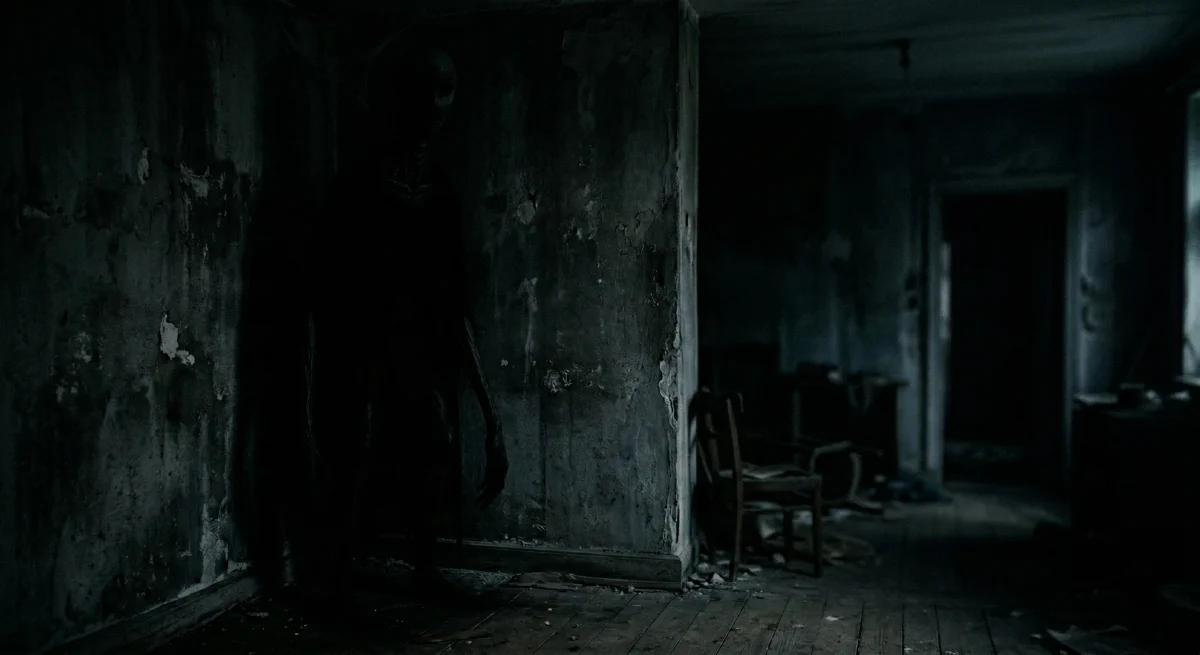
Not the thing from the corner. Not the patient watcher, the still figure that had stood in the space where the walls met with the inhuman patience of something that had been there for years and would be there for years more. This was different. The same wrongness, the same sealed face, but the posture was forward, inclined, the orientation of something that was not observing. Somewhere in the part of Ellie’s brain that still functioned, the clinical part, the part that categorized and filed, a distinction registered: the ones in the corners watched. This one had come for something. This was in the doorway and it was moving. Its head nearly touched the header and its body filled the frame side to side and the proportions were wrong, the wrongness that Daniel had described and that she had noted and filed and not believed, the arms too long, hanging past the knees, the joints folded at angles that her eyes could see but her brain refused to process. The face was the same sealed nothing, the skin stretched over absence, the surface of a wound closed badly. But the body was leaning forward, displacing the air ahead of it, and it was moving.
Not walking. Not stepping. The space between them contracted, the distance shrinking without the mechanism of legs and feet and the ordinary physics of a body crossing a room. It was in the doorway and then it was closer and it had not walked and the distance was less.
It made a sound.
Low. Continuous. Not from its mouth (it had no mouth, the face was sealed, the face was closed). From its body, from the center of it, a vibration that Ellie felt in her chest before she heard it in her ears, deep and resonant, the frequency of something large operating at a pitch below speech, below hearing, the sound of standing too close to a transformer on a summer night, the hum that lives in the wires and the metal and the space around them. It filled the kitchen. It pressed against her ribs.
Its arms were reaching.
The too-long arms with the wrong joints, the fingers (not fingers, something with too many segments, something that articulated from angles a hand cannot reach) extended toward her, and it was closer, it was close, the air between them was cold, not the cold of the apartment, not the cold of January, a deeper cold, the cold of something that took heat from the space around it the way a hole takes light.
Ellie’s hand went behind her.
She did not decide. Her body decided. Her hand went back and found the counter and slid along it and hit the knife block (cheap, wooden, four knives and two empty slots because two had been lost or broken or never replaced, the kind of block that comes with a set from a department store and sits on the counter doing nothing because she ate Lean Cuisines and never cooked) and her fingers closed around the handle of the largest one and pulled.
She swung.
The blade caught it across the arm. The reaching arm, the one closest to her, the one that was almost on her. Contact. The knife hit something that was not flesh and not bone and not anything she had a word for. Dense. Resistant. Like cutting through cold rubber, through something that had the consistency of packed clay, and the blade went in and met resistance and pushed through and the thing made a sound that was different from the humming, a shorter sound, almost a click, almost the noise of a machine encountering an input it hadn’t expected.
It bled.
The substance that came from the cut was dark. Not red, not black, something between, something that had no name in the spectrum she knew. It did not fall the way blood falls. It seeped. It moved along the surface of the arm with a slow, deliberate crawl, as if the fluid itself were alive, as if it were trying to return to the wound.
The thing did not stop. It reached again.
Its hand closed on her arm. The left arm, above the elbow, and the grip was the wrong geometry, the fingers wrapping from angles that should not have been possible, the pressure distributed in a pattern that no human hand could produce, and the cold. The cold went through her skin and into the muscle and into the bone and past the bone into the place behind her thoughts where instinct lived, where the animal lived, and the cold said stop and the cold said still and the cold was a command and her body almost obeyed.
She screamed.
The first sound she’d made. It came from somewhere below her throat, from the place where the scream lives when you have no time to decide to scream, and it tore through the kitchen and broke the humming and her right hand came up with the knife and she stabbed.
The blade went into the center mass, the widest part, and the knife sank and the resistance was there and then it gave and the dark fluid ran over her hand, down the handle, warm (the only warm thing about it, the fluid was warm, almost hot, in terrible contrast to the cold of its grip on her arm), and the thing convulsed.
Its hand tightened. The cold deepened. Ellie felt the strength of it, the raw mechanical force of something that was not built from muscle and bone but from something else, something that gripped without fatigue, without limit, and her arm was going numb and the knife was buried in its body and it was not letting go.
She pulled the knife out and it threw her.
Not with its arms. With its body, a forward surge, a displacement of mass and force that caught her in the chest and sent her backward into the counter. Her hip took the edge. The pain was immediate, bright, a line of fire across the bone that cut through the cold and the numbness and the animal fog and told her she was alive and she was hurt and she was still holding the knife.
She went down. Her back hit the cabinet doors. Her hip screamed. She was on the floor with the knife in her hand and the thing was above her, filling the kitchen the way it had filled the doorway, and its arms were reaching and the humming was back, louder now, vibrating in her teeth, in her sinuses, in the thin bones behind her eyes.
She kicked.
Both feet, into the mass of it, the center, where the knife had been. It buckled. Not the way a person buckles, not at the knees, but inward, folding at a joint she hadn’t seen, collapsing briefly toward the floor before straightening, and in the half second it took to recover she was up, scrambling, her hip a white line of pain, her back against the counter, the knife in front of her in both hands because one hand wasn’t enough, because the handle was slick with the dark fluid and her fingers were shaking and the only thing holding the knife was her refusal to let it go.
It came again.
She cut it. Across what might have been a torso, a long lateral slash that opened something and the dark fluid ran, and it made the sound again, the short sound, the click of surprise, and she drove the knife forward, both hands on the handle, the way you brace against something heavy, the way you push a door shut against a wind that wants it open. She put her weight behind it, all of it, everything she had, and the blade went in.
Deep.
The thing convulsed. Its arms went rigid, locked at the wrong angles, the joints frozen in their impossible geometry. The humming stopped. The silence that replaced it was sudden and total, as if someone had pulled a plug, and the air in the kitchen changed, the pressure dropping, the density falling away like water draining from a room, and the thing shuddered once, a full-body tremor that moved through it from the sealed face to wherever it ended, and it fell.
Or it folded. Or it collapsed inward, the structure losing its frame, the height and the narrowness and the wrong proportions giving way all at once, and it was on the kitchen floor and the knife was still in it and Ellie was standing over it with both hands on the handle and her breath coming in pulls that tore at her throat and the dark fluid was on her arms and her shirt and the linoleum.
Silence.
Not the attended kind. Not the watching kind. Silence like a room after a window breaks, the sudden absence of the thing that was there a moment ago. The kitchen was a kitchen. The counter was a counter. The curtain hung flat over the window. The light came through the gap, brighter now, the grey shifting toward something almost white. Time had passed. She did not know how much.
She looked down.
It was on the floor. It was there. It was real the way she was real, occupying space, displacing air, lying on her kitchen linoleum between the counter and the table with one chair, and the dark fluid pooled beneath it in a slow deliberate spread, and the knife was in its body, and it was not moving.
She had killed it.
The thought arrived flat, without emotion, the way facts arrive when the mind has been scoured clean by terror. She had killed it. With a knife from a cheap wooden block that she’d never used for anything besides opening packaging. In her kitchen. In her apartment on Birch Street. In Millbrook, Ohio. In January. In the grey morning light. She had killed it.
She stood over it, shaking. Her hip was screaming. There was a cut on her left forearm she didn’t remember getting, a shallow slice that ran from the inside of her elbow toward her wrist, beading blood (her blood, red, ordinary, human). The bruise forming on her shoulder where she’d hit the counter was already stiffening. Her hands would not stop trembling, and she was alive.
She sat down.
On the kitchen floor. Back against the cabinets. Knees up. The knife on the linoleum beside her, the handle dark and wet. The thing lay two feet away, between her and the doorway to the hall, and she could see it there in the pale light, the shape, the length, the wrongness, and she did not look at it closely because looking at it closely was more than she could do. She saw the dark fluid on the floor and on her hands and on Tommy’s Indians shirt and she sat with her back against the cabinets and she breathed. The breathing was hard and ragged and it sounded like someone else’s breathing, and she sat.
The light through the curtain gap moved. It was the only clock she had in this room, the thin line of grey shifting angle as the morning progressed, falling across the floor at a different slant, touching the edge of the dark pool, then sliding past it. She watched the light and did not move. The apartment was quiet. The quiet was ordinary, the real ordinary, the kind that means nothing is here, except that was not true because she was here and it was here and the floor was not clean.
She didn’t notice exactly when it started.
The thing on the floor began to lose definition. Not at the center, where the knife wound was, where the dark fluid was thickest. At the edges. The outline of the body, the boundary between the thing and the linoleum, softened. Blurred. As if the resolution were failing, as if whatever held it together in three dimensions was losing signal. The arms went first, the too-long arms with the wrong joints, the edges dissolving into something less than shadow, less than shape, a thinning, a recession, like a photograph left in the sun.
The center held. And then it didn’t.
The substance of it became less substantial. The floor began to show through it. Not transparency, not like glass, but like fog, like breath on a cold window, the thing becoming less present, less there, as if it were being recalled, pulled back through whatever gap it had come through, returned to whatever place existed on the other side of the corner and the corridor and the sealed face and the wrong geometry.
The dark fluid went with it. The pool on the linoleum thinned, contracted, drew inward toward the body and then past it, into whatever process was taking it back. On her hands, the fluid lifted from her skin in a way that was not evaporation and was not absorption, a way that had no name, the dark warmth simply becoming less, the sensation of it fading the way a sound fades, until there was nothing, until her hands were her hands and the floor was the floor and the kitchen was clean.
The knife was clean.
Tommy’s shirt was clean.
She looked around the kitchen. The counter. The curtain over the window. The table with one chair. The linoleum between the cabinets and the doorway where it had lain. Clean. All of it. The kitchen was exactly the kitchen she had stood in ten thousand mornings, making coffee, rinsing trays, looking at the curtain. As if nothing had been on the floor. As if nothing had been in the room at all.
She touched her left forearm. The cut was there. The shallow slice, beading red. She pressed it and the pain was real. She touched her hip where the counter edge had caught her and the bruise was there, hot and swollen under the skin. She rolled her shoulder and the stiffness answered, the deep ache of impact.
Her body knew. The kitchen didn’t.
The light through the curtain gap was almost white now, late morning, and there was nothing on the linoleum between the counter and the table. No body. No blood. No evidence. The apartment had erased it, or it had erased itself, and the clean floor was worse than the blood had been, worse than the body, because the blood and the body had been proof. She had lain on this floor with the dark fluid on her hands and the thing two feet away and it had been real and now there was nothing, and the nothing was not absence, the nothing was erasure, and the difference was everything.
Except the cut on her arm. Except the bruise on her hip. Except the trembling in her hands that would not stop.
She sat on the kitchen floor with her back against the cabinets and her knees up and the clean knife beside her and the clean floor around her and the light moving through the gap in the curtain, and she knew. The way she had known that night in the bedroom, sitting on the edge of the bed, looking at the empty corner. The way Daniel knew. The way Hadley knew. The way her father, sitting in the living room in the dark, might have known, in the years before he left and the years after, in whatever room he sat in, in whatever dark he chose.
She knew, and the knowing had changed. Before this the knowing had been terror, pure and simple, the fear of someone who sees something impossible and cannot explain it. Now the knowing had a second layer, colder, quieter, worse. She had killed something. She had put a knife into a thing that was not supposed to exist and it had bled and fallen and she had stood over it and she had not hesitated, not at the end, and the part of her that was still a nurse, still clinical, still the woman who charted and categorized and kept the line between this side and that side, that part understood what the rest of her could not yet say: she would do it again. She would have to.
She got up. She washed her hands. She ran the water until it was hot and held them under it and the heat was real and the water was real and her hands were real and she watched them and they were shaking and she could not make them stop.
She dried her hands on the kitchen towel. She picked up the knife from the floor and put it back in the block, in the slot where it had always sat, where it had sat doing nothing since the day she’d moved in, and the block held four knives and two empty slots and everything was as it had been.
She went to the bathroom and cleaned the cut on her forearm with hydrogen peroxide, the way she’d clean a patient’s wound, methodical, precise, the nurse in her performing the task while the rest of her stood at a great distance and watched. She put a bandage on it. She looked at herself in the mirror. The face that looked back was a face she barely recognized: grey, hollow, the eyes too wide, the cheekbones too sharp, Tommy’s shirt hanging off her like a flag on a still day.
She went back to the kitchen. She stood at the counter with her hands flat on it and the clean floor behind her and the clean knife in the block and the curtain drawn across the window and the light coming through the gap, pale and white and ordinary, and the apartment was quiet, and the quiet was the real kind, the old kind, the kind she remembered from before all of this.
There was no one to tell. That was what she stood with, in the quiet, in the clean kitchen. Not the killing and not the vanishing and not the wounds her body carried that the apartment refused to corroborate. The aloneness. She could not tell Jan, who would hear burnout and sleep deprivation. She could not tell Rachel, who saw warm lights at windows and did not know they were the same thing wearing a different face. She could not tell Daniel, who already knew and had stopped speaking. She could not write it in a chart. She could not call a number from the yellow pages. She stood at the counter with her hands flat on it and she was thirty-one years old and she had killed something in her kitchen and there was no one in the world she could say it to, and the quiet held her, and she let it, because the quiet was all she had.