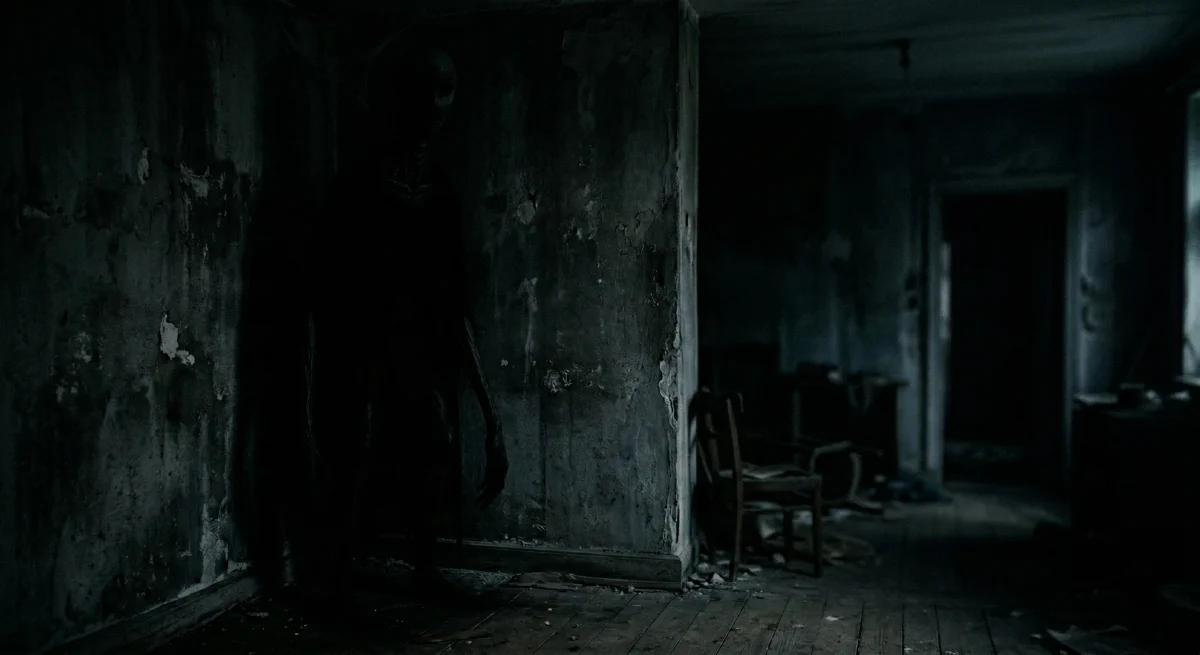
Chapter 8: Daniel's Note
The day passed.
She did not sleep. She sat on the edge of the bed with her feet on the cold floor and her hands gripping the mattress on either side and she watched the corner where the crack ran across the ceiling, and the corner was empty, and she watched it anyway. The posture was Daniel’s. She knew that. She felt it in her own body, the way her spine held and her fingers pressed into the fabric and her eyes fixed on the place where the walls met, and she thought: this is how it starts. This is how you become a person who watches corners. You sit, and you grip, and you wait, and the waiting doesn’t end because there is nothing on the other side of it.
The light through the curtain gap moved. Grey to white. White to yellow. Yellow to the thin gold of late afternoon, the last good light January could offer before it gave up and let the dark back in. She watched the light the way she watched the corner, without purpose, without thought, the way a body watches things when the mind has gone somewhere else and left the eyes running.
Her hands trembled. The trembling had been constant since the kitchen, a fine vibration in the fingers and the tendons, the aftershock of something the muscles remembered even if the apartment didn’t. It faded over the hours. Not gone. Less. Enough that she could hold a pen, which was the thing she needed her hands to do, because the shift started at eleven and the shift was where she was going because the shift was what she had.
At some point in the afternoon she got up and showered. She stood under the water and the heat was good and the steam was good and she held her left arm outside the curtain to keep the bandage dry, the way you hold something injured away from the world, and the bruise on her hip bloomed dark under the stream, purple and black, the colors of something that had been struck hard against something that wouldn’t move. She watched the water run over it. The water was clean. Everything was clean.
She put on fresh scrubs. She stood at the bathroom mirror and the face was the one from last night, grey and hollow, the eyes too wide, and she looked at the bandage on her forearm, the white gauze showing beneath the cuff of her sleeve. It was visible. She could cover it if she pulled the sleeve down, but the fabric rode up when she moved, and it would be visible, and there was nothing to do about that because it was there and it would be there for days.
She drove to Thornwood.
The evening was dark, the way January evenings were dark in Millbrook, fully and without apology, the streetlights on by five and the sky black by six and the world reduced to the reach of headlights and the amber circles of parking lot lamps. She drove the route she had driven hundreds of times, ten and two, the Civic’s heater blowing its dust-and-rubber warmth, the town sliding past her in the dark, the shapes of buildings and bare trees and the occasional lit window, and she did not look at any of it too closely because looking at things too closely was a habit she could not afford tonight.
She parked by the dumpsters. She sat in the car for a moment with the engine off and the cold coming in through the gaps and she looked across the road at the sidewalk. The space where the figure had stood two mornings ago. Concrete. Frost. The amber light from the parking lot lamps falling on nothing.
She went inside.
Something was wrong.
She felt it in the air before she saw it in the faces. The ward had a quality she recognized, the particular atmosphere of a place where something has happened and the people in it are still arranging themselves around the fact of it. It was in the lights (the office behind the station was on, which it shouldn’t have been at shift change), in the movement (a cluster of staff near the medication window, two aides and someone from administration she didn’t recognize), in the quiet, which was not the usual nighttime settling but something held, something deliberate, the quiet of people who have been speaking in low voices and have stopped because someone new has walked in.
Kim was at the station.
Kim’s shift had ended five hours ago. Kim should have been home, in bed, asleep, living the half of her life that didn’t belong to Thornwood. But she was at the station with Daniel’s chart open in front of her and another chart beside it and a form Ellie recognized, the white-and-yellow carbon of an incident report, and she was still wearing her day scrubs and her face was the face of someone doing a job she had not expected to do today.
Patel was beside her. Patel looked up when Ellie came in and her expression did something, a small, complicated motion, the eyes widening slightly and then narrowing, the mouth opening and then closing, as if she had started to say one thing and decided on another.
“Ellie.”
Just her name. But the tone carried the weight of everything the name was not saying, and Ellie stopped at the edge of the station and looked at Kim and Kim looked at her and the chart was Daniel’s and the incident report was white and yellow and the office light was on behind them.
“Daniel Morrison passed this afternoon,” Kim said.
She said it the way charge nurses say these things, direct and even and without inflection, the professional delivery of a fact that deserves more than professionalism but cannot be given more, not here, not on a ward where forty-two other patients still need their medications and their charts and their thirty-minute checks. She said it and the words arrived in Ellie’s body before they arrived in her mind, a physical sensation, a dropping, as if the floor had shifted an inch lower and everything on it had rearranged.
“Day staff found him at three-fifteen during afternoon rounds. He was in his bed. Same position.” Kim paused. The pause was not for effect. It was the pause of a person who has said this sentence before, to the administrator and to Rennick on the phone and to the aide who found him, and who is tired of saying it but knows she has to say it again. “On his back. Hands folded. Eyes closed. No signs of distress, no indication of acute event. He was gone when they checked.”
“Cardiac?” Ellie said. Her voice was steady. She heard it from somewhere outside herself, the nurse voice, the clinical voice, the one that asked the right questions in the right order because the asking was the structure and the structure was what held.
“Preliminary, yes. Rennick’s leaning toward arrhythmia, possibly Haldol-related. He’s ordered a full workup.” Kim closed the chart. “The family’s been notified. What there is of it. A sister in Columbus.”
Ellie stood at the station. The fluorescent above her buzzed its dying buzz. The corridor stretched away behind her, long and badly lit, the same corridor she had walked for six years, the same corridor where Daniel had told her the glass was clearing and the things behind it were getting through. The fluorescent flickered. The building breathed.
Daniel Morrison was dead. He was thirty-four years old and he had been a high school English teacher and he had described the things he saw with the precision of a man trained to choose words carefully. He had told Ellie they were watching her and he had told Ellie it followed her and he had spent his last days in silence because he had said everything he was going to say, and now he was dead. And twelve hours ago, in her kitchen, she had killed one of the things he’d spent months describing, and the timing was not coincidence, and the two facts occupied the same sentence in her mind, and the sentence would not come apart.
“There’s one more thing,” Kim said.
She reached for a plastic evidence bag on the counter, the small kind, the kind used for patient belongings that needed to be logged. Inside it was a piece of paper, folded once. Ellie could see the writing through the plastic, small and precise, the handwriting of someone who had spent years grading essays and filling out lesson plans and who wrote the way he spoke, with care.
“Found on his chest. Folded. Day staff logged it as part of the incident documentation.” Kim held the bag flat so Ellie could read it through the plastic.
The paper was the back of a progress note. The printed side showed the Thornwood letterhead and the date fields and the blank lines for clinical observations. The other side, in Daniel’s handwriting, two sentences:
She killed one. Now they know.
The fluorescent buzzed. The corridor breathed. Ellie looked at the two sentences through the plastic bag and the words were there, small and precise and real, and they said what they said, and she could not unhear them and she could not unknow them. Daniel was dead and his last words were about her.
“Rennick thinks it’s consistent with the paranoid ideation,” Kim said. “The ‘she’ could be anyone in his framework. A patient, a staff member, one of the figures.” She looked at Ellie. “Does it mean anything to you? Any context from your sessions with him?”
“No,” Ellie said. “I don’t know who ‘she’ refers to.”
Her hands were below the counter. Kim could not see them. They were shaking.
“Okay.” Kim made a note. “It’ll go in the chart with the incident report. Rennick will want to review.” She paused. “I’m sorry, Ellie. I know he was yours.”
Yours. The word sat between them. Kim meant it the way nurses mean it: your patient, your primary, the one whose rhythms you know, whose chart you’ve kept, whose bad nights you’ve sat through. She didn’t mean it the other way. She didn’t know there was another way.
“Thanks, Kim.”
“I’ll be here another hour or so. Paperwork.” Kim stood up and gathered the charts and the incident report and the evidence bag with Daniel’s note inside it, and she carried them toward the office, and the office door closed, and the note was gone, behind a door, in a bag, in a chart, in a system that would file it under delusional content, consistent with paranoid schizophrenia, and that would be the last thing Daniel Morrison said to the world, and only Ellie would ever know what it meant.
She picked up her clipboard and started rounds.
Room 22 was at the far end of B corridor, past the dead fluorescents, past the stairwell junction with its pooling dark. She did not go there first. She went through the ward the way she always went through the ward, in order, room by room, checking observation windows, marking charts, the machinery of care grinding forward because the machinery did not grieve and the machinery did not stop.
She checked Aguilar (sleeping). She checked Prescott (sleeping, the wallpaper still). She checked Webb (snoring, lightly). She gave Mrs. Okafor her Benadryl and Okafor took it without complaint and lay down and closed her eyes. She checked Singh. Singh was awake, sitting on the edge of her bed, hands gripping the mattress. The posture. The same posture. Singh looked up when Ellie appeared at the observation window and her eyes were wide and searching and she did not speak and Ellie did not open the door and they looked at each other through the glass and then Ellie moved on.
Hoffman was at his window again. Both palms flat on the reinforced glass, forehead pressed against it, the big man made small by the darkness he was looking into. His breath fogged the glass in slow, even pulses. She watched him for a moment. He did not turn. She moved on.
Room 31. Hadley. Cross-legged on the bed, facing the far corner. Motionless. Patient. When Ellie stopped at the observation window, Hadley did not look up. But her head tilted, barely, the way it always did, the listening gesture, the angle of someone hearing a sound just below the threshold. She knew. She might not know the specifics, the name, the room number, the cardiac event, the note on the chest. But she knew something had shifted. Something had left the building, and the leaving had changed the frequency, and Hadley was listening to the change.
Ellie walked down B corridor.
The fluorescents were still dead in their two places. The dark pooled at the stairwell junction and in the long stripe between the working lights, and she walked through both, her footsteps even, her clipboard in her hand, and the corridor was a corridor and the dark was dark and nothing moved beside her.
Room 22.
The door was open. Not ajar, not propped, but fully open, the way cleaning leaves a room, aired out, turned over, the finality of a space that has been emptied of its person. She stood in the doorway and looked.
The bed was stripped. The mattress was bare, the thin institutional pad with its waterproof cover, stained faintly with the years of bodies that had lain on it. The desk was empty. The chair was pushed in. The small shelf above the desk where Daniel had kept his three books (Faulkner, O’Connor, a worn paperback of Wise Blood she’d seen him reading in the dayroom months ago) was bare. The window showed the January dark pressing in, the same dark it had always shown, the reinforced glass cold to the touch if you put your hand on it, which she would not.
The corner was empty.
The corner where Daniel had stared for hours, for days, for months. The corner he had described to her in that steady, reporting voice, cataloguing the tall figures and their wrong proportions and their folded faces with the consistency of someone describing a room he visited every day. The corner where the baseboard met the wall and the wall met the ceiling and the geometry of the room came to its point, and something had stood there, according to Daniel, something tall and still and patient, and it had watched him and he had watched it and neither one had looked away.
The corner was a corner. The scuffed baseboard. The faint water stain on the ceiling above. The ordinary intersection of surfaces.
She stood in the doorway and she did not go in. The room was clean. The room was empty. The room was exactly what her kitchen had been twelve hours ago, a space returned to blankness, wiped of whatever had happened in it, and the parallel sat in her chest like a stone. Daniel’s room, emptied. Her kitchen, cleaned. The evidence removed, the surfaces restored, and nothing left to prove that anything had ever happened except what the living carried in their bodies.
She went back to the station.
The rest of the shift passed the way shifts pass after a death on the ward: quietly, carefully, the staff moving through their tasks with the particular attention that comes when the fact of mortality has been made present and specific. Patel worked beside her and their pens scratched and the fluorescent buzzed and at one point Patel’s eyes went to Ellie’s forearm, to the gauze showing below the cuff of her scrub sleeve, and the look lasted a second, maybe two, and then Patel’s eyes returned to her chart and her pen continued and she did not ask and Ellie did not explain and the not-asking was its own kind of understanding, the language they had been building for weeks, the grammar of things noticed and not named.
The hours moved. Ellie walked the corridors. She checked the rooms. She wrote her notes in her steady handwriting and the notes said what they needed to say and nothing more. She was a nurse. She was at work. Her patient had died and she was doing the next thing, which was the thing after that, which was the shift, which was the job, which was the structure, and the structure held because it always held because she made it hold because if the structure failed there was nothing underneath it.
Dawn.
The grey light came through the reinforced windows the way it always came, grudgingly, without promise, the January sky offering visibility but not warmth, not hope, not anything that could be mistaken for kindness. The rattle of the breakfast cart. The PA system. The day sounds replacing the night sounds, the world changing shifts.
She gave report to Kim, who had stayed. Who had been in the office all night with her paperwork and her forms and Daniel’s chart and Daniel’s note in its plastic bag. Kim took the report and said, “Go home, Ellie. Get some rest,” and the words were kind and they meant nothing because rest was not what Ellie needed and home was not where rest lived.
She walked to the parking lot. The cold hit her face. The sky was the color of wet cement, the same sky, the same cold, the same parking lot she had crossed a thousand times. She walked to the Civic and she did not look across the road at the sidewalk and then she did, because the looking was not something she controlled anymore, and the sidewalk was empty, and the road was empty, and the dawn was grey and flat and nothing stood in it.
She got in the car.
She sat with her hands on the wheel at ten and two. The position that held. The position that was armor and cage simultaneously, the thing her father taught her before he stopped teaching her things, the grip of someone who needs the wheel to be still because everything else is not.
She breathed. The breath came easier than it had twelve hours ago. Not because anything was better. Because the body adapted. Because the hands steadied and the breathing slowed and the animal went on, because going on was what the animal did, even when going on meant carrying something that would not get lighter.
Daniel was dead. His note was in a chart. Two sentences that no one would read correctly because reading them correctly meant believing them, and believing them meant standing where Ellie stood, which was nowhere, which was the space between what was real and what was possible, and she was the only person in it.
She killed one. Now they know.
She had. And they did. And whatever came next would come, and she would be here for it, not because she had chosen it but because it had chosen her, or because there was no choosing involved, because this was just what was, the way the ward was what was and the shift was what was and the dark was what was, and you didn’t choose to be the person standing in the corridor when the light went out. You just were. And then you stood there.
She started the engine. The heater blew cold. She sat and waited for it to warm and the waiting was familiar, the same waiting she did every morning, the same cold car and the same cold air and the same three blocks before the warmth came, and she would drive home and she would lock the door and she would sit in the apartment that remembered nothing, and tomorrow night she would come back, and the night after that, and the night after that, and the things in the corners would be there, and she would be there, and that was all. That was everything. That was what her life was now.
She pulled out of the parking lot. The Civic shuddered over the railroad tracks on Route 4, and the town slid past in the grey morning light, and she drove home.