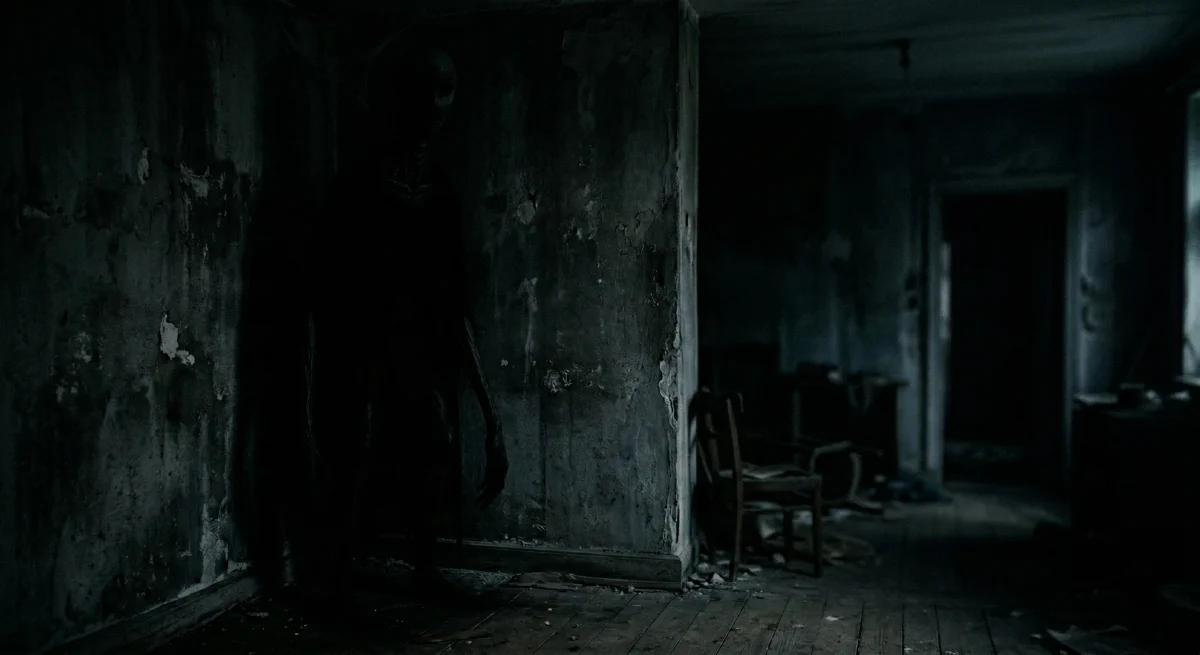
Chapter 9: Rules
She locked the door. She put her keys on the counter and stood in the kitchen. The apartment was cold. The light through the curtain gap was grey, early morning grey, the thin grudging light of January that said it would do this much and no more. The counter was cold under her hands. The knife block was on the counter where it had always been, four knives, two empty slots, and she looked at it.
She pulled out the largest one.
The handle was cheap plastic, the kind that came with department store sets, the kind nobody buys on purpose. It sat in her hand with a weight she hadn’t known before two days ago. Before two days ago it had been nothing. A utensil she’d never used because she ate Lean Cuisines and never cooked and the knife block sat on the counter the way the calendar hung on the wall, present but purposeless, furniture of a life that didn’t require it.
She turned it in her hand. The blade was clean. The apartment had done that, or whatever process erased things had done that, the same process that had taken the body and the blood and the dark fluid from the linoleum and left the floor clean and the knife clean and everything as it was. The blade caught the grey light from the curtain gap and it was a kitchen knife and it had killed something.
She put it back in the block.
She went to bed. She did not sleep. She lay on her back with her hands at her sides and the blackout curtains drawn and the dark pressing in and the attended silence in the room, the one that had lived there for weeks now, patient and constant, and she lay in it and her eyes were open and the corner was empty and the hours passed.
The next afternoon, before her shift, she drove to Millbrook Hardware.
It was on Main Street, between the old barber shop and a store that sold vacuum cleaners and had a CLOSED sign that had been in the window since September. The hardware store was small and overcrowded the way hardware stores in small towns are, aisles packed tight with bins and pegboards and the particular smell of metal and sawdust and machine oil that Ellie associated with her father, with the garage, with a time before everything. She went to the back, past the paint aisle and the plumbing, to the locked case behind the counter where the hunting knives were displayed on a cloth backing, blades fanned out like a hand of cards.
The man behind the counter was sixty, maybe older, with a flannel shirt and reading glasses and hands that looked like they’d been in hardware their whole life. He unlocked the case when she pointed. She chose the one that felt right in her hand, which was a thing she hadn’t known she’d know how to do: fixed blade, full tang, the kind of knife that existed for one purpose and did not pretend otherwise. The handle was rubberized, dark. The blade was maybe five inches. It cost seventeen dollars.
She paid cash. The man put it in a paper bag and she put the paper bag in her coat pocket and he did not ask her why a thirty-one-year-old woman in scrubs needed a hunting knife, and she did not offer, and the transaction passed in the wordless efficiency of two people in a small town who understood that purchases were private.
The knife sat in her coat pocket. It sat there like a sentence she hadn’t said yet.
Days passed.
The cut on her forearm scabbed over. The raw red edge of it tightened and darkened and became a thin pink line running from the inside of her elbow toward her wrist, the kind of scar that would fade but not disappear, that would stay as a pale thread on her skin for years, proof written in tissue. The bruise on her hip went from purple to the color of something turning, yellow-green, the color of healing, though healing was not the word she would have used for what was happening to her.
She worked her shifts. She drove to Thornwood and back. She parked by the dumpsters and sat in the Civic for a moment before going in, the way she always sat, hands at ten and two, looking at the building, except now she was also looking at the sidewalk across the road, the concrete and the frost and the amber light from the parking lot lamps falling on nothing. She went inside. She did her rounds. She wrote her notes in her steady handwriting and Patel worked beside her and their pens scratched and the fluorescent buzzed and the shift passed and dawn came and she drove home. The routine continued. But the routine had a different shape inside it now, a harder shape, something angular beneath the familiar surface, and the difference was not visible to anyone but her.
She went to the Kroger on the west side of town because the freezer was empty. The last Lean Cuisine had been the beef tips, days ago, standing at the counter in the hours before the thing came through the doorway, and she had eaten it without tasting it and rinsed the tray and that had been the last of the food in the apartment. She moved through the aisles the way she always moved through them, quickly, without browsing. Lean Cuisines, four of them. Milk. Bread. Coffee. Apples, the cheapest kind. She paid and carried the single bag to the car and drove home and put everything away and stood at the counter and the kitchen was a kitchen and the routine held because she made it hold.
She slept in fragments. Twenty minutes here, an hour there, the shallow fitful sleep of a body that would not let go of its watch. She ate standing at the counter. She left the lights on. All of them. The overhead in the kitchen, the lamp in the bedroom, the bulb in the bathroom, the hall light that had never worked consistently and now she changed the bulb and made it work because the dark was not just the dark anymore. The dark was where they came from.
She moved the kitchen chair so it faced the doorway. She sat in it sometimes, in the hours before her shift or after it, the hunting knife on the counter beside her coffee mug, and she faced the door and she waited. Not the way she had waited before, passive, afraid, enduring. She waited the way you wait when you have decided something. Monitoring. The attended silence was still there. It lived in the walls and the corners and the spaces between things, the way it had lived there for weeks, patient and constant. But she listened to it differently now. Before, it had been a presence she endured. Now she tracked it for changes, for the thickening, for the shift in pressure that meant something was coming through. She noted when it was heavier (late at night, always, the hours between midnight and three) and when it was lighter (mornings, briefly, the grey light pushing it back, though not far, though never gone). The nurse in her, taking vitals on the air.
She carried the hunting knife everywhere. In her coat pocket at work, against policy. On the counter when she was home. Under her pillow when she tried to sleep. The weight of it was constant, a pressure against her hip or her thigh or the flat of her palm, and the weight was good. The weight was the only thing she trusted.
A week after Daniel died, it came on a night she was off shift.
Late. Past midnight. She was in the kitchen, not sleeping, standing at the counter with the curtain drawn and the hunting knife beside her coffee mug. Tommy’s Indians shirt. Bare feet on cold linoleum. The overhead light on, all the lights on, the apartment blazing against the January dark.
She felt it before she saw it.
The pressure. The density. The air in the kitchen taking up more space than air should, the way a room contracts when something enters it, the way your ears know altitude before your body does. The attended silence becoming something with weight, with mass, the quality shifting from background to foreground, and the kitchen doorway was behind her and the hallway was dark.
She picked up the knife.
She turned toward the hallway. It was there. In the dark of the hall (the hall light had gone out, the bulb she had just changed was dead, and the dark pooled in the narrow space between the walls the way water fills a channel). It was the same wrongness, the same sealed face, the same proportions that the mind could see but not accept. But a different one. Smaller, slightly, the body not as tall, the arms not as long, the proportions a different kind of wrong, as if whatever made them had made this one from a different template, a different draft.
It was moving toward her.
She went to meet it.
Not waiting. Not backing against the counter. Not gripping the counter while it filled the doorway and the humming pressed against her ribs. She stepped forward, into the space between the kitchen and the hall, and the hunting knife was in her right hand and her left hand was free and she was moving toward it because she had decided, sometime in the days of sitting in the chair with the knife on the counter, that she would not wait for them to come to her. She would go.
The fight was ugly. She was faster this time (she knew where to aim, she knew the resistance, she knew the blade needed to go deep into center mass), but it grabbed her. The hand closed on her upper arm, the left, the cold fingers wrapping from angles that no human hand could produce, and the cold went through her skin and into the muscle and into the bone and the paralytic command said stop and said still and her arm went numb to the elbow and the strength of the grip was the same as before, the raw mechanical force of something that was not built from muscle and bone.
She screamed. She drove the hunting knife in with her free hand.
The blade went in. The resistance was there and then it gave and the dark fluid ran, warm (always warm, the terrible warmth of it against the cold, the heat of something that should not have heat), and the thing convulsed. She pulled the knife out and stabbed again. Pulled it out. Stabbed again. Sloppy. Desperate. Nothing like skill, nothing like efficiency, just a woman with a knife in a narrow hallway stabbing something that should not exist because it was the only thing she knew how to do.
It convulsed. It fell.
Its hand released. The cold withdrew from her arm in a slow recession, the numbness lifting unevenly, feeling returning in patches, and she stood over it, breathing hard, the air coming in pulls that hurt her throat. The dark fluid on her hands, on the knife, on the linoleum. She looked at it. She looked at it deliberately this time. She wanted to see.
The edges went first. The boundary between the body and the floor softened, blurred, the outline losing resolution the way a photograph bleaches in direct sunlight. Then the center, the mass of it, began to thin. The floor showed through. Not transparency but recession, the substance of it being recalled, pulled back through whatever gap it had come through. The dark fluid drew inward, contracting, withdrawing from the linoleum toward the body and then past it, into whatever process took it back. She counted. Three minutes. Maybe four. The floor cleaned itself. The knife was clean. Her hands were her hands and the linoleum was linoleum and the hallway was a hallway and nothing was there.
The bruise on her upper arm was already forming under the skin, deep purple, the handprint visible in the pattern of the pressure, the wrong geometry of the grip printed into her flesh. Her body knew. The apartment didn’t.
She made it to the bathroom. She vomited. Her knees on the cold tile and her hands braced on the rim and her stomach emptying itself of coffee and bile and the accumulated weight of what she had done, what she had now done twice, what she would do again. When it stopped she sat on the floor with her back against the tub and the hunting knife beside her on the tile and she cried.
Not the quiet kind. The kind that comes from the stomach, from the place below thought, the ugly crying of a person who has done something terrible and knows they will do it again. The sound of it was raw, filling the small bathroom, and it had no words because words were too clean for this. She cried until her body ran out of whatever fuel crying needs, and she sat on the tile floor with the knife beside her and her hands in her lap and the quiet came back, the ordinary quiet, the kind that meant nothing was there.
She washed her face. She ran the water hot. She looked in the mirror.
The face was worse than last time. Thinner. Greyer. The eyes darker, the skin pulled tight across the bones, the look of a person who was being consumed from inside by something she could not name. She did not fully recognize it. But the face was ready. That was the thing she could not look away from. Beneath the exhaustion and the grey and the horror still working its way through her body, the face in the mirror had a readiness to it. The set of the jaw. The stillness of the eyes. A face that had decided something, even if the rest of her had not caught up to the decision.
She did not look away. She stood at the sink with the water running and she held the look because the readiness was hers, the only thing the apartment could not clean from her, and she was going to need it. She turned off the water.
She went back to the kitchen and sat in the chair with the knife on the counter and the lights blazing and the dark pressing at the windows, and she sat there until morning came through the curtain gap, grey and thin, and she got up because getting up was the next thing and the next thing was all she had.
She bought a spiral notebook at the drugstore on Market Street. Green cover, college ruled. A dollar forty-nine.
She sat at the kitchen table with the one chair facing the doorway and the hunting knife on the counter behind her and she opened the notebook to the first page and she wrote. Not a chart. Not a clinical note. Not the language of the ward, with its abbreviations and its careful neutrals and its distance. Something rawer. Something that had no template.
What they look like. (Tall. Narrow. Sealed face. Wrong proportions. Arms too long. Joints at impossible angles. No eyes, no mouth. Skin stretched over absence.) How they move. (Not walking. The space contracts. They displace air.) What hurts them. (Blade, center mass. Deep. The hunting knife is better than the kitchen knife, heavier, longer, holds the grip when the fluid makes the handle slick.) How they bleed. (Dark fluid. Not red, not black. Warm. Moves deliberately, crawls back toward wound. Alive, or something adjacent to alive.) How long the dissolution takes. She wrote “3-4 min” and put a question mark beside it, because she had counted but counting in the aftermath of killing something is not precise. Where they come from. (The doorway both times. But the pressure preceded them. The cold. The thickening of the attended silence. Minutes of warning, maybe more.)
She wrote it all in her steady nurse’s handwriting, the same handwriting she’d used for six years of charts and medication logs and progress notes, the clinical hand applied to something that had no clinical category, and the notebook sat on the counter beside the knife block and it was the beginning of something, and the something did not have a name yet.
At the bottom of the page she added one more entry. She underlined it.
They come to the apartment. Why HERE?
She started driving differently.
Not just the route to Thornwood and back. She took detours. Down streets she didn’t use, through neighborhoods she didn’t visit, past the parts of Millbrook she had driven past a thousand times without seeing because familiarity had made them invisible. She drove slowly, windows up, and she listened. Not with her ears. With the thing behind her ears, the sense that had no name, the one that registered pressure and density and the quality of silence the way a barometer registers weather.
The old mill district on the east side. The steel mill had closed in ‘86 and the buildings stood empty, brick and corrugated metal, the chain-link around the perimeter rusted through in places, the parking lots cracked and weedy even in January when the weeds were dead. She drove past slowly. The air through the closed windows had a thickness to it, a weight. The attended silence concentrated in the empty buildings and the spaces between them like groundwater pooling beneath the surface.
The vacant lot behind the Caldwell house on Elm. The narrow channel of shadow between the two properties where she had once seen a shape that had been a fence post, or she had told herself it was a fence post, and the telling had held because she’d needed it to hold. The air was wrong there too.
Linden Park after dark. The empty swings, the tilted merry-go-round, the basketball court with its puddles and its hoop with no net. She parked on Hawthorn and sat in the Civic with the engine running and the heater blowing and she listened, and the park had the silence, thick and close, the way a place has humidity, present in the air itself, and she thought of Tommy on the bench with his popsicle and his red-stained lips and his sneakers that didn’t reach the ground, and the thought was there and then it was gone because she could not hold Tommy and this at the same time. They did not fit in the same room.
Some places were ordinary. Cold and empty and nothing. The Kroger parking lot. The laundromat on Vine. Her own street, mostly, except for the apartment.
She wrote the addresses in the notebook. She drew a rough map of Millbrook on the inside back cover, not to scale, not precise, just the streets and the blocks and small X marks where the silence was thickest. Mill district. Caldwell lot. Linden Park. The road past the boarded houses near the tracks. And around Thornwood she drew a circle, not an X, because the thickness there was not a point but a field.
She was at Thornwood, doing rounds, walking B corridor past the dead fluorescents and the pooling dark. The air was wrong. Not the way her apartment was wrong before an attack, not the sudden thickening and the cold. Subtler than that. More constant. Like background radiation, like the low hum of a machine you stop hearing until someone asks you if you hear it and then you can’t stop. She had felt it here before. She had felt it here for years, maybe, the wrongness woven into the building’s wrongness, the dying lights and the wide corridors and the Victorian bones and the shadows in the corners where the walls met. She had never named it. Now she had a framework for naming.
She walked the ward slowly. She passed Hadley’s room. Hadley was cross-legged on the bed, facing the corner, motionless, patient, the same position she had held since the day she was admitted, the posture of someone who had made her peace with what she was watching. Singh’s room. Singh was awake, sitting on the edge of her bed, hands gripping the mattress, the wide searching eyes, the posture Ellie knew now because she had sat in it herself, in her own bedroom, on her own bed, gripping the same way. Hoffman’s room. Hoffman was at the window again, both palms flat on the reinforced glass, forehead pressed to it, breathing his slow fog onto the surface, watching the dark beyond it with the patience of a man who had been watching for a long time and would watch for longer.
Room 22. Daniel’s room. Already filled, a young woman Ellie hadn’t met yet, the day shift’s intake, a name on a chart she hadn’t read. The woman was curled on the bed with the blanket pulled over her head, knees drawn up, making herself as small as possible in the room where Daniel Morrison had lain on his back with his hands folded on his chest and described the things he saw with the precision of a man giving sworn testimony and had died with two sentences on a piece of paper on his chest.
The ward was full of seers. And the attended silence was thickest here.
Ellie stood at the nurses’ station. She looked down the corridor. The fluorescents buzzed their dying buzz. The dark pooled at the far end where the stairwell met the junction, the same dark that had pooled there for years, that she had reported and re-reported and that no one had fixed because four to six weeks meant never. Forty-two patients behind reinforced glass. Singh gripping her mattress. Hadley watching her corner. Hoffman pressing his face to the glass. The new woman in Daniel’s room, hiding under her blanket. And the air was wrong. Not in pockets, not in moments, but constantly, pervasively, the way humidity sits in a basement, the way cold lives in a stone floor. The attended silence was not just present here. It was concentrated. Thicker than her apartment. Thicker than the mill district. Thicker than anywhere she had driven with her notebook and her X marks.
The thought arrived the way Daniel’s note had arrived. Flat. Factual. Two sentences that connected and would not come apart.
They’re not coming to her apartment because of her apartment. They’re coming because of the hospital. Because of the patients. The patients are what draws them.
She stood at the station and the thought settled into her body the way the cold from their grip settled, deep and heavy, past the skin and into the bone and into the place behind thought where the things you know but cannot say live. Forty-two people in their rooms. Singh gripping her mattress. Hadley watching her corner. Hoffman pressing his palms to the glass. The new woman curled under her blanket in Daniel’s room. They lay in their beds behind reinforced glass and the things gathered in the corridors outside their doors, and the dark pooled at the stairwell junction, and the fluorescents died and were not replaced, and the attended silence was thickest here, in this building, around these people, and Ellie had been leaving every morning. Driving home. Locking her door. Not sleeping. While the things clustered and the ward breathed its heavy breath and forty-two patients lay in the dark with whatever they saw and no one stood between them.
She looked at the corridor. She looked at the dark at the far end. She put her hand in her coat pocket and the hunting knife was there, the rubberized handle, the fixed blade, the weight of it against her fingers, and the weight was the weight of something she hadn’t decided yet but was about to.